OCR · A-Level · Biology
Course version: H420 · Version from Sept 2025
Exchange surfaces: (b) the features of an efficient exchange surface
An efficient exchange surface maximises the rate of diffusion or active transport across it.
Checked against the OCR H420 specification (opens in a new tab) on .
- Point 2 of 7
- 4 key terms
Study notes
From the checked teaching notes for this specification point.
The idea
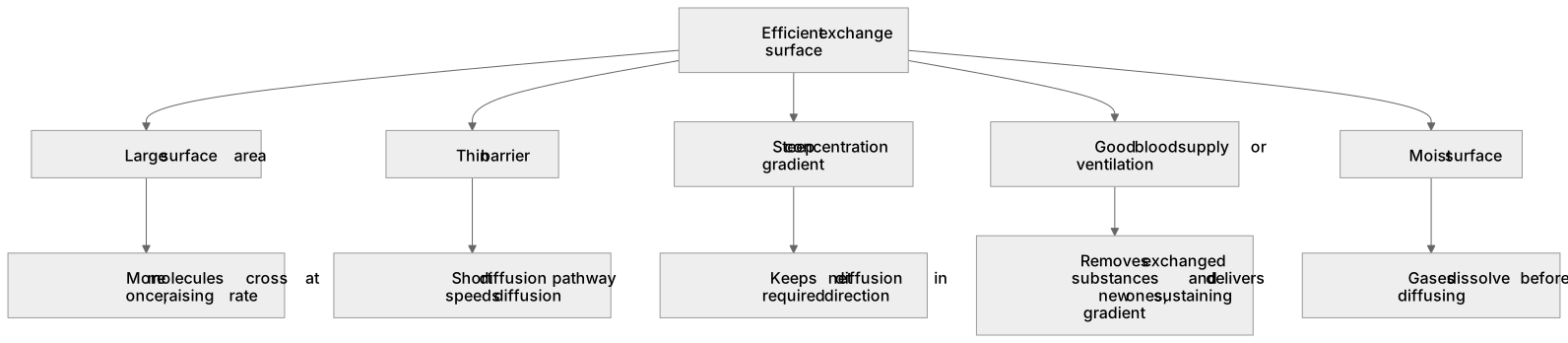
An efficient exchange surface maximises the rate of diffusion or active transport across it. Key features include a large surface area, for example the many alveoli or the folds and villi of the small intestine, which provides more space for exchange. A thin barrier, often a single layer of flattened cells, gives a short diffusion pathway. A steep concentration gradient is maintained by ventilation, by blood flow, or by active transport, so substances keep moving across. In animals, an efficient moist surface and a good blood supply help gas exchange. Learners should be able to identify these features in named examples and explain how each one increases the rate of exchange, rather than merely listing them.
What earns the marks
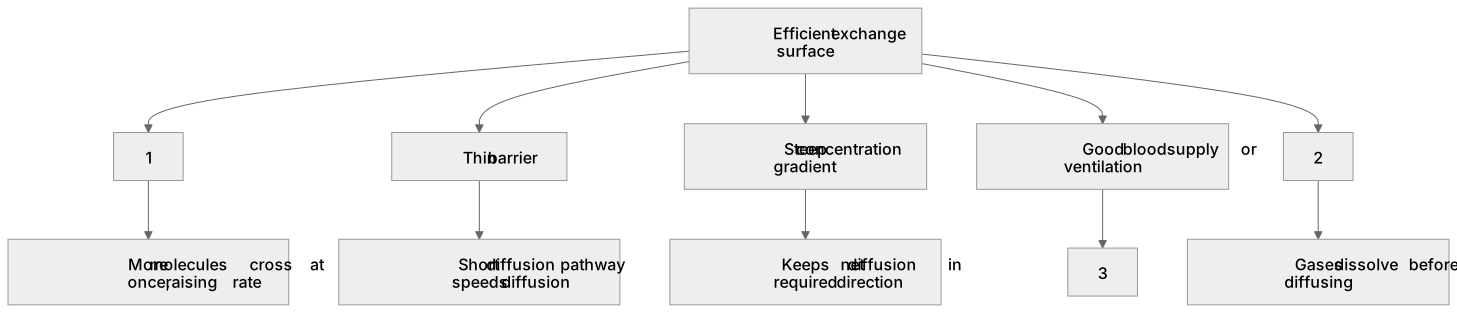
- A large surface area increases the number of molecules that can cross at once, raising the rate of exchange.
- A thin barrier, such as a single layer of flattened cells, shortens the diffusion pathway and speeds diffusion.
- A steep concentration gradient, maintained by ventilation or blood flow, keeps net diffusion in the required direction.
- A good blood supply or ventilation removes exchanged substances and delivers new ones, sustaining the gradient.
- A moist surface, as in alveoli, allows gases to dissolve before diffusing.
Common mistakes and how to put them right
Listing features without explaining how each increases the rate of exchange.
Put it right: Link every feature to diffusion rate.
Confusing a large surface area with a short diffusion distance.
Put it right: These are separate features and each needs its own explanation.
Assuming a steep gradient is fixed.
Put it right: It must be maintained by ventilation, blood flow or active transport, so state the mechanism.
Exam tips
- For each feature, state the effect on diffusion rate, for example larger area means more molecules cross per unit time.
- Use a named exchange surface such as alveoli or villi and apply the features to it.
- Mention how the concentration gradient is maintained, not just that it exists.
Try the lesson
The start of the Exchange surfaces: (b) the features of an efficient exchange surface lesson, made from checked teaching notes for this specification point.
Have a go first
Which feature of an efficient gas exchange surface helps to maintain a steep concentration gradient?
Listen
An efficient exchange surface maximises the rate of diffusion or active transport across it. Key features include a large surface area, for example the many alveoli or the folds and villi of the small intestine, which provides more space for exchange. A thin barrier, often a single layer of flattened cells, gives a short diffusion pathway. A steep concentration gradient is maintained by ventilation, by blood flow, or by active transport, so substances keep moving across. In animals, an efficient moist surface and a good blood supply help gas exchange. Learners should be able to identify these features in named examples and explain how each one increases the rate of exchange, rather than merely listing them. A strong answer earns marks for these points. A large surface area increases the number of molecules that can cross at once, raising the rate of exchange. A thin barrier, such as a single layer of flattened cells, shortens the diffusion pathway and speeds diffusion. A steep concentration gradient, maintained by ventilation or blood flow, keeps net diffusion in the required direction. A good blood supply or ventilation removes exchanged substances and delivers new ones, sustaining the gradient. A common slip: Listing features without explaining how each increases the rate of exchange. Instead, link every feature to diffusion rate. Exam tip: For each feature, state the effect on diffusion rate, for example larger area means more molecules cross per unit time.
See it
Key words
Say what each word means before you turn the card.
Large surface area
Try answering aloud or in your head before turning the card.
Thin diffusion pathway
Try answering aloud or in your head before turning the card.
Maintaining concentration gradients
Try answering aloud or in your head before turning the card.
Moist surfaces and blood supply
Try answering aloud or in your head before turning the card.
See every definition
- Large surface area
- Provides more space for exchange, increasing the number of molecules that can cross at once and raising the rate of exchange.
- Thin diffusion pathway
- A thin barrier, often a single layer of flattened cells, gives a short diffusion pathway and speeds diffusion.
- Maintaining concentration gradients
- A steep concentration gradient is maintained by ventilation, by blood flow, or by active transport, so substances keep moving across.
- Moist surfaces and blood supply
- In animals, an efficient moist surface and a good blood supply help gas exchange, with gases dissolving before diffusing.
Label the diagram
Some boxes have lost their names. Pick the right name for each number.
1Box 1
2Box 2
3Box 3
There is more to this lesson
The full lesson goes on to check your understanding and help you earn the marks. Create a free account to carry on, with your progress saved.
A week of Premium from your first lesson · Then the free plan continues · No card, no charge
Test your understanding of Exchange surfaces: (b) the features of an efficient exchange surface
Active recall beats re-reading. Take an instant quiz now to test what you’ve learned and lock it into long-term memory.
A week of Premium from your first lesson · Then the free plan continues · No card, no charge