OCR · A-Level · Biology
Course version: H420 · Version from Sept 2025
(a) the term excretion and its importance in maintaining metabolism and…
Full specification wording
Excretion as an example of homeostatic control: (a) the term excretion and its importance in maintaining metabolism and homeostasis
Excretion is the removal of metabolic waste products from the body.
Checked against the OCR H420 specification (opens in a new tab) on .
- Point 1 of 6
- 4 key terms
Study notes
From the checked teaching notes for this specification point.
The idea
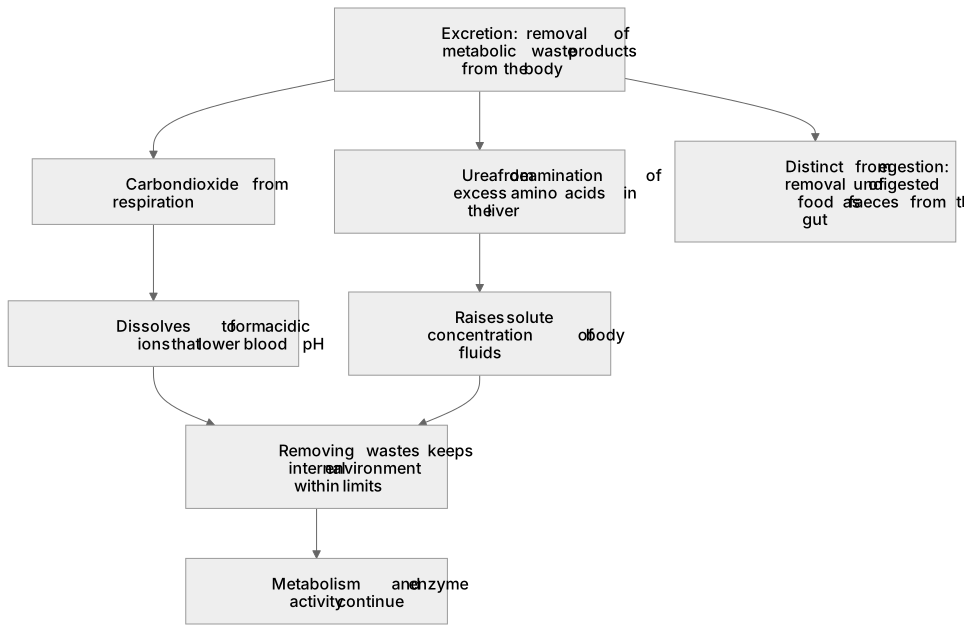
Excretion is the removal of metabolic waste products from the body. These wastes are produced by reactions inside cells, for example carbon dioxide from respiration and urea from the breakdown of excess amino acids in the liver (deamination). Excretion matters because waste products can be toxic or disturb homeostasis: carbon dioxide dissolves to form acidic ions that lower blood pH, and urea raises the concentration of solutes in body fluids. Removing these wastes keeps the internal environment within limits so enzymes and cells function, and it helps maintain water and solute balance. Excretion differs from egestion, which is the removal of undigested food as faeces from the gut, not a product of metabolism.
What earns the marks
- Excretion is the removal of metabolic waste products from the body.
- Examples of metabolic wastes include carbon dioxide from respiration and urea from deamination of excess amino acids in the liver.
- Removing carbon dioxide helps prevent blood pH falling, since it forms acidic ions in solution.
- Removing urea helps control the solute concentration of body fluids and maintain homeostasis.
- Excretion keeps the internal environment within limits so metabolism and enzyme activity continue.
- Excretion is distinct from egestion, which removes undigested food rather than metabolic waste.
Common mistakes and how to put them right
Confusing excretion with egestion.
Put it right: Is that egestion removes undigested food as faeces, whereas excretion removes metabolic waste.
Thinking faeces are an excretory product.
Put it right: Is that faeces are mainly undigested material, not a product of cell metabolism.
Believing excretion only removes water.
Put it right: Is that it removes wastes such as carbon dioxide and urea that would otherwise disturb pH or solute balance.
Exam tips
- Define excretion precisely as removal of metabolic waste, then give named examples.
- Explain the consequence of not removing a waste, such as a fall in blood pH from carbon dioxide.
- Keep egestion and excretion clearly separated when comparing processes.
Try the lesson
The start of the Excretion as an example of homeostatic control: (a) the term excretion and its importance in maintaining metabolism and homeostasis lesson, made from checked teaching notes for this specification point.
Have a go first
Which statement correctly defines excretion?
Listen
Excretion is the removal of metabolic waste products from the body. These wastes are produced by reactions inside cells, for example carbon dioxide from respiration and urea from the breakdown of excess amino acids in the liver (deamination). Excretion matters because waste products can be toxic or disturb homeostasis: carbon dioxide dissolves to form acidic ions that lower blood pH, and urea raises the concentration of solutes in body fluids. Removing these wastes keeps the internal environment within limits so enzymes and cells function, and it helps maintain water and solute balance. Excretion differs from egestion, which is the removal of undigested food as faeces from the gut, not a product of metabolism. A strong answer earns marks for these points. Excretion is the removal of metabolic waste products from the body. Examples of metabolic wastes include carbon dioxide from respiration and urea from deamination of excess amino acids in the liver. Removing carbon dioxide helps prevent blood pH falling, since it forms acidic ions in solution. Removing urea helps control the solute concentration of body fluids and maintain homeostasis. A common slip: Confusing excretion with egestion. Instead, is that egestion removes undigested food as faeces, whereas excretion removes metabolic waste. Exam tip: Define excretion precisely as removal of metabolic waste, then give named examples.
See it
Key words
Say what each word means before you turn the card.
Excretion
Try answering aloud or in your head before turning the card.
Metabolic waste products
Try answering aloud or in your head before turning the card.
Homeostasis and the internal environment
Try answering aloud or in your head before turning the card.
Deamination and urea
Try answering aloud or in your head before turning the card.
See every definition
- Excretion
- The removal of metabolic waste products from the body, which keeps the internal environment within limits so metabolism and enzyme activity continue.
- Metabolic waste products
- Wastes produced by reactions inside cells, for example carbon dioxide from respiration and urea from the breakdown of excess amino acids in the liver.
- Homeostasis and the internal environment
- Keeping the internal environment within limits so enzymes and cells function, helped by removing wastes that disturb pH or solute balance.
- Deamination and urea
- The breakdown of excess amino acids in the liver produces urea, and removing it helps control the solute concentration of body fluids.
Label the diagram
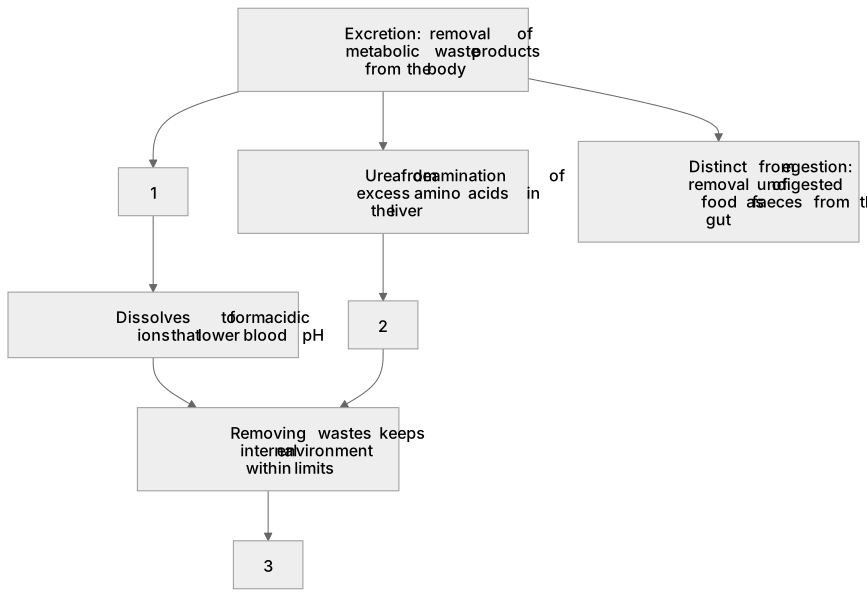
Some boxes have lost their names. Pick the right name for each number.
1Box 1
2Box 2
3Box 3
There is more to this lesson
The full lesson goes on to check your understanding and help you earn the marks. Create a free account to carry on, with your progress saved.
A week of Premium from your first lesson · Then the free plan continues · No card, no charge
Test your understanding of Excretion as an example of homeostatic control: (a) the term excretion and its importance in maintaining metabolism and homeostasis
Active recall beats re-reading. Take an instant quiz now to test what you’ve learned and lock it into long-term memory.
A week of Premium from your first lesson · Then the free plan continues · No card, no charge