OCR · A-Level · Biology
Course version: H420 · Version from Sept 2025
(c) (i) the structure, mechanisms of action and functions of the mammalian…
Full specification wording
Excretion as an example of homeostatic control: (c) (i) the structure, mechanisms of action and functions of the mammalian kidney
The mammalian kidney is a paired excretory organ built from an outer cortex, an inner medulla and a renal pelvis that drains into the ureter.
Checked against the OCR H420 specification (opens in a new tab) on .
- Point 3 of 6
- 4 key terms
Study notes
From the checked teaching notes for this specification point.
The idea
The mammalian kidney is a paired excretory organ built from an outer cortex, an inner medulla and a renal pelvis that drains into the ureter. Each kidney contains about a million nephrons: a Bowman's capsule enclosing a glomerulus, a proximal convoluted tubule, a loop of Henle, a distal convoluted tubule and a collecting duct. Blood arrives under pressure in the afferent arteriole, is filtered at the glomerulus, and the filtrate is modified along the nephron. Ultrafiltration separates small molecules by size and charge; selective reabsorption returns glucose, amino acids and most water and ions; the loop of Henle generates a medullary solute gradient; the collecting duct adjusts water reabsorption under ADH control. The kidney therefore removes nitrogenous waste such as urea, osmoregulates body fluids and regulates blood pH and ion balance.
What earns the marks
- Identifies cortex, medulla and renal pelvis as the gross regions of the kidney, with the pelvis draining to the ureter.
- Describes the nephron sequence: Bowman's capsule and glomerulus, proximal convoluted tubule, loop of Henle, distal convoluted tubule and collecting duct.
- Explains ultrafiltration at the glomerulus as pressure-driven filtration separating molecules by size, retaining blood cells and large proteins.
- States that selective reabsorption in the proximal convoluted tubule returns glucose, amino acids, ions and most water to the blood.
- Explains that the loop of Henle creates a solute gradient in the medulla that allows water reabsorption from the collecting duct.
- Links ADH acting on the collecting duct to variable water reabsorption and so to osmoregulation.
- States functions of the kidney: excretion of urea, osmoregulation, and regulation of ion balance and blood pH.
Common mistakes and how to put them right
Thinking all filtration happens along the whole nephron.
Put it right by locating ultrafiltration specifically at the glomerulus into Bowman's capsule.
Confusing reabsorption with secretion, or assuming the loop of Henle reabsorbs glucose.
Put it right by placing glucose reabsorption in the proximal convoluted tubule and the loop's role in creating a solute gradient.
Believing ADH is secreted by the kidney.
Put it right by stating ADH is released from the posterior pituitary and acts on the collecting duct.
Assuming the kidney only excretes waste.
Put it right by adding osmoregulation and ion/pH regulation as functions.
Exam tips
- Learn the nephron as an ordered sequence so you can place each process at the correct region.
- Use precise terms: ultrafiltration, selective reabsorption, solute gradient, osmoregulation.
- When a question asks for functions, give more than excretion, for example osmoregulation and ion balance.
Try the lesson
The start of the Excretion as an example of homeostatic control: (c) (i) the structure, mechanisms of action and functions of the mammalian kidney lesson, made from checked teaching notes for this specification point.
Have a go first
In which part of a nephron does ultrafiltration take place?
Listen
The mammalian kidney is a paired excretory organ built from an outer cortex, an inner medulla and a renal pelvis that drains into the ureter. Each kidney contains about a million nephrons: a Bowman's capsule enclosing a glomerulus, a proximal convoluted tubule, a loop of Henle, a distal convoluted tubule and a collecting duct. Blood arrives under pressure in the afferent arteriole, is filtered at the glomerulus, and the filtrate is modified along the nephron. Ultrafiltration separates small molecules by size and charge; selective reabsorption returns glucose, amino acids and most water and ions; the loop of Henle generates a medullary solute gradient; the collecting duct adjusts water reabsorption under ADH control. The kidney therefore removes nitrogenous waste such as urea, osmoregulates body fluids and regulates blood pH and ion balance. A strong answer earns marks for these points. Identifies cortex, medulla and renal pelvis as the gross regions of the kidney, with the pelvis draining to the ureter. Describes the nephron sequence: Bowman's capsule and glomerulus, proximal convoluted tubule, loop of Henle, distal convoluted tubule and collecting duct. Explains ultrafiltration at the glomerulus as pressure-driven filtration separating molecules by size, retaining blood cells and large proteins. States that selective reabsorption in the proximal convoluted tubule returns glucose, amino acids, ions and most water to the blood. A common slip: Thinking all filtration happens along the whole nephron. Instead, locating ultrafiltration specifically at the glomerulus into Bowman's capsule. Exam tip: Learn the nephron as an ordered sequence so you can place each process at the correct region.
See it
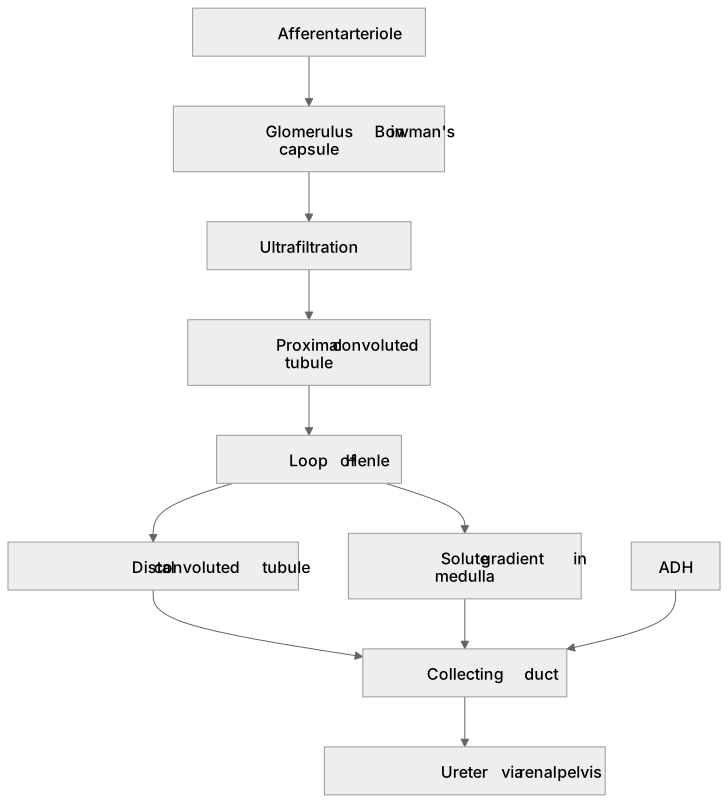
Key words
Say what each word means before you turn the card.
Ultrafiltration
Try answering aloud or in your head before turning the card.
Selective reabsorption
Try answering aloud or in your head before turning the card.
Osmoregulation
Try answering aloud or in your head before turning the card.
Solute gradient
Try answering aloud or in your head before turning the card.
See every definition
- Ultrafiltration
- Pressure-driven filtration at the glomerulus that separates small molecules by size and charge, retaining blood cells and large proteins.
- Selective reabsorption
- Process in the proximal convoluted tubule that returns glucose, amino acids, ions and most water to the blood.
- Osmoregulation
- Homeostatic function in which the collecting duct adjusts water reabsorption under ADH control to regulate body fluids.
- Solute gradient
- Gradient in the medulla generated by the loop of Henle that allows water reabsorption from the collecting duct.
Label the diagram
Some boxes have lost their names. Pick the right name for each number.
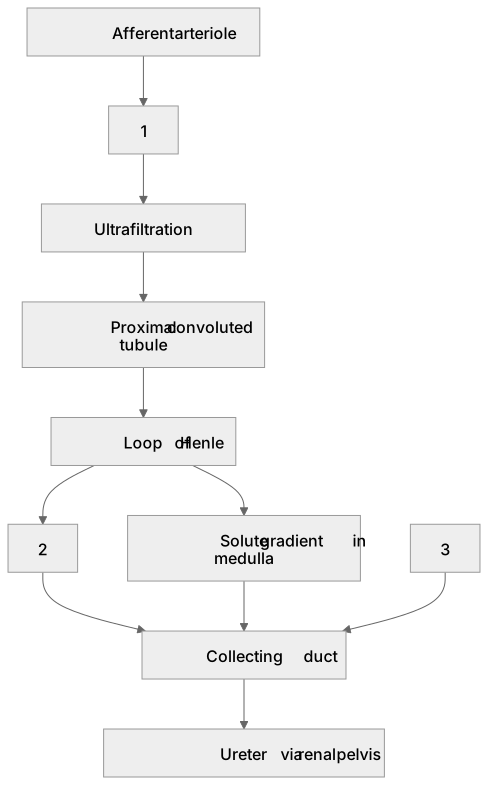
1Box 1
2Box 2
3Box 3
There is more to this lesson
The full lesson goes on to check your understanding and help you earn the marks. Create a free account to carry on, with your progress saved.
A week of Premium from your first lesson · Then the free plan continues · No card, no charge
Test your understanding of Excretion as an example of homeostatic control: (c) (i) the structure, mechanisms of action and functions of the mammalian kidney
Active recall beats re-reading. Take an instant quiz now to test what you’ve learned and lock it into long-term memory.
A week of Premium from your first lesson · Then the free plan continues · No card, no charge