OCR · A-Level · Biology
Course version: H420 · Version from Sept 2025
Hormonal communication: (a) endocrine communication by hormones
Endocrine communication is the body's chemical signalling route in which specialised endocrine cells secrete hormones directly into the blood.
Checked against the OCR H420 specification (opens in a new tab) on .
- Point 1 of 6
- 4 key terms
Study notes
From the checked teaching notes for this specification point.
The idea
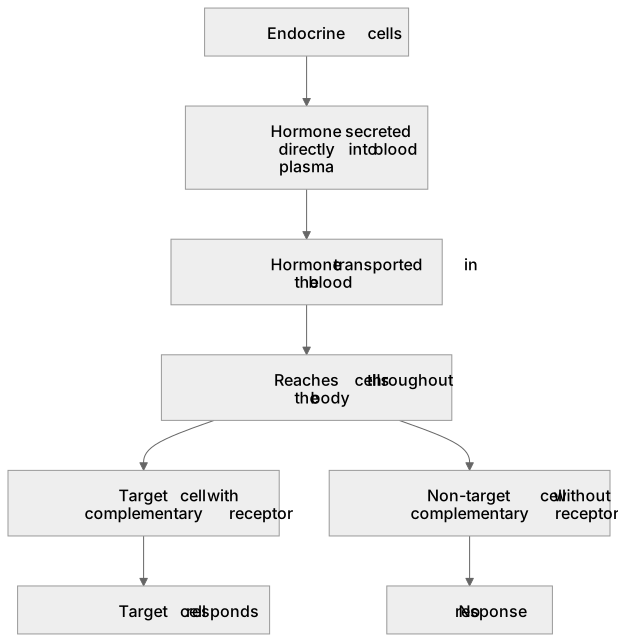
Endocrine communication is the body's chemical signalling route in which specialised endocrine cells secrete hormones directly into the blood. The hormone travels in the plasma to reach cells anywhere in the body, but only target cells respond because they carry a complementary receptor. This is why one hormone can affect several tissues while leaving others unaffected. Learners should distinguish endocrine signalling from nervous signalling: nerves act quickly over short distances via neurones and neurotransmitters, whereas hormones act more slowly but often for longer and can reach every perfused tissue. A useful method is to trace one example end to end, for example insulin released by pancreatic beta cells into the blood, binding to receptors on liver and muscle cells to increase glucose uptake.
What earns the marks
- Hormones are chemical messengers secreted by endocrine cells directly into the blood plasma, not into ducts.
- Hormones are transported in the blood and reach cells throughout the body, but only target cells with complementary receptors respond.
- Endocrine signalling is generally slower and longer-lasting than nervous signalling, which uses neurones and neurotransmitters.
- Hormones act at very low concentrations, and their blood concentration depends on the balance between secretion and breakdown (for example in the liver).
- A named example correctly traced, such as insulin from pancreatic beta cells acting on liver or muscle cells to increase glucose uptake.
Common mistakes and how to put them right
Thinking hormones travel along neurones.
Put it right by stating that hormones are secreted into the blood and carried in the plasma.
Assuming every cell responds to every hormone.
Put it right by explaining that only target cells with complementary receptors respond.
Describing endocrine glands as releasing hormones through ducts.
Put it right by stating that endocrine secretion is ductless and directly into the blood.
Exam tips
- Read the whole stem before choosing: options often contrast endocrine with nervous communication, so check speed, route and duration.
- Eliminate options that place hormones in ducts, in neurones or acting on all cells equally.
- When an option names a hormone, check that the source, transport route and target tissue are all consistent.
Try the lesson
The start of the Hormonal communication: (a) endocrine communication by hormones lesson, made from checked teaching notes for this specification point.
Have a go first
How are hormones transported from an endocrine gland to their target cells?
Listen
Endocrine communication is the body's chemical signalling route in which specialised endocrine cells secrete hormones directly into the blood. The hormone travels in the plasma to reach cells anywhere in the body, but only target cells respond because they carry a complementary receptor. This is why one hormone can affect several tissues while leaving others unaffected. Learners should distinguish endocrine signalling from nervous signalling: nerves act quickly over short distances via neurones and neurotransmitters, whereas hormones act more slowly but often for longer and can reach every perfused tissue. A useful method is to trace one example end to end, for example insulin released by pancreatic beta cells into the blood, binding to receptors on liver and muscle cells to increase glucose uptake. A strong answer earns marks for these points. Hormones are chemical messengers secreted by endocrine cells directly into the blood plasma, not into ducts. Hormones are transported in the blood and reach cells throughout the body, but only target cells with complementary receptors respond. Endocrine signalling is generally slower and longer-lasting than nervous signalling, which uses neurones and neurotransmitters. Hormones act at very low concentrations, and their blood concentration depends on the balance between secretion and breakdown (for example in the liver). A common slip: Thinking hormones travel along neurones. Instead, stating that hormones are secreted into the blood and carried in the plasma. Exam tip: Read the whole stem before choosing: options often contrast endocrine with nervous communication, so check speed, route and duration.
See it
Watch it explained
What is the one idea the video explains? Say it in a sentence.
Read the described scene instead
Endocrine communication is the body's chemical signalling route. Specialised endocrine cells secrete hormones directly into the blood plasma, not through ducts. The blood then carries these chemical messengers throughout the body. A hormone can travel in the plasma to many tissues, but only target cells respond. This happens because target cells carry a receptor complementary to that hormone. So one hormone can affect several tissues while leaving others unaffected. Before I trace insulin, pause briefly and think where it is released and where it acts. Pancreatic beta cells secrete insulin into the blood plasma. Insulin travels in the blood and binds to receptors on liver and muscle cells. This binding increases glucose uptake by those target cells. Endocrine signalling differs from nervous signalling. Nerves act quickly over short distances using neurones and neurotransmitters. Hormones act more slowly, often for longer, and can reach every perfused tissue because they travel in the blood. Avoid three common mistakes. Hormones are not carried along neurones; they are secreted into the blood and transported in the plasma. Not every cell responds to every hormone; only target cells with complementary receptors respond. Endocrine glands are ductless and release hormones directly into the blood, not through ducts. Hormones act at very low concentrations. Their blood concentration depends on the balance between secretion and breakdown, for example in the liver. Remember: endocrine cells secrete hormones into the blood; plasma carries them; only target cells with complementary receptors respond; and endocrine responses are generally slower and longer-lasting than nervous responses.
Key words
Say what each word means before you turn the card.
Hormones
Try answering aloud or in your head before turning the card.
Target cells
Try answering aloud or in your head before turning the card.
Endocrine signalling
Try answering aloud or in your head before turning the card.
Blood transport of hormones
Try answering aloud or in your head before turning the card.
See every definition
- Hormones
- Chemical messengers secreted by endocrine cells directly into the blood plasma, not into ducts.
- Target cells
- Cells that respond to a hormone because they carry a complementary receptor.
- Endocrine signalling
- Chemical signalling that is generally slower and longer-lasting than nervous signalling, which uses neurones and neurotransmitters.
- Blood transport of hormones
- Hormones are carried in the plasma to reach cells throughout the body, and their blood concentration depends on the balance between secretion and breakdown.
Label the diagram
Some boxes have lost their names. Pick the right name for each number.
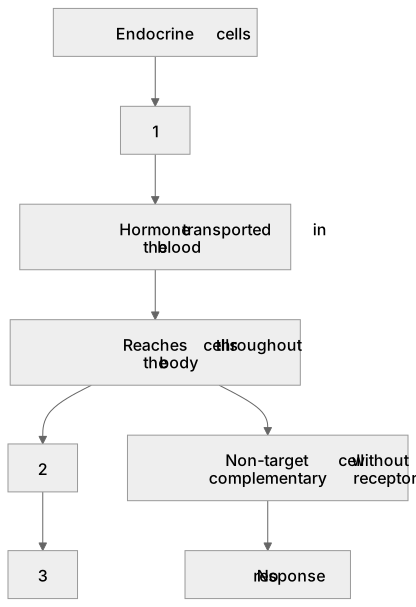
1Box 1
2Box 2
3Box 3
There is more to this lesson
The full lesson goes on to check your understanding and help you earn the marks. Create a free account to carry on, with your progress saved.
A week of Premium from your first lesson · Then the free plan continues · No card, no charge
Test your understanding of Hormonal communication: (a) endocrine communication by hormones
Active recall beats re-reading. Take an instant quiz now to test what you’ve learned and lock it into long-term memory.
A week of Premium from your first lesson · Then the free plan continues · No card, no charge