OCR · A-Level · Biology
Course version: H420 · Version from Sept 2025
Manipulating genomes: (c) the principles of DNA profiling and its uses
DNA profiling exploits variation in repetitive, non-coding DNA to produce a pattern characteristic of an individual.
Checked against the OCR H420 specification (opens in a new tab) on .
- Point 5 of 10
- 4 key terms
Study notes
From the checked teaching notes for this specification point.
The idea
DNA profiling exploits variation in repetitive, non-coding DNA to produce a pattern characteristic of an individual. In OCR's core method, DNA is extracted and amplified by PCR, cut with restriction enzymes, and the fragments separated by gel electrophoresis; shorter fragments travel further, so band positions reflect fragment lengths. Alternatively, short tandem repeat (STR) numbers at several loci are measured, giving a multi-locus profile. Because close relatives share more bands than unrelated people, profiles are compared rather than read absolutely. Uses include forensic identification from crime-scene samples, paternity and kinship testing, identifying tissue or blood samples, and monitoring genetic diversity in conservation. A match is probabilistic evidence, not proof of guilt.
What earns the marks
- DNA profiling examines variable repetitive non-coding regions (for example STRs) rather than whole genes, so individuals differ in fragment lengths or repeat numbers.
- The method involves extraction, PCR amplification, restriction digestion and gel electrophoresis, or STR locus sizing; shorter fragments migrate further in the gel.
- A profile is a pattern of bands or peaks compared between samples; a match indicates the samples likely came from the same individual or related individuals.
- Forensic use compares crime-scene DNA with a suspect or database sample; paternity testing compares a child's profile with parents.
- Interpretation is probabilistic: relatives share bands, contamination and degraded samples cause problems, so a match supports rather than proves identity.
Common mistakes and how to put them right
Thinking a profile sequences the whole genome.
Put it right by explaining that only variable repeat regions are compared.
Assuming a single matching band proves identity.
Put it right by noting that several loci must be compared and that relatives share many bands.
Believing longer fragments travel furthest in electrophoresis.
Put it right by stating that shorter fragments move further through the gel.
Exam tips
- Link each stage of the method to the reason for it, for example PCR increases DNA quantity before digestion.
- Use the phrase 'probability' or 'likelihood' when describing a match rather than claiming certainty.
- Practise comparing two band patterns and stating which loci differ and what that implies about relatedness.
Try the lesson
The start of the Manipulating genomes: (c) the principles of DNA profiling and its uses lesson, made from checked teaching notes for this specification point.
Have a go first
Which of the following best describes the main principle behind DNA profiling?
Listen
DNA profiling exploits variation in repetitive, non-coding DNA to produce a pattern characteristic of an individual. In OCR's core method, DNA is extracted and amplified by PCR, cut with restriction enzymes, and the fragments separated by gel electrophoresis; shorter fragments travel further, so band positions reflect fragment lengths. Alternatively, short tandem repeat (STR) numbers at several loci are measured, giving a multi-locus profile. Because close relatives share more bands than unrelated people, profiles are compared rather than read absolutely. Uses include forensic identification from crime-scene samples, paternity and kinship testing, identifying tissue or blood samples, and monitoring genetic diversity in conservation. A match is probabilistic evidence, not proof of guilt. A strong answer earns marks for these points. DNA profiling examines variable repetitive non-coding regions (for example STRs) rather than whole genes, so individuals differ in fragment lengths or repeat numbers. The method involves extraction, PCR amplification, restriction digestion and gel electrophoresis, or STR locus sizing; shorter fragments migrate further in the gel. A profile is a pattern of bands or peaks compared between samples; a match indicates the samples likely came from the same individual or related individuals. Forensic use compares crime-scene DNA with a suspect or database sample; paternity testing compares a child's profile with parents. A common slip: Thinking a profile sequences the whole genome. Instead, explaining that only variable repeat regions are compared. Exam tip: Link each stage of the method to the reason for it, for example PCR increases DNA quantity before digestion.
See it
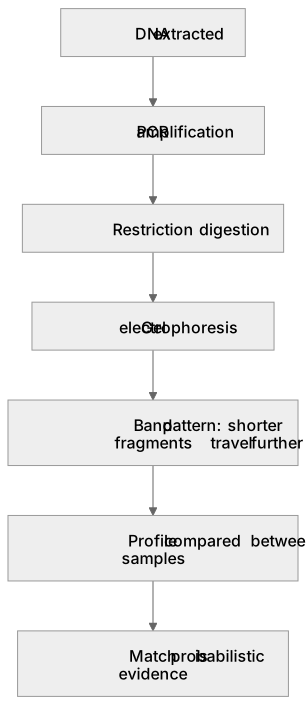
Put it in order
Put these steps in the order they happen.
- 1. Match is probabilistic evidence
- 2. Profile compared between samples
- 3. Restriction digestion
- 4. Band pattern: shorter fragments travel further
- 5. DNA extracted
- 6. PCR amplification
- 7. Gel electrophoresis
Key words
Say what each word means before you turn the card.
Variable repetitive DNA as the basis of profiling
Try answering aloud or in your head before turning the card.
Gel electrophoresis and fragment size separation
Try answering aloud or in your head before turning the card.
STR multi-locus comparison
Try answering aloud or in your head before turning the card.
Forensic, paternity and conservation applications
Try answering aloud or in your head before turning the card.
See every definition
- Variable repetitive DNA as the basis of profiling
- Profiling exploits variation in repetitive, non-coding DNA to produce a pattern characteristic of an individual, so individuals differ in fragment lengths or repeat numbers.
- Gel electrophoresis and fragment size separation
- Fragments are separated by gel electrophoresis; shorter fragments travel further, so band positions reflect fragment lengths.
- STR multi-locus comparison
- Short tandem repeat numbers at several loci are measured, giving a multi-locus profile that is compared between samples.
- Forensic, paternity and conservation applications
- Uses include forensic identification from crime-scene samples, paternity and kinship testing, identifying tissue or blood samples, and monitoring genetic diversity in conservation.
Label the diagram
Some boxes have lost their names. Pick the right name for each number.
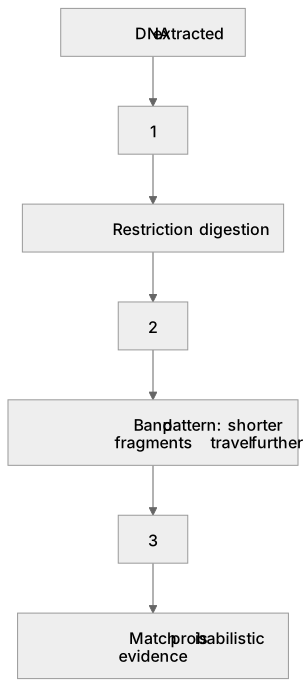
1Box 1
2Box 2
3Box 3
There is more to this lesson
The full lesson goes on to check your understanding and help you earn the marks. Create a free account to carry on, with your progress saved.
A week of Premium from your first lesson · Then the free plan continues · No card, no charge
Test your understanding of Manipulating genomes: (c) the principles of DNA profiling and its uses
Active recall beats re-reading. Take an instant quiz now to test what you’ve learned and lock it into long-term memory.
A week of Premium from your first lesson · Then the free plan continues · No card, no charge