OCR · A-Level · Biology
Course version: H420 · Version from Sept 2025
(iii) how gene sequencing has allowed for the development of synthetic…
Full specification wording
Manipulating genomes: (iii) how gene sequencing has allowed for the development of synthetic biology
Synthetic biology designs and builds new biological parts and systems, or redesigns existing ones.
Checked against the OCR H420 specification (opens in a new tab) on .
- Point 4 of 10
- 4 key terms
Study notes
From the checked teaching notes for this specification point.
The idea
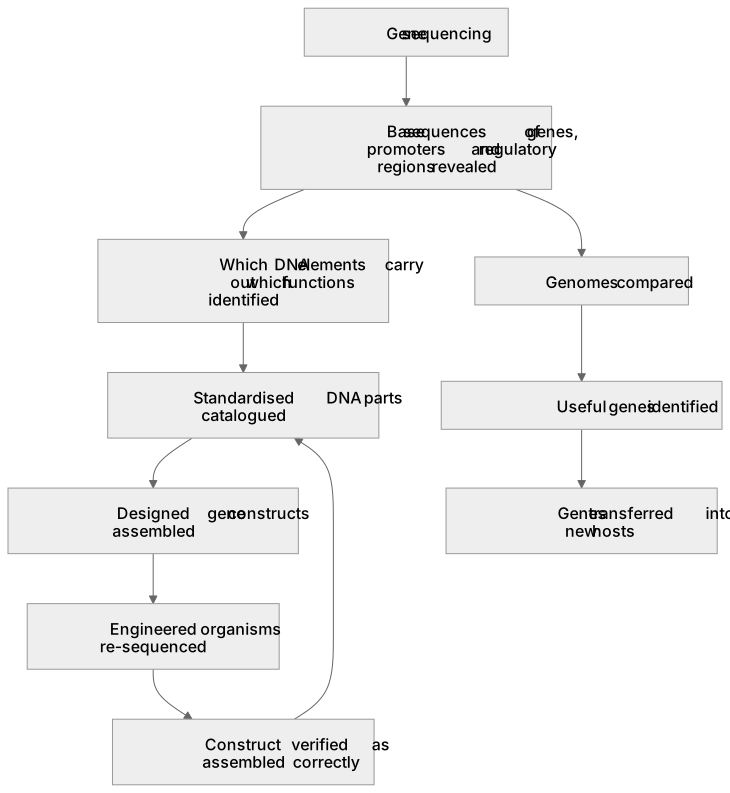
Synthetic biology designs and builds new biological parts and systems, or redesigns existing ones. Gene sequencing supplies the raw information: it reveals the base sequences of genes, promoters and regulatory regions, so engineers can identify which DNA elements perform which functions. Sequenced data allow standardised parts to be catalogued, novel gene constructs to be designed and assembled, and the resulting organisms to be checked by re-sequencing. Sequencing also supports comparison across genomes, revealing useful genes that can be transferred into new hosts. In this way sequencing underpins the design-build-test cycle of synthetic biology, from identifying functional DNA elements to verifying engineered constructs.
What earns the marks
- Synthetic biology involves designing and constructing new biological parts, devices or systems, or redesigning existing biological systems.
- Gene sequencing identifies the base sequences of genes, promoters and regulatory regions, revealing which DNA elements carry out which functions.
- Sequenced information allows standardised DNA parts to be catalogued and combined into designed gene constructs.
- Re-sequencing engineered organisms verifies that the intended construct has been assembled correctly, supporting the design-build-test cycle.
- Comparing sequenced genomes identifies useful genes that can be transferred into new host organisms for novel functions.
Common mistakes and how to put them right
Treating synthetic biology as identical to gene sequencing.
Put it right by explaining that sequencing provides information used to design and build new systems.
Assuming sequencing alone creates a new organism.
Put it right by noting that sequencing informs design, while assembly and testing are separate steps.
Overlooking the role of sequencing in verifying engineered constructs.
Put it right by including re-sequencing as a check on the assembled DNA.
Exam tips
- Define synthetic biology briefly before explaining how sequencing supports it, so the link is explicit.
- Give a concrete example, such as identifying a promoter from sequence data to build a gene construct.
- Mention the design-build-test cycle and the role of re-sequencing in verifying engineered DNA.
Try the lesson
The start of the Manipulating genomes: (iii) how gene sequencing has allowed for the development of synthetic biology lesson, made from checked teaching notes for this specification point.
Have a go first
Which of the following is a direct application of gene sequencing in synthetic biology?
Listen
Synthetic biology designs and builds new biological parts and systems, or redesigns existing ones. Gene sequencing supplies the raw information: it reveals the base sequences of genes, promoters and regulatory regions, so engineers can identify which DNA elements perform which functions. Sequenced data allow standardised parts to be catalogued, novel gene constructs to be designed and assembled, and the resulting organisms to be checked by re-sequencing. Sequencing also supports comparison across genomes, revealing useful genes that can be transferred into new hosts. In this way sequencing underpins the design-build-test cycle of synthetic biology, from identifying functional DNA elements to verifying engineered constructs. A strong answer earns marks for these points. Synthetic biology involves designing and constructing new biological parts, devices or systems, or redesigning existing biological systems. Gene sequencing identifies the base sequences of genes, promoters and regulatory regions, revealing which DNA elements carry out which functions. Sequenced information allows standardised DNA parts to be catalogued and combined into designed gene constructs. Re-sequencing engineered organisms verifies that the intended construct has been assembled correctly, supporting the design-build-test cycle. A common slip: Treating synthetic biology as identical to gene sequencing. Instead, explaining that sequencing provides information used to design and build new systems. Exam tip: Define synthetic biology briefly before explaining how sequencing supports it, so the link is explicit.
See it
Key words
Say what each word means before you turn the card.
Synthetic biology
Try answering aloud or in your head before turning the card.
Sequencing as a source of design information
Try answering aloud or in your head before turning the card.
Standardised DNA parts and constructs
Try answering aloud or in your head before turning the card.
Verification by re-sequencing
Try answering aloud or in your head before turning the card.
See every definition
- Synthetic biology
- Designing and constructing new biological parts, devices or systems, or redesigning existing biological systems.
- Sequencing as a source of design information
- Gene sequencing identifies the base sequences of genes, promoters and regulatory regions, revealing which DNA elements carry out which functions.
- Standardised DNA parts and constructs
- Sequenced information allows standardised DNA parts to be catalogued and combined into designed gene constructs.
- Verification by re-sequencing
- Re-sequencing engineered organisms verifies that the intended construct has been assembled correctly, supporting the design-build-test cycle.
Label the diagram
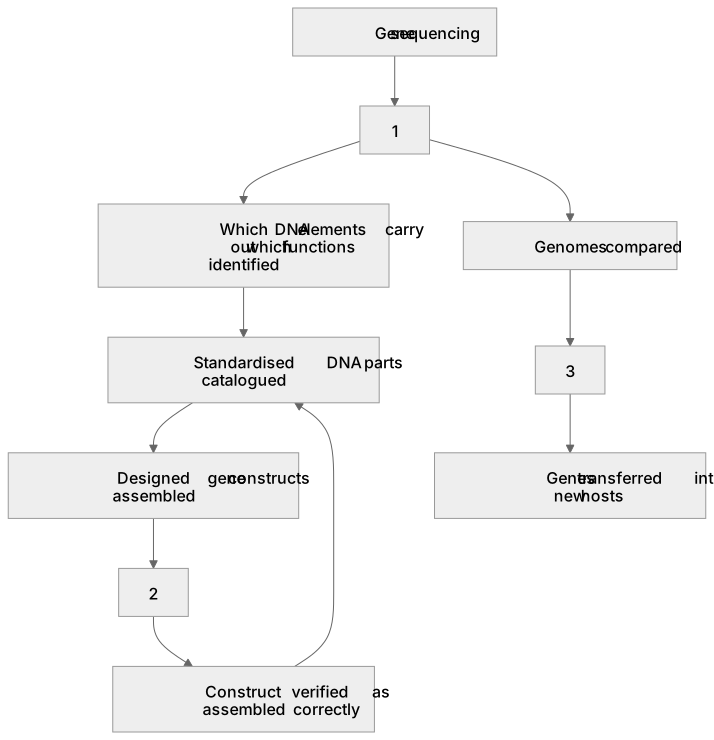
Some boxes have lost their names. Pick the right name for each number.
1Box 1
2Box 2
3Box 3
There is more to this lesson
The full lesson goes on to check your understanding and help you earn the marks. Create a free account to carry on, with your progress saved.
A week of Premium from your first lesson · Then the free plan continues · No card, no charge
Test your understanding of Manipulating genomes: (iii) how gene sequencing has allowed for the development of synthetic biology
Active recall beats re-reading. Take an instant quiz now to test what you’ve learned and lock it into long-term memory.
A week of Premium from your first lesson · Then the free plan continues · No card, no charge