OCR · A-Level · Biology
Course version: H420 · Version from Sept 2025
(a) the roles of mammalian sensory receptors in converting different types…
Full specification wording
Neuronal communication: (a) the roles of mammalian sensory receptors in converting different types of stimuli into nerve impulses
Sensory receptors are specialised cells or nerve endings that detect a specific stimulus and convert its energy into a nerve impulse, a process called transduction.
Checked against the OCR H420 specification (opens in a new tab) on .
- Point 1 of 4
- 4 key terms
Study notes
From the checked teaching notes for this specification point.
The idea
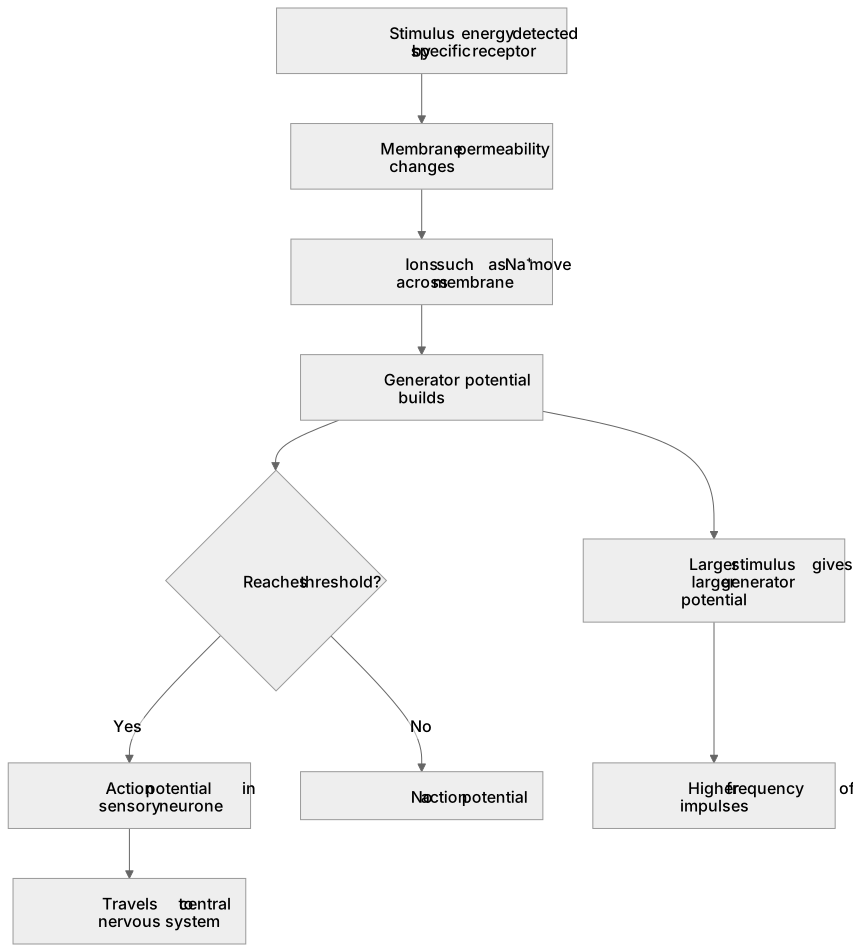
Sensory receptors are specialised cells or nerve endings that detect a specific stimulus and convert its energy into a nerve impulse, a process called transduction. Each receptor type responds to one form of energy: rods and cones in the retina detect light, hair cells in the cochlea detect sound, thermoreceptors detect temperature change, mechanoreceptors in skin detect pressure, and chemoreceptors detect chemicals. The stimulus alters the membrane permeability of the receptor cell, so ions move across the membrane and a generator potential builds. If the generator potential reaches the threshold, an action potential is generated and travels along a sensory neurone to the central nervous system. Pacinian corpuscles in skin illustrate this: pressure deforms the layered capsule, stretch-sensitive sodium channels open, Na⁺ enters and depolarises the membrane.
What earns the marks
- Sensory receptors are specialised cells or nerve endings that detect a specific type of stimulus.
- Transduction is the conversion of stimulus energy into a generator potential and then into nerve impulses.
- Each receptor type is sensitive to one form of energy, for example rods and cones detect light and thermoreceptors detect temperature.
- The stimulus changes membrane permeability so ions such as Na⁺ move across the membrane, producing a generator potential.
- A generator potential that reaches threshold triggers an action potential in a sensory neurone.
- A larger stimulus produces a larger generator potential and a higher frequency of impulses, encoding intensity.
- Pacinian corpuscles detect pressure: deformation of the capsule opens stretch-mediated sodium channels and depolarises the membrane.
Common mistakes and how to put them right
Thinking any stimulus directly creates an action potential.
Put it right by explaining that a generator potential must first reach threshold.
Assuming one receptor detects all stimulus types.
Put it right by stating each receptor is specific to one form of energy.
Believing impulse size increases with stimulus strength.
Put it right by explaining that impulse frequency, not amplitude, encodes intensity.
Confusing the generator potential with the action potential.
Put it right by distinguishing the graded receptor potential from the all-or-nothing impulse.
Exam tips
- Link each named receptor to the specific stimulus energy it detects rather than listing receptors alone.
- Use the term generator potential and state the threshold requirement explicitly.
- Explain intensity coding through frequency of impulses, not through bigger impulses.
Try the lesson
The start of the Neuronal communication: (a) the roles of mammalian sensory receptors in converting different types of stimuli into nerve impulses lesson, made from checked teaching notes for this specification point.
Have a go first
What name is given to the process by which a sensory receptor converts a stimulus such as light or pressure into a nerve impulse?
Listen
Sensory receptors are specialised cells or nerve endings that detect a specific stimulus and convert its energy into a nerve impulse, a process called transduction. Each receptor type responds to one form of energy: rods and cones in the retina detect light, hair cells in the cochlea detect sound, thermoreceptors detect temperature change, mechanoreceptors in skin detect pressure, and chemoreceptors detect chemicals. The stimulus alters the membrane permeability of the receptor cell, so ions move across the membrane and a generator potential builds. If the generator potential reaches the threshold, an action potential is generated and travels along a sensory neurone to the central nervous system. Pacinian corpuscles in skin illustrate this: pressure deforms the layered capsule, stretch-sensitive sodium channels open, Na⁺ enters and depolarises the membrane. A strong answer earns marks for these points. Sensory receptors are specialised cells or nerve endings that detect a specific type of stimulus. Transduction is the conversion of stimulus energy into a generator potential and then into nerve impulses. Each receptor type is sensitive to one form of energy, for example rods and cones detect light and thermoreceptors detect temperature. The stimulus changes membrane permeability so ions such as Na⁺ move across the membrane, producing a generator potential. A common slip: Thinking any stimulus directly creates an action potential. Instead, explaining that a generator potential must first reach threshold. Exam tip: Link each named receptor to the specific stimulus energy it detects rather than listing receptors alone.
See it
Watch it explained
What is the one idea the video explains? Say it in a sentence.
Read the described scene instead
Every moment your body is detecting change. Sensory receptors are specialised cells or nerve endings that detect a specific stimulus and convert its energy into a nerve impulse. That conversion is called transduction. This lesson follows that journey, from stimulus to generator potential, and then to an action potential travelling to the central nervous system. Receptors are not general-purpose. Each receptor type responds to one form of energy. Rods and cones in the retina detect light. Hair cells in the cochlea detect sound. Thermoreceptors detect temperature change, mechanoreceptors in the skin detect pressure, and chemoreceptors detect chemicals. Receptor specificity is the key idea here. How does the conversion work? The stimulus alters the membrane permeability of the receptor cell. Ions move across the membrane, and a generator potential builds. That generator potential is graded: it rises with the strength of the stimulus. Only if it reaches the threshold is an action potential generated, and that impulse travels along a sensory neurone to the central nervous system. Take the Pacinian corpuscle, which detects pressure in the skin. Pressure deforms the layered capsule around the nerve ending. That deformation stretches the membrane and opens stretch-sensitive sodium channels. Sodium ions enter the neurone and depolarise the membrane, producing a generator potential. Pause here and ask yourself: what would happen if the pressure were too small? If the generator potential stays below threshold, no action potential fires. If it reaches threshold, an action potential is triggered in the sensory neurone. The action potential is all-or-nothing: it does not get larger with a stronger stimulus. That distinguishes it from the graded generator potential. Three things to avoid. First, a stimulus does not directly create an action potential; a generator potential must reach threshold first. Second, no single receptor detects every stimulus; each is specific to one form of energy. Third, a stronger stimulus does not produce a bigger impulse. Instead it produces a larger generator potential and a higher frequency of impulses, which is how intensity is encoded. To summarise: receptors detect a specific stimulus and transduce its energy into a generator potential. Ions cross the membrane after permeability changes, and threshold triggers an all-or-nothing action potential along a sensory neurone. Intensity is signalled by impulse frequency, not impulse size.
Key words
Say what each word means before you turn the card.
Transduction
Try answering aloud or in your head before turning the card.
Generator potential
Try answering aloud or in your head before turning the card.
Threshold
Try answering aloud or in your head before turning the card.
Encoding stimulus intensity
Try answering aloud or in your head before turning the card.
See every definition
- Transduction
- The conversion of stimulus energy into a generator potential and then into nerve impulses.
- Generator potential
- A potential produced when the stimulus changes membrane permeability so ions such as Na⁺ move across the membrane.
- Threshold
- The level a generator potential must reach to trigger an action potential in a sensory neurone.
- Encoding stimulus intensity
- A larger stimulus produces a larger generator potential and a higher frequency of impulses, encoding intensity.
Label the diagram
Some boxes have lost their names. Pick the right name for each number.
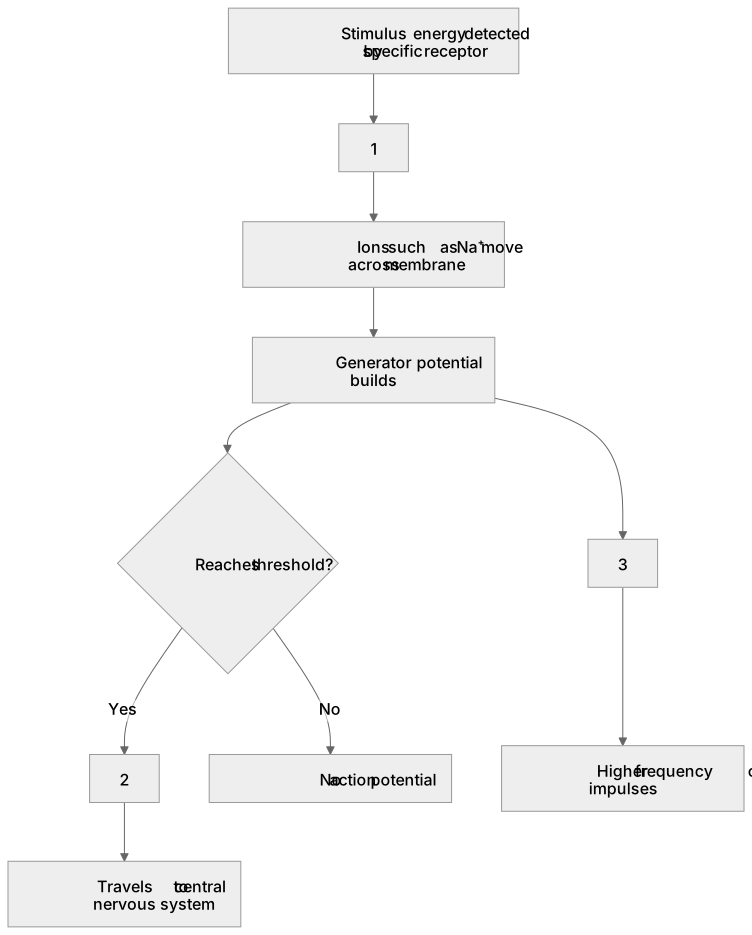
1Box 1
2Box 2
3Box 3
There is more to this lesson
The full lesson goes on to check your understanding and help you earn the marks. Create a free account to carry on, with your progress saved.
A week of Premium from your first lesson · Then the free plan continues · No card, no charge
Test your understanding of Neuronal communication: (a) the roles of mammalian sensory receptors in converting different types of stimuli into nerve impulses
Active recall beats re-reading. Take an instant quiz now to test what you’ve learned and lock it into long-term memory.
A week of Premium from your first lesson · Then the free plan continues · No card, no charge