OCR · A-Level · Biology
Course version: H420 · Version from Sept 2025
(b) the structure and functions of sensory, relay and motor neurones
Full specification wording
Neuronal communication: (b) the structure and functions of sensory, relay and motor neurones
Neurones share a basic structure: a cell body containing the nucleus, dendrites that receive impulses, and an axon that carries impulses away, often wrapped in a myelin sheath formed by Schwann…
Checked against the OCR H420 specification (opens in a new tab) on .
- Point 2 of 4
- 4 key terms
Study notes
From the checked teaching notes for this specification point.
The idea
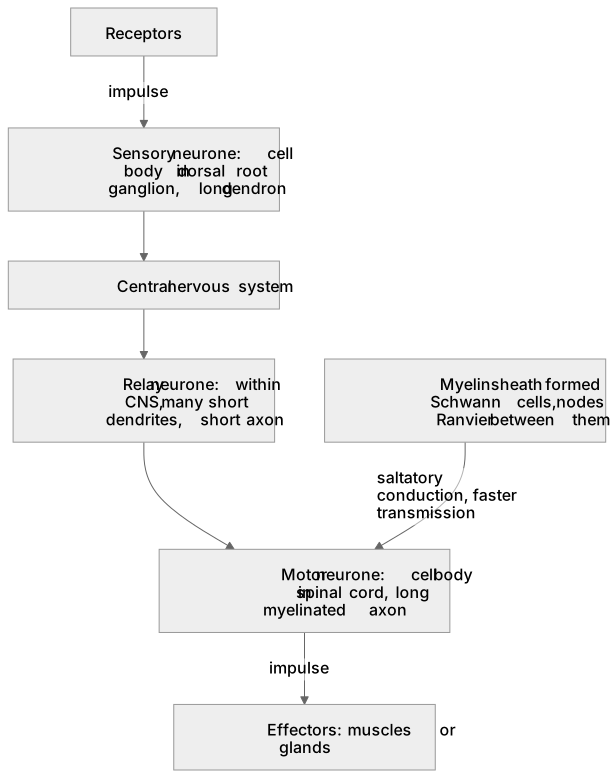
Neurones share a basic structure: a cell body containing the nucleus, dendrites that receive impulses, and an axon that carries impulses away, often wrapped in a myelin sheath formed by Schwann cells with nodes of Ranvier between them. Sensory neurones carry impulses from receptors to the central nervous system; they have a cell body in a dorsal root ganglion and a long dendron. Relay (intermediate) neurones lie within the central nervous system and connect sensory to motor neurones, often with many short dendrites and a short axon. Motor neurones carry impulses from the central nervous system to effectors such as muscles or glands; they have a large cell body in the spinal cord and a long myelinated axon. Myelination allows saltatory conduction, speeding transmission.
What earns the marks
- All neurones have a cell body with a nucleus, dendrites that receive impulses and an axon that transmits impulses away.
- Sensory neurones carry impulses from receptors to the central nervous system and typically have a cell body in a dorsal root ganglion with a long dendron.
- Relay neurones are found within the central nervous system and connect sensory neurones to motor neurones, often with many short dendrites and a short axon.
- Motor neurones carry impulses from the central nervous system to effectors such as muscles or glands, with a cell body in the spinal cord and a long axon.
- The myelin sheath, formed by Schwann cells with nodes of Ranvier between them, enables saltatory conduction and faster transmission.
Common mistakes and how to put them right
Reversing the direction of sensory and motor neurones.
Put it right: Sensory neurones carry impulses towards the central nervous system and motor neurones carry impulses away from it to effectors.
Placing relay neurones outside the central nervous system.
Put it right: Relay neurones are located within the central nervous system.
Confusing the dendron of a sensory neurone with the axon.
Put it right: The sensory neurone has a long dendron carrying impulses towards its cell body.
Ignoring the role of Schwann cells and nodes of Ranvier.
Put it right: These structures produce the myelin sheath and allow saltatory conduction.
Exam tips
- Match each neurone type to its direction of impulse travel and its typical cell-body position before selecting an option.
- Use the terms dendron, axon, myelin sheath, Schwann cell and node of Ranvier precisely, as distractors often swap them.
- Link structure to function, for example long myelinated axons to rapid conduction, to eliminate plausible but incorrect options.
Try the lesson
The start of the Neuronal communication: (b) the structure and functions of sensory, relay and motor neurones lesson, made from checked teaching notes for this specification point.
Have a go first
Which part of a motor neurone conducts impulses away from the cell body towards an effector?
Listen
Neurones share a basic structure: a cell body containing the nucleus, dendrites that receive impulses, and an axon that carries impulses away, often wrapped in a myelin sheath formed by Schwann cells with nodes of Ranvier between them. Sensory neurones carry impulses from receptors to the central nervous system; they have a cell body in a dorsal root ganglion and a long dendron. Relay (intermediate) neurones lie within the central nervous system and connect sensory to motor neurones, often with many short dendrites and a short axon. Motor neurones carry impulses from the central nervous system to effectors such as muscles or glands; they have a large cell body in the spinal cord and a long myelinated axon. Myelination allows saltatory conduction, speeding transmission. A strong answer earns marks for these points. All neurones have a cell body with a nucleus, dendrites that receive impulses and an axon that transmits impulses away. Sensory neurones carry impulses from receptors to the central nervous system and typically have a cell body in a dorsal root ganglion with a long dendron. Relay neurones are found within the central nervous system and connect sensory neurones to motor neurones, often with many short dendrites and a short axon. Motor neurones carry impulses from the central nervous system to effectors such as muscles or glands, with a cell body in the spinal cord and a long axon. A common slip: Reversing the direction of sensory and motor neurones. Instead, sensory neurones carry impulses towards the central nervous system and motor neurones carry impulses away from it to effectors. Exam tip: Match each neurone type to its direction of impulse travel and its typical cell-body position before selecting an option.
See it
Watch it explained
What is the one idea the video explains? Say it in a sentence.
Read the described scene instead
Neurones share a basic structure: a cell body containing the nucleus, dendrites that receive impulses, and an axon that carries impulses away. Many axons have a myelin sheath formed by Schwann cells, with nodes of Ranvier between them. All three neurone types use the same basic parts, but their positions and shapes differ. Sensory neurones carry impulses from receptors to the central nervous system. Relay neurones lie within the central nervous system and connect sensory to motor neurones. Motor neurones carry impulses from the central nervous system to effectors. A sensory neurone typically has its cell body in a dorsal root ganglion. It has a long dendron carrying impulses towards the cell body, and an axon carrying impulses towards the central nervous system. This arrangement supports its role in carrying impulses from receptors to the central nervous system. Relay neurones are found within the central nervous system. They often have many short dendrites and a short axon, connecting sensory neurones to motor neurones. Motor neurones have a large cell body in the spinal cord and a long myelinated axon, carrying impulses from the central nervous system to effectors such as muscles or glands. The myelin sheath is formed by Schwann cells, with nodes of Ranvier between them. Myelination allows saltatory conduction, which speeds transmission along the axon. This is why a long myelinated axon in a motor neurone can support rapid conduction. A common mistake is reversing the direction of sensory and motor neurones. Sensory neurones carry impulses towards the central nervous system; motor neurones carry impulses away from it to effectors. Another is placing relay neurones outside the central nervous system, but relay neurones are located within it. Also, a sensory neurone has a long dendron carrying impulses towards its cell body, not an axon. In summary, all neurones have a cell body, dendrites and an axon. Sensory neurones carry impulses from receptors to the central nervous system, relay neurones connect within the central nervous system, and motor neurones carry impulses to effectors. Myelination by Schwann cells allows saltatory conduction and faster transmission.
Key words
Say what each word means before you turn the card.
Dendrites
Try answering aloud or in your head before turning the card.
Sensory neurones
Try answering aloud or in your head before turning the card.
Relay neurones
Try answering aloud or in your head before turning the card.
Saltatory conduction
Try answering aloud or in your head before turning the card.
See every definition
- Dendrites
- Structures of a neurone that receive impulses, while the axon transmits impulses away.
- Sensory neurones
- Neurones that carry impulses from receptors to the central nervous system, typically with a cell body in a dorsal root ganglion and a long dendron.
- Relay neurones
- Neurones found within the central nervous system that connect sensory neurones to motor neurones, often with many short dendrites and a short axon.
- Saltatory conduction
- Conduction enabled by the myelin sheath, formed by Schwann cells with nodes of Ranvier between them, giving faster transmission.
Label the diagram
Some boxes have lost their names. Pick the right name for each number.
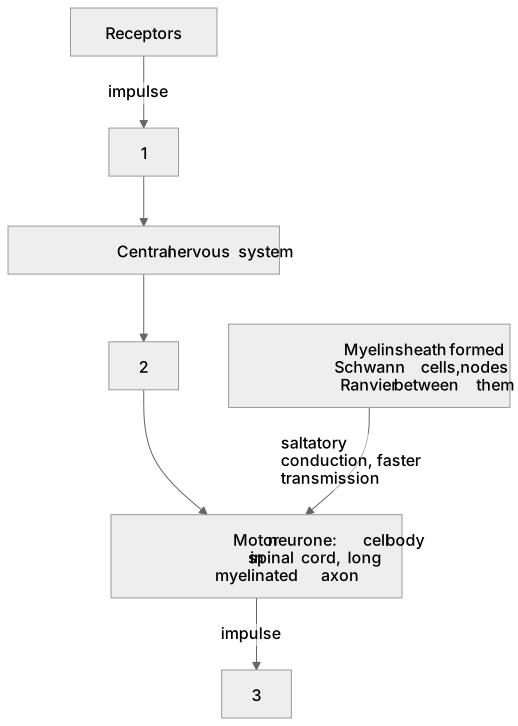
1Box 1
2Box 2
3Box 3
There is more to this lesson
The full lesson goes on to check your understanding and help you earn the marks. Create a free account to carry on, with your progress saved.
A week of Premium from your first lesson · Then the free plan continues · No card, no charge
Test your understanding of Neuronal communication: (b) the structure and functions of sensory, relay and motor neurones
Active recall beats re-reading. Take an instant quiz now to test what you’ve learned and lock it into long-term memory.
A week of Premium from your first lesson · Then the free plan continues · No card, no charge