OCR · A-Level · Biology
Course version: H420 · Version from Sept 2025
(b) the synthesis and breakdown of polynucleotides by the formation and…
Full specification wording
Nucleotides and nucleic acids: (b) the synthesis and breakdown of polynucleotides by the formation and breakage of phosphodiester bonds
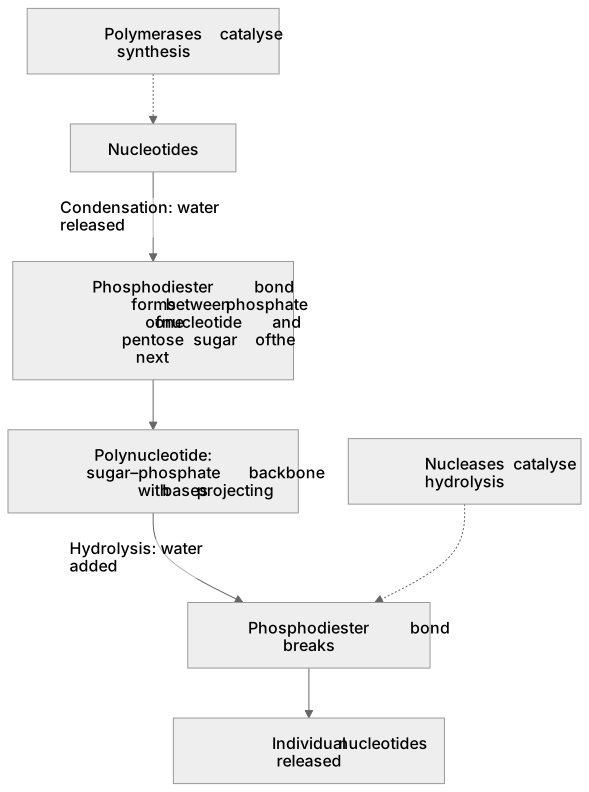
Polynucleotides form when nucleotides join in a condensation reaction, releasing water and creating a phosphodiester bond between the phosphate of one nucleotide and the sugar of the next.
Checked against the OCR H420 specification (opens in a new tab) on .
- Point 2 of 8
- 4 key terms
Study notes
From the checked teaching notes for this specification point.
The idea
Polynucleotides form when nucleotides join in a condensation reaction, releasing water and creating a phosphodiester bond between the phosphate of one nucleotide and the sugar of the next. The backbone is a sugar–phosphate chain with bases projecting from it. Breakdown occurs by hydrolysis, where water is added to break the phosphodiester bond, releasing nucleotides. Teach the direction and chemistry: condensation builds, hydrolysis breaks, and both involve the same bond. In cells, polymerases catalyse synthesis and nucleases catalyse hydrolysis. A typical MCQ asks which reaction forms the bond, what is released during condensation, or which enzyme class breaks the bond.
What earns the marks
- Polynucleotides are synthesised by condensation reactions that form phosphodiester bonds between adjacent nucleotides.
- Each condensation releases a water molecule.
- The phosphodiester bond links the phosphate group of one nucleotide to the pentose sugar of the next.
- Hydrolysis breaks phosphodiester bonds by adding water, releasing individual nucleotides.
- Enzymes such as polymerases catalyse synthesis and nucleases catalyse hydrolysis.
Common mistakes and how to put them right
Saying hydrolysis forms the bond.
Put it right: Condensation forms it and releases water; hydrolysis breaks it and uses water.
Describing the bond as linking two bases.
Put it right: The phosphodiester bond links phosphate to sugar in the backbone.
Forgetting the water: condensation releases water, hydrolysis requires water.
Exam tips
- Link each reaction to whether water is released or used.
- State precisely which groups the phosphodiester bond joins.
- Use the terms condensation and hydrolysis accurately in explanations.
Try the lesson
The start of the Nucleotides and nucleic acids: (b) the synthesis and breakdown of polynucleotides by the formation and breakage of phosphodiester bonds lesson, made from checked teaching notes for this specification point.
Have a go first
In a single strand of DNA, adjacent nucleotides are held together by which kind of bond?
Listen
Polynucleotides form when nucleotides join in a condensation reaction, releasing water and creating a phosphodiester bond between the phosphate of one nucleotide and the sugar of the next. The backbone is a sugar–phosphate chain with bases projecting from it. Breakdown occurs by hydrolysis, where water is added to break the phosphodiester bond, releasing nucleotides. Teach the direction and chemistry: condensation builds, hydrolysis breaks, and both involve the same bond. In cells, polymerases catalyse synthesis and nucleases catalyse hydrolysis. A typical MCQ asks which reaction forms the bond, what is released during condensation, or which enzyme class breaks the bond. A strong answer earns marks for these points. Polynucleotides are synthesised by condensation reactions that form phosphodiester bonds between adjacent nucleotides. Each condensation releases a water molecule. The phosphodiester bond links the phosphate group of one nucleotide to the pentose sugar of the next. Hydrolysis breaks phosphodiester bonds by adding water, releasing individual nucleotides. Exam tip: Link each reaction to whether water is released or used.
See it
Key words
Say what each word means before you turn the card.
Condensation polymerisation
Try answering aloud or in your head before turning the card.
Phosphodiester bonds
Try answering aloud or in your head before turning the card.
Hydrolysis
Try answering aloud or in your head before turning the card.
Enzyme catalysis
Try answering aloud or in your head before turning the card.
See every definition
- Condensation polymerisation
- Nucleotides join in a condensation reaction that forms phosphodiester bonds between adjacent nucleotides and releases a water molecule each time.
- Phosphodiester bonds
- The bond links the phosphate group of one nucleotide to the pentose sugar of the next, forming a sugar–phosphate backbone with bases projecting from it.
- Hydrolysis
- Water is added to break the phosphodiester bond, releasing individual nucleotides.
- Enzyme catalysis
- Polymerases catalyse synthesis and nucleases catalyse hydrolysis.
Label the diagram
Some boxes have lost their names. Pick the right name for each number.
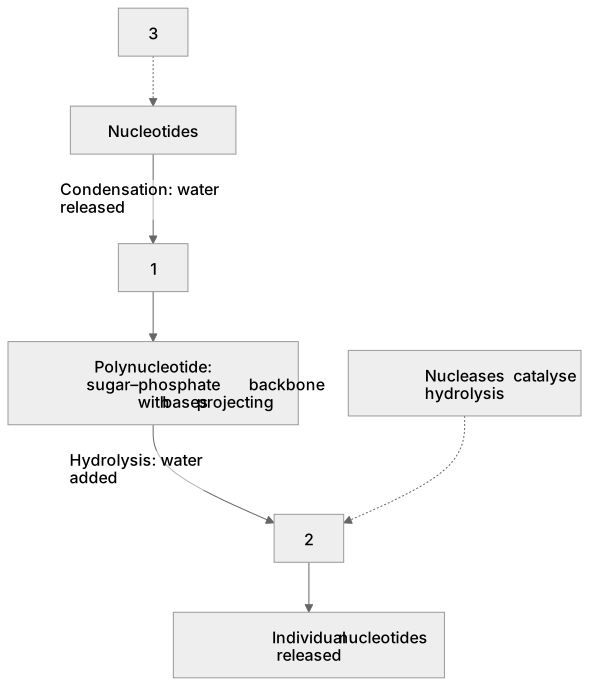
1Box 1
2Box 2
3Box 3
There is more to this lesson
The full lesson goes on to check your understanding and help you earn the marks. Create a free account to carry on, with your progress saved.
A week of Premium from your first lesson · Then the free plan continues · No card, no charge
Test your understanding of Nucleotides and nucleic acids: (b) the synthesis and breakdown of polynucleotides by the formation and breakage of phosphodiester bonds
Active recall beats re-reading. Take an instant quiz now to test what you’ve learned and lock it into long-term memory.
A week of Premium from your first lesson · Then the free plan continues · No card, no charge