OCR · A-Level · Biology
Course version: H420 · Version from Sept 2025
(c) the structure of ADP and ATP as phosphorylated nucleotides
Full specification wording
Nucleotides and nucleic acids: (c) the structure of ADP and ATP as phosphorylated nucleotides
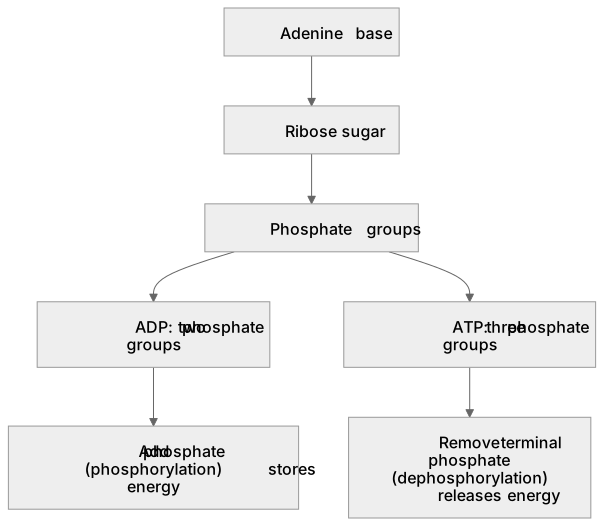
ADP and ATP are phosphorylated nucleotides: each is built on a nucleotide framework in which a nitrogenous base (adenine) is joined to a pentose sugar (ribose), and the sugar carries phosphate groups.
Checked against the OCR H420 specification (opens in a new tab) on .
- Point 3 of 8
- 3 key terms
Study notes
From the checked teaching notes for this specification point.
The idea
ADP and ATP are phosphorylated nucleotides: each is built on a nucleotide framework in which a nitrogenous base (adenine) is joined to a pentose sugar (ribose), and the sugar carries phosphate groups. In ADP (adenosine diphosphate) the ribose carries two phosphate groups; in ATP (adenosine triphosphate) it carries three, so ATP has one extra phosphate compared with ADP. The phosphate groups are attached in a chain, and adding the terminal phosphate to ADP (phosphorylation) stores energy, while removing it (dephosphorylation) releases energy. Recognise the components: adenine base, ribose sugar, and two or three phosphate groups respectively. A useful check is to count phosphates: diphosphate means two, triphosphate means three. Distinguish these from a plain nucleotide such as AMP, which has a single phosphate.
What earns the marks
- ADP and ATP are both phosphorylated nucleotides, built from adenine, ribose and phosphate groups.
- ADP (adenosine diphosphate) has two phosphate groups attached to the ribose sugar.
- ATP (adenosine triphosphate) has three phosphate groups attached to the ribose sugar.
- ATP differs from ADP by one additional phosphate group, added by phosphorylation.
- The base is adenine and the pentose sugar is ribose in both molecules.
- Adding a phosphate to ADP stores energy; removing the terminal phosphate from ATP releases energy.
Common mistakes and how to put them right
Confusing the number of phosphates.
Put it right: Count the 'di' (two) and 'tri' (three) prefixes.
Thinking ATP contains deoxyribose.
Put it right: The sugar in ADP and ATP is ribose, not deoxyribose.
Treating ATP as a nucleotide with a single phosphate.
Put it right: ATP is a phosphorylated nucleotide carrying three phosphate groups.
Believing the base differs between ADP and ATP.
Put it right: Both contain adenine; only the phosphate count differs.
Exam tips
- Learn the component list (adenine, ribose, phosphate groups) and the phosphate count for each molecule.
- Use the prefixes di- and tri- to recall two versus three phosphate groups.
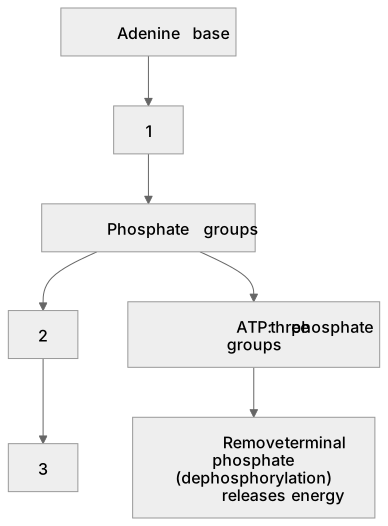
- Practise labelling a simple diagram of ATP showing base, sugar and the phosphate chain.
- Link phosphorylation to energy storage and dephosphorylation to energy release when explaining the difference.
Try the lesson
The start of the Nucleotides and nucleic acids: (c) the structure of ADP and ATP as phosphorylated nucleotides lesson, made from checked teaching notes for this specification point.
Have a go first
How many phosphate groups are present in one molecule of ATP?
Listen
ADP and ATP are phosphorylated nucleotides: each is built on a nucleotide framework in which a nitrogenous base (adenine) is joined to a pentose sugar (ribose), and the sugar carries phosphate groups. In ADP (adenosine diphosphate) the ribose carries two phosphate groups; in ATP (adenosine triphosphate) it carries three, so ATP has one extra phosphate compared with ADP. The phosphate groups are attached in a chain, and adding the terminal phosphate to ADP (phosphorylation) stores energy, while removing it (dephosphorylation) releases energy. Recognise the components: adenine base, ribose sugar, and two or three phosphate groups respectively. A useful check is to count phosphates: diphosphate means two, triphosphate means three. Distinguish these from a plain nucleotide such as AMP, which has a single phosphate. A strong answer earns marks for these points. ADP and ATP are both phosphorylated nucleotides, built from adenine, ribose and phosphate groups. ADP (adenosine diphosphate) has two phosphate groups attached to the ribose sugar. ATP (adenosine triphosphate) has three phosphate groups attached to the ribose sugar. ATP differs from ADP by one additional phosphate group, added by phosphorylation. A common slip: Confusing the number of phosphates: ADP has two and ATP has three. Instead, count the 'di' (two) and 'tri' (three) prefixes. Exam tip: Learn the component list (adenine, ribose, phosphate groups) and the phosphate count for each molecule.
See it
Key words
Say what each word means before you turn the card.
Phosphorylated nucleotides
Try answering aloud or in your head before turning the card.
ATP and ADP as energy carriers
Try answering aloud or in your head before turning the card.
Structure–function relationship
Try answering aloud or in your head before turning the card.
See every definition
- Phosphorylated nucleotides
- Nucleotides in which the sugar carries phosphate groups, as in ADP and ATP, which are built on a nucleotide framework.
- ATP and ADP as energy carriers
- Adding the terminal phosphate to ADP (phosphorylation) stores energy, while removing it (dephosphorylation) releases energy.
- Structure–function relationship
- ADP has two phosphate groups and ATP has three, so ATP has one extra phosphate compared with ADP, attached in a chain.
Label the diagram
Some boxes have lost their names. Pick the right name for each number.
1Box 1
2Box 2
3Box 3
There is more to this lesson
The full lesson goes on to check your understanding and help you earn the marks. Create a free account to carry on, with your progress saved.
A week of Premium from your first lesson · Then the free plan continues · No card, no charge
Test your understanding of Nucleotides and nucleic acids: (c) the structure of ADP and ATP as phosphorylated nucleotides
Active recall beats re-reading. Take an instant quiz now to test what you’ve learned and lock it into long-term memory.
A week of Premium from your first lesson · Then the free plan continues · No card, no charge