OCR · A-Level · Biology
Course version: H420 · Version from Sept 2025
Nucleotides and nucleic acids: (e) semi-conservative DNA replication
Semi-conservative replication means each new DNA molecule keeps one original strand and gains one newly built strand.
Checked against the OCR H420 specification (opens in a new tab) on .
- Point 6 of 8
- 4 key terms
Study notes
From the checked teaching notes for this specification point.
The idea
Semi-conservative replication means each new DNA molecule keeps one original strand and gains one newly built strand. The two strands of the double helix separate, and each acts as a template. Free nucleotides line up by complementary base pairing (A with T, C with G), and enzymes join them into a new strand. The result is two identical DNA molecules, each half old and half new. Questions test the meaning of semi-conservative, the role of complementary base pairing, the template function of each strand, and why the products are genetically identical. You should be able to explain the process step by step and predict the outcome for daughter molecules.
What earns the marks
- The double helix unwinds and the two strands separate, each acting as a template for a new strand.
- Free nucleotides align opposite the template by complementary base pairing: adenine with thymine and cytosine with guanine.
- Enzymes catalyse the joining of nucleotides into a new strand along each template.
- Each resulting DNA molecule contains one original (conserved) strand and one newly synthesised strand, which is what semi-conservative means.
- Because base pairing is complementary, the two daughter molecules are identical to the original, conserving the genetic information.
Common mistakes and how to put them right
Thinking both strands of a daughter molecule are new.
Put it right by stating one strand is original and one is new.
Mixing up base pairs, for example pairing adenine with cytosine.
Put it right by stating A pairs with T and C pairs with G.
Believing the original DNA is destroyed.
Put it right by explaining the original strands are conserved as templates in the products.
Exam tips
- Define semi-conservative explicitly in terms of one old and one new strand per molecule.
- State the complementary base-pairing rules precisely when describing template alignment.
- Explain the outcome (two identical molecules) and link it to conservation of genetic information.
Try the lesson
The start of the Nucleotides and nucleic acids: (e) semi-conservative DNA replication lesson, made from checked teaching notes for this specification point.
Have a go first
In semi-conservative DNA replication, what does each newly formed DNA molecule contain?
Listen
Semi-conservative replication means each new DNA molecule keeps one original strand and gains one newly built strand. The two strands of the double helix separate, and each acts as a template. Free nucleotides line up by complementary base pairing (A with T, C with G), and enzymes join them into a new strand. The result is two identical DNA molecules, each half old and half new. Questions test the meaning of semi-conservative, the role of complementary base pairing, the template function of each strand, and why the products are genetically identical. You should be able to explain the process step by step and predict the outcome for daughter molecules. A strong answer earns marks for these points. The double helix unwinds and the two strands separate, each acting as a template for a new strand. Free nucleotides align opposite the template by complementary base pairing: adenine with thymine and cytosine with guanine. Enzymes catalyse the joining of nucleotides into a new strand along each template. Each resulting DNA molecule contains one original (conserved) strand and one newly synthesised strand, which is what semi-conservative means. A common slip: Thinking both strands of a daughter molecule are new. Instead, stating one strand is original and one is new. Exam tip: Define semi-conservative explicitly in terms of one old and one new strand per molecule.
See it
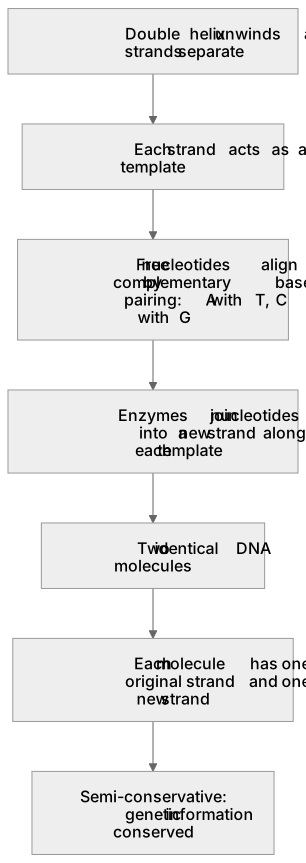
Put it in order
Put these steps in the order they happen.
- 1. Semi-conservative: genetic information conserved
- 2. Each molecule has one original strand and one new strand
- 3. Free nucleotides align by complementary base pairing: A with T, C with G
- 4. Two identical DNA molecules
- 5. Double helix unwinds and strands separate
- 6. Each strand acts as a template
- 7. Enzymes join nucleotides into a new strand along each template
Key words
Say what each word means before you turn the card.
Separation of strands and template function
Try answering aloud or in your head before turning the card.
Complementary base pairing of free nucleotides
Try answering aloud or in your head before turning the card.
Enzyme-catalysed formation of new strands
Try answering aloud or in your head before turning the card.
Conservation of one original strand per daughter molecule
Try answering aloud or in your head before turning the card.
See every definition
- Separation of strands and template function
- The double helix unwinds and the two strands separate, each acting as a template for a new strand.
- Complementary base pairing of free nucleotides
- Free nucleotides align opposite the template by complementary base pairing: adenine with thymine and cytosine with guanine.
- Enzyme-catalysed formation of new strands
- Enzymes catalyse the joining of nucleotides into a new strand along each template.
- Conservation of one original strand per daughter molecule
- Each resulting DNA molecule contains one original (conserved) strand and one newly synthesised strand, which is what semi-conservative means.
Label the diagram
Some boxes have lost their names. Pick the right name for each number.
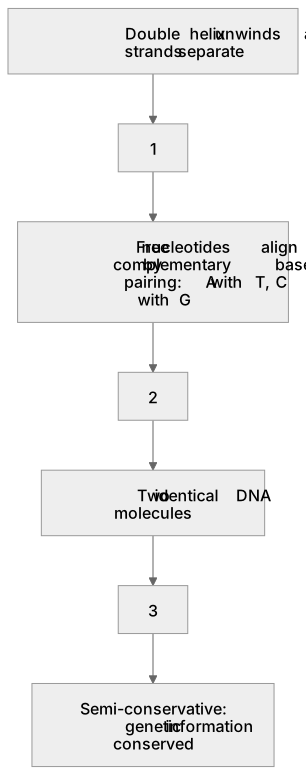
1Box 1
2Box 2
3Box 3
There is more to this lesson
The full lesson goes on to check your understanding and help you earn the marks. Create a free account to carry on, with your progress saved.
A week of Premium from your first lesson · Then the free plan continues · No card, no charge
Test your understanding of Nucleotides and nucleic acids: (e) semi-conservative DNA replication
Active recall beats re-reading. Take an instant quiz now to test what you’ve learned and lock it into long-term memory.
A week of Premium from your first lesson · Then the free plan continues · No card, no charge