OCR · A-Level · Biology
Course version: H420 · Version from Sept 2025
Nucleotides and nucleic acids: (f) the nature of the genetic code
The genetic code is the set of rules by which the base sequence of DNA is translated into the amino acid sequence of a polypeptide.
Checked against the OCR H420 specification (opens in a new tab) on .
- Point 7 of 8
- 4 key terms
Study notes
From the checked teaching notes for this specification point.
The idea
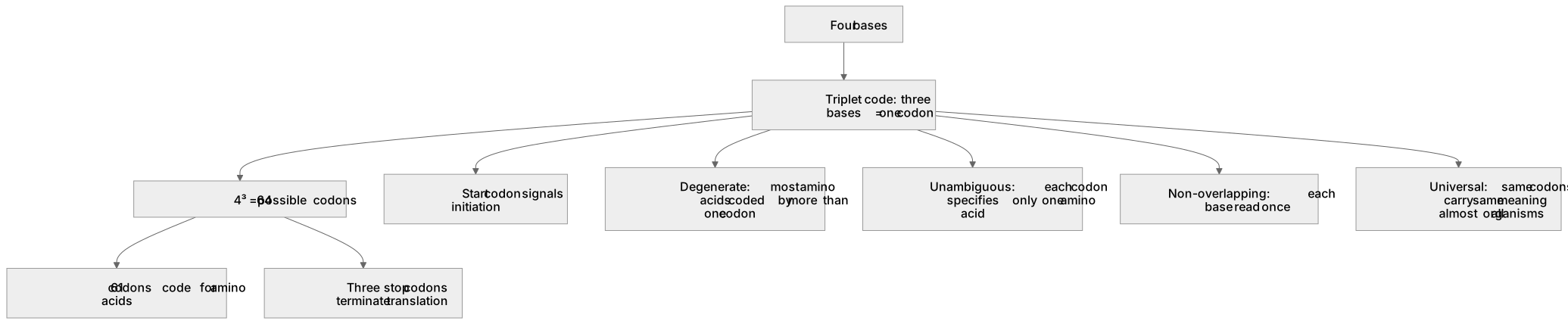
The genetic code is the set of rules by which the base sequence of DNA is translated into the amino acid sequence of a polypeptide. Teach learners that the code is a triplet code: three bases (a codon) specify one amino acid, and because there are four bases, 4³ = 64 possible codons arise. Of these, 61 code for amino acids while three are stop codons that terminate translation; a start codon also signals initiation. The code is degenerate, meaning most amino acids are encoded by more than one codon, yet it is unambiguous because each codon specifies only one amino acid. It is non-overlapping, so each base is read once, and it is universal, since the same codons carry the same meaning in almost all organisms. A concrete method: read a short mRNA sequence in groups of three from the start codon and assign each codon to its amino acid.
What earns the marks
- States that the code is a triplet code in which three bases (a codon) code for one amino acid.
- Explains that 4³ = 64 codons exist, of which 61 code for amino acids and three are stop codons.
- Describes the code as degenerate because most amino acids are coded for by more than one codon.
- Describes the code as unambiguous because each codon specifies only one amino acid.
- States that the code is non-overlapping, with each base read only once.
- States that the code is universal, as the same codons carry the same meaning in almost all organisms.
Common mistakes and how to put them right
Thinking one base codes for one amino acid.
Put it right by stating that three bases form a codon coding for one amino acid.
Confusing degenerate with ambiguous.
Put it right by explaining that degeneracy means several codons share an amino acid, while each codon still specifies only one amino acid.
Assuming all 64 codons code for amino acids.
Put it right by noting that three are stop codons.
Believing the code overlaps so bases are shared between codons.
Put it right by stating that each base is read once in a non-overlapping triplet code.
Exam tips
- Learn the named features of the code (triplet, degenerate, unambiguous, non-overlapping, universal) and be ready to match each to its definition.
- Use the calculation 4³ = 64 to justify the number of codons rather than recalling it blindly.
- When a sequence is given, group the bases into threes from the start codon before assigning amino acids.
Try the lesson
The start of the Nucleotides and nucleic acids: (f) the nature of the genetic code lesson, made from checked teaching notes for this specification point.
Have a go first
How many bases of DNA code for a single amino acid in a polypeptide?
Listen
The genetic code is the set of rules by which the base sequence of DNA is translated into the amino acid sequence of a polypeptide. Teach learners that the code is a triplet code: three bases (a codon) specify one amino acid, and because there are four bases, 4³ = 64 possible codons arise. Of these, 61 code for amino acids while three are stop codons that terminate translation; a start codon also signals initiation. The code is degenerate, meaning most amino acids are encoded by more than one codon, yet it is unambiguous because each codon specifies only one amino acid. It is non-overlapping, so each base is read once, and it is universal, since the same codons carry the same meaning in almost all organisms. A concrete method: read a short mRNA sequence in groups of three from the start codon and assign each codon to its amino acid. A strong answer earns marks for these points. States that the code is a triplet code in which three bases (a codon) code for one amino acid. Explains that 4³ = 64 codons exist, of which 61 code for amino acids and three are stop codons. Describes the code as degenerate because most amino acids are coded for by more than one codon. Describes the code as unambiguous because each codon specifies only one amino acid. A common slip: Thinking one base codes for one amino acid. Instead, stating that three bases form a codon coding for one amino acid. Exam tip: Learn the named features of the code (triplet, degenerate, unambiguous, non-overlapping, universal) and be ready to match each to its definition.
See it
Key words
Say what each word means before you turn the card.
Triplet code and codons
Try answering aloud or in your head before turning the card.
Degeneracy and unambiguity
Try answering aloud or in your head before turning the card.
Non-overlapping reading
Try answering aloud or in your head before turning the card.
Universality of the code
Try answering aloud or in your head before turning the card.
See every definition
- Triplet code and codons
- Three bases, a codon, specify one amino acid, and because there are four bases, 4³ = 64 possible codons arise.
- Degeneracy and unambiguity
- Most amino acids are encoded by more than one codon, yet each codon specifies only one amino acid.
- Non-overlapping reading
- Each base is read once, so bases are not shared between codons.
- Universality of the code
- The same codons carry the same meaning in almost all organisms.
Label the diagram
Some boxes have lost their names. Pick the right name for each number.
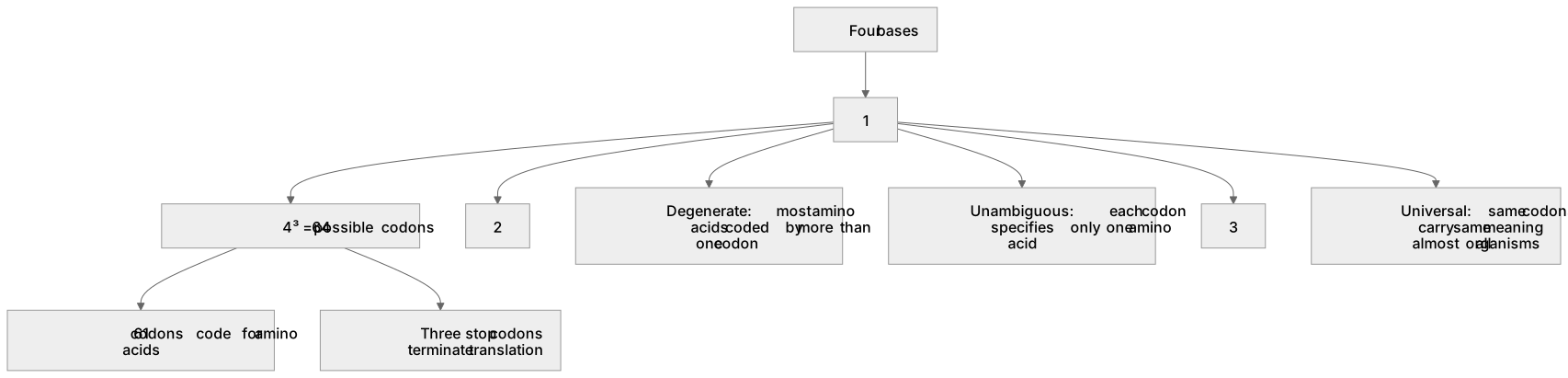
1Box 1
2Box 2
3Box 3
There is more to this lesson
The full lesson goes on to check your understanding and help you earn the marks. Create a free account to carry on, with your progress saved.
A week of Premium from your first lesson · Then the free plan continues · No card, no charge
Test your understanding of Nucleotides and nucleic acids: (f) the nature of the genetic code
Active recall beats re-reading. Take an instant quiz now to test what you’ve learned and lock it into long-term memory.
A week of Premium from your first lesson · Then the free plan continues · No card, no charge