OCR · A-Level · Biology
Course version: H420 · Version from Sept 2025
(a) (i) the contribution of both environmental and genetic factors to…
Full specification wording
Patterns of inheritance: (a) (i) the contribution of both environmental and genetic factors to phenotypic variation
Phenotype is the observable characteristic of an organism, and variation in phenotype can arise from genetic factors, environmental factors, or both acting together.
Checked against the OCR H420 specification (opens in a new tab) on .
- Point 1 of 10
- 4 key terms
Study notes
From the checked teaching notes for this specification point.
The idea
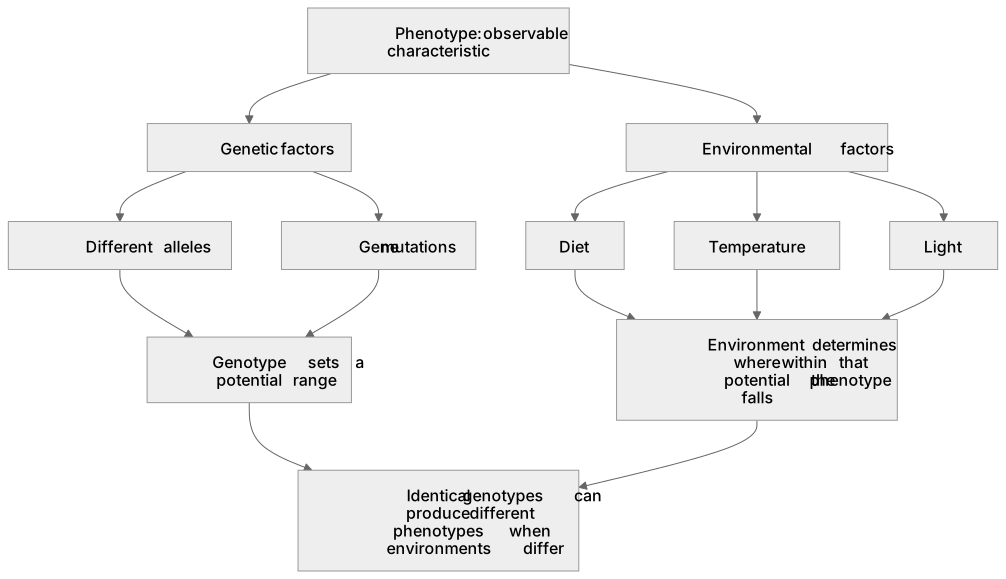
Phenotype is the observable characteristic of an organism, and variation in phenotype can arise from genetic factors, environmental factors, or both acting together. Genetic factors include different alleles and gene mutations, which are inherited and set the range of possible phenotypes. Environmental factors include diet, temperature, light and other conditions that influence how genes are expressed or how an organism develops. Some characteristics, such as blood group, are determined largely by genes, while others, such as body mass in many organisms, are influenced strongly by environment. Many traits show combined effects: genotype sets a potential and the environment determines where within that potential the phenotype falls. Recognising both contributions explains continuous variation and why identical genotypes can produce different phenotypes.
What earns the marks
- Phenotype is the observable characteristic of an organism.
- Genetic factors such as different alleles and mutations contribute to phenotypic variation.
- Environmental factors such as diet, temperature or light contribute to phenotypic variation.
- Many characteristics are influenced by both genetic and environmental factors acting together.
- Identical genotypes can produce different phenotypes when environments differ.
- Some characteristics are determined mainly by genes while others are influenced strongly by environment.
Common mistakes and how to put them right
Claiming phenotype is determined only by genotype.
Put it right: Environmental factors also contribute to phenotypic variation.
Assuming identical genotypes always give identical phenotypes.
Put it right: Differing environments can produce different phenotypes.
Confusing genotype with phenotype.
Put it right: Genotype is the genetic makeup while phenotype is the observable characteristic.
Exam tips
- Name a specific environmental factor rather than saying 'the environment' in general.
- Use an example of a characteristic influenced by both factors to show combined contribution.
- State clearly that genotype sets a potential range and environment influences the actual phenotype expressed.
Try the lesson
The start of the Patterns of inheritance: (a) (i) the contribution of both environmental and genetic factors to phenotypic variation lesson, made from checked teaching notes for this specification point.
Have a go first
Two plants of the same species are genetically identical clones but one is grown in shade and one in full sunlight. The difference in their height is best described as caused by which factor?
Listen
Phenotype is the observable characteristic of an organism, and variation in phenotype can arise from genetic factors, environmental factors, or both acting together. Genetic factors include different alleles and gene mutations, which are inherited and set the range of possible phenotypes. Environmental factors include diet, temperature, light and other conditions that influence how genes are expressed or how an organism develops. Some characteristics, such as blood group, are determined largely by genes, while others, such as body mass in many organisms, are influenced strongly by environment. Many traits show combined effects: genotype sets a potential and the environment determines where within that potential the phenotype falls. Recognising both contributions explains continuous variation and why identical genotypes can produce different phenotypes. A strong answer earns marks for these points. Phenotype is the observable characteristic of an organism. Genetic factors such as different alleles and mutations contribute to phenotypic variation. Environmental factors such as diet, temperature or light contribute to phenotypic variation. Many characteristics are influenced by both genetic and environmental factors acting together. A common slip: Claiming phenotype is determined only by genotype. Instead, environmental factors also contribute to phenotypic variation. Exam tip: Name a specific environmental factor rather than saying 'the environment' in general.
See it
Key words
Say what each word means before you turn the card.
Phenotype
Try answering aloud or in your head before turning the card.
Genetic sources of variation
Try answering aloud or in your head before turning the card.
Environmental influences
Try answering aloud or in your head before turning the card.
Combined effects on variation
Try answering aloud or in your head before turning the card.
See every definition
- Phenotype
- The observable characteristic of an organism, which can vary due to genetic factors, environmental factors, or both acting together.
- Genetic sources of variation
- Different alleles and gene mutations, which are inherited and set the range of possible phenotypes.
- Environmental influences
- Diet, temperature, light and other conditions that influence how genes are expressed or how an organism develops.
- Combined effects on variation
- Genotype sets a potential and the environment determines where within that potential the phenotype falls.
Label the diagram
Some boxes have lost their names. Pick the right name for each number.
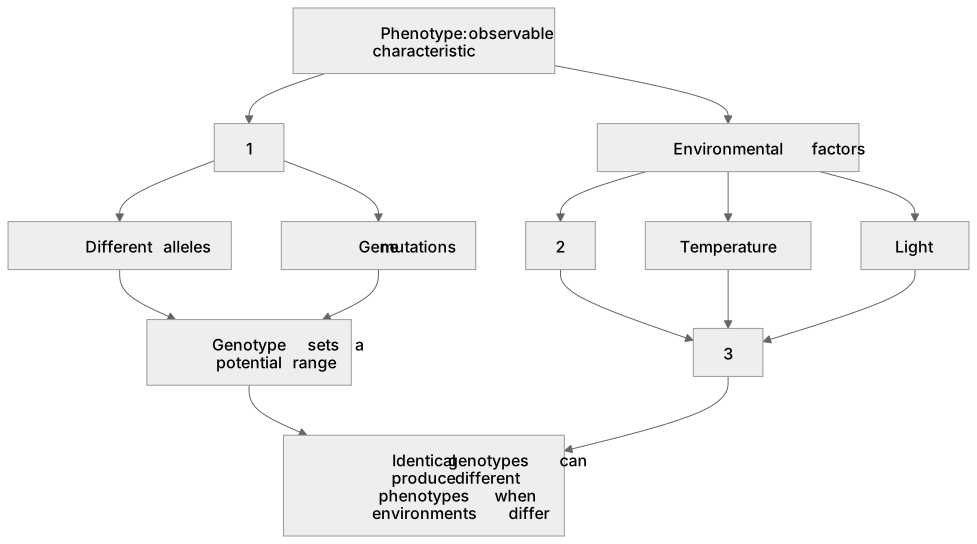
1Box 1
2Box 2
3Box 3
There is more to this lesson
The full lesson goes on to check your understanding and help you earn the marks. Create a free account to carry on, with your progress saved.
A week of Premium from your first lesson · Then the free plan continues · No card, no charge
Test your understanding of Patterns of inheritance: (a) (i) the contribution of both environmental and genetic factors to phenotypic variation
Active recall beats re-reading. Take an instant quiz now to test what you’ve learned and lock it into long-term memory.
A week of Premium from your first lesson · Then the free plan continues · No card, no charge