OCR · A-Level · Biology
Course version: H420 · Version from Sept 2025
(ii) how sexual reproduction can lead to genetic variation within a species
Full specification wording
Patterns of inheritance: (ii) how sexual reproduction can lead to genetic variation within a species
Sexual reproduction generates variation because offspring receive a new combination of alleles from two parents.
Checked against the OCR H420 specification (opens in a new tab) on .
- Point 2 of 10
- 4 key terms
Study notes
From the checked teaching notes for this specification point.
The idea
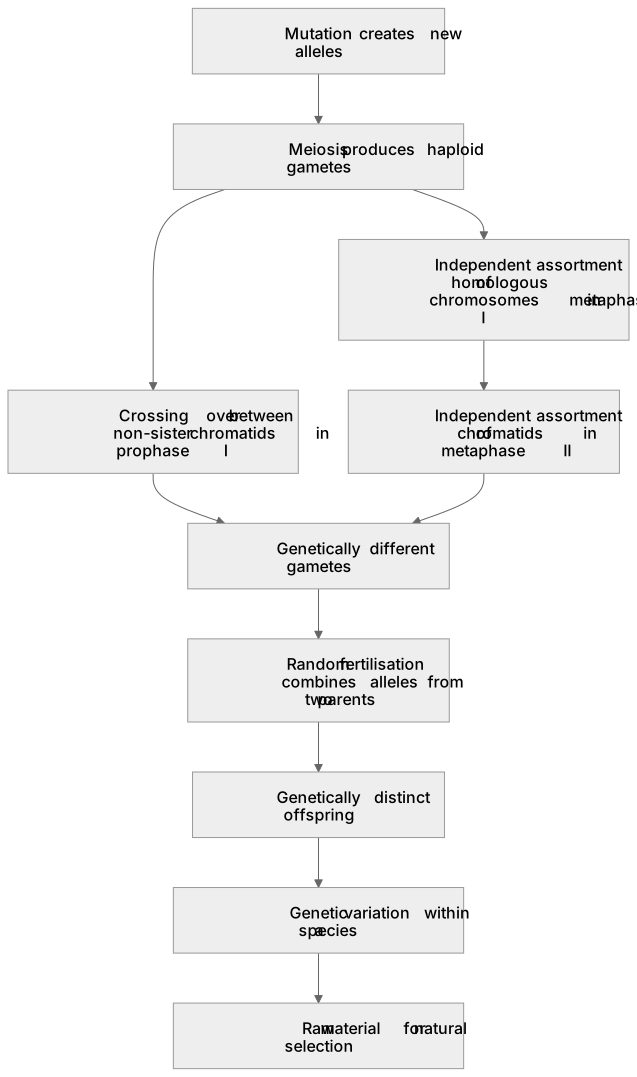
Sexual reproduction generates variation because offspring receive a new combination of alleles from two parents. Meiosis produces gametes that are haploid and genetically different: crossing over between non-sister chromatids of homologous chromosomes in prophase I, and independent assortment of homologous chromosomes in metaphase I, shuffle alleles. Independent assortment of chromatids in metaphase II adds further combinations. Random fertilisation then pairs one gamete from each parent, so many allele combinations are possible. Mutation creates new alleles in the first place. The result is that members of a species differ genetically, which is the raw material for natural selection.
For example: A parent heterozygous at two unlinked loci can produce four gamete types in equal proportions, and fertilisation multiplies the possible offspring genotypes.
What earns the marks
- Meiosis produces haploid gametes, halving the chromosome number so gametes carry one allele of each gene.
- Crossing over between non-sister chromatids of homologous chromosomes in prophase I exchanges alleles and creates recombinant chromatids.
- Independent assortment of homologous chromosomes in metaphase I, and of chromatids in metaphase II, gives many random combinations of maternal and paternal alleles.
- Random fertilisation of two gametes combines alleles from two parents, producing genetically distinct offspring.
- Mutation is the original source of new alleles, which sexual reproduction then reshuffles.
- Genetic variation within a species provides the variation on which natural selection can act.
Common mistakes and how to put them right
Thinking sexual reproduction itself creates new alleles.
Put it right: Mutation creates new alleles; meiosis and fertilisation reshuffle existing alleles.
Confusing crossing over with independent assortment.
Put it right: Crossing over exchanges sections between non-sister chromatids, whereas independent assortment is the random alignment and separation of whole chromosomes or chromatids.
Believing offspring are identical to parents or to each other.
Put it right: Random fertilisation and meiosis produce genetically distinct offspring.
Assuming crossing over occurs between sister chromatids.
Put it right: It occurs between non-sister chromatids of homologous chromosomes.
Exam tips
- Name the stage of meiosis for each source of variation (prophase I for crossing over, metaphase I and II for independent assortment).
- Use precise terms: haploid gametes, homologous chromosomes, non-sister chromatids, random fertilisation.
- Link variation explicitly to its importance for natural selection to gain credit for the 'within a species' clause.
Try the lesson
The start of the Patterns of inheritance: (ii) how sexual reproduction can lead to genetic variation within a species lesson, made from checked teaching notes for this specification point.
Have a go first
Which feature of sexual reproduction directly creates genetic variation among the offspring of two parents?
Listen
Sexual reproduction generates variation because offspring receive a new combination of alleles from two parents. Meiosis produces gametes that are haploid and genetically different: crossing over between non-sister chromatids of homologous chromosomes in prophase I, and independent assortment of homologous chromosomes in metaphase I, shuffle alleles. Independent assortment of chromatids in metaphase II adds further combinations. Random fertilisation then pairs one gamete from each parent, so many allele combinations are possible. Mutation creates new alleles in the first place. The result is that members of a species differ genetically, which is the raw material for natural selection. For example, a parent heterozygous at two unlinked loci can produce four gamete types in equal proportions, and fertilisation multiplies the possible offspring genotypes. A strong answer earns marks for these points. Meiosis produces haploid gametes, halving the chromosome number so gametes carry one allele of each gene. Crossing over between non-sister chromatids of homologous chromosomes in prophase I exchanges alleles and creates recombinant chromatids. Independent assortment of homologous chromosomes in metaphase I, and of chromatids in metaphase II, gives many random combinations of maternal and paternal alleles. Random fertilisation of two gametes combines alleles from two parents, producing genetically distinct offspring. A common slip: Thinking sexual reproduction itself creates new alleles. Instead, mutation creates new alleles; meiosis and fertilisation reshuffle existing alleles. Exam tip: Name the stage of meiosis for each source of variation (prophase I for crossing over, metaphase I and II for independent assortment).
See it
Key words
Say what each word means before you turn the card.
Meiosis and gamete formation
Try answering aloud or in your head before turning the card.
Crossing over and independent assortment
Try answering aloud or in your head before turning the card.
Random fertilisation
Try answering aloud or in your head before turning the card.
Genetic variation as raw material for natural selection
Try answering aloud or in your head before turning the card.
See every definition
- Meiosis and gamete formation
- Produces haploid gametes, halving the chromosome number so gametes carry one allele of each gene.
- Crossing over and independent assortment
- Crossing over between non-sister chromatids of homologous chromosomes in prophase I exchanges alleles, while independent assortment of homologous chromosomes in metaphase I and chromatids in metaphase II gives random combinations of maternal and paternal alleles.
- Random fertilisation
- Pairs one gamete from each parent, combining alleles from two parents to produce genetically distinct offspring.
- Genetic variation as raw material for natural selection
- Members of a species differ genetically, providing the variation on which natural selection can act.
Label the diagram
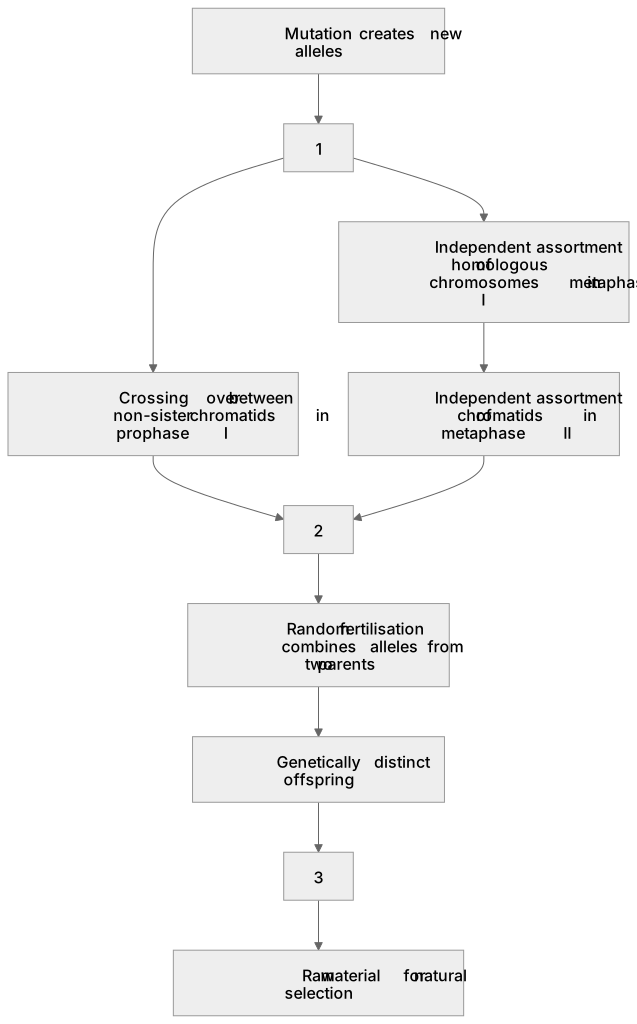
Some boxes have lost their names. Pick the right name for each number.
1Box 1
2Box 2
3Box 3
There is more to this lesson
The full lesson goes on to check your understanding and help you earn the marks. Create a free account to carry on, with your progress saved.
A week of Premium from your first lesson · Then the free plan continues · No card, no charge
Test your understanding of Patterns of inheritance: (ii) how sexual reproduction can lead to genetic variation within a species
Active recall beats re-reading. Take an instant quiz now to test what you’ve learned and lock it into long-term memory.
A week of Premium from your first lesson · Then the free plan continues · No card, no charge