OCR · A-Level · Biology
Course version: H420 · Version from Sept 2025
(e) the factors that can affect the evolution of a species
Full specification wording
Patterns of inheritance: (e) the factors that can affect the evolution of a species
Evolution is a change in allele frequencies in a population over generations.
Checked against the OCR H420 specification (opens in a new tab) on .
- Point 7 of 10
- 4 key terms
Study notes
From the checked teaching notes for this specification point.
The idea
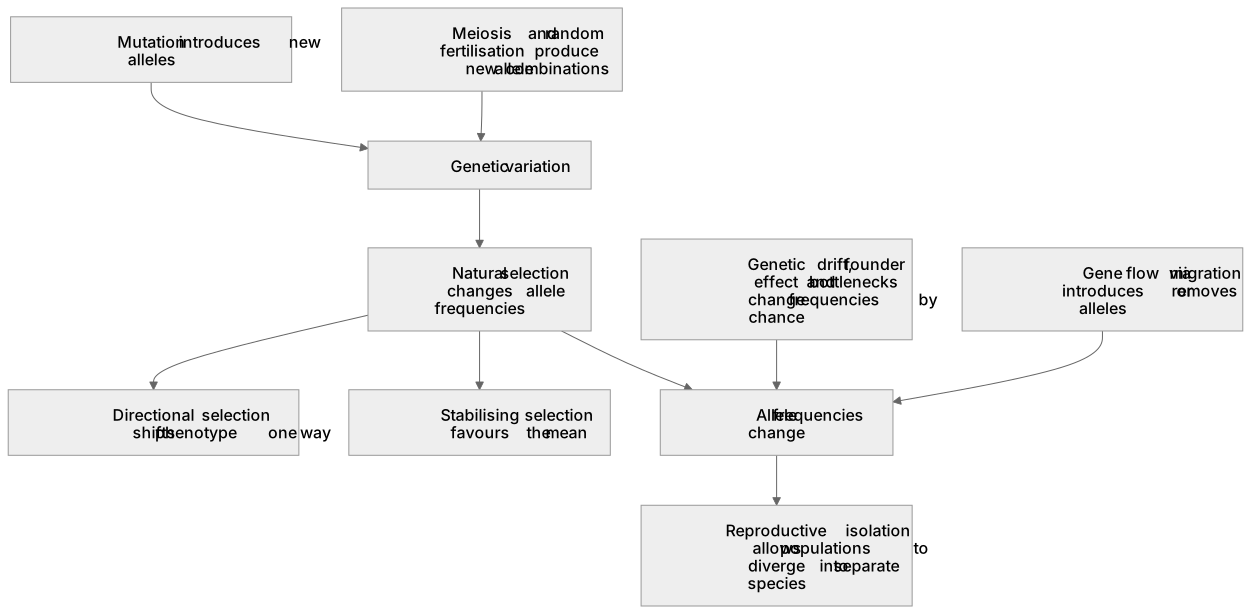
Evolution is a change in allele frequencies in a population over generations. Several factors drive or constrain it. Mutation creates new alleles and so provides the genetic variation on which selection acts. Meiosis, including crossing over and independent assortment, and random fertilisation reshuffle alleles into new combinations. Natural selection then changes allele frequencies when heritable variation affects survival and reproduction: individuals with advantageous alleles reproduce more, passing those alleles on. Directional selection shifts a phenotype in one direction; stabilising selection favours the mean and reduces extremes. Genetic drift, especially in small populations, changes frequencies by chance rather than by fitness, and the founder effect and bottlenecks reduce variation. Gene flow through migration between populations can introduce or remove alleles.
What earns the marks
- Mutation introduces new alleles, increasing genetic variation that selection can act on.
- Meiosis (crossing over and independent assortment) and random fertilisation produce new allele combinations in offspring.
- Natural selection changes allele frequencies when heritable variation affects survival and reproductive success.
- Directional selection shifts the phenotype in one direction; stabilising selection favours the mean phenotype.
- Genetic drift, founder effect and bottlenecks change allele frequencies by chance, especially in small populations.
- Gene flow via migration between populations can introduce or remove alleles.
- Reproductive isolation prevents interbreeding and allows populations to diverge into separate species.
Common mistakes and how to put them right
Thinking evolution happens to an individual during its lifetime.
Put it right: Evolution is a change in allele frequencies in a population across generations.
Confusing genetic drift with natural selection.
Put it right: Drift is a chance change in allele frequency, not driven by fitness differences.
Assuming mutation is always harmful.
Put it right: Mutations may be neutral, harmful or advantageous, and are the ultimate source of new alleles.
Believing selection acts directly on genotype.
Put it right: Selection acts on the phenotype, which reflects the genotype and environment.
Exam tips
- Name the specific factor (mutation, selection, drift, gene flow, isolation) rather than writing 'evolution' vaguely.
- State the direction of effect on allele frequency, for example 'increases the frequency of the advantageous allele'.
- Link each factor to variation and to reproductive success to show the mechanism.
Try the lesson
The start of the Patterns of inheritance: (e) the factors that can affect the evolution of a species lesson, made from checked teaching notes for this specification point.
Have a go first
A farmer repeatedly sprays a field with an insecticide, and after several years many insects survive the spray. Which factor best explains the rise in resistant insects?
Listen
Evolution is a change in allele frequencies in a population over generations. Several factors drive or constrain it. Mutation creates new alleles and so provides the genetic variation on which selection acts. Meiosis, including crossing over and independent assortment, and random fertilisation reshuffle alleles into new combinations. Natural selection then changes allele frequencies when heritable variation affects survival and reproduction: individuals with advantageous alleles reproduce more, passing those alleles on. Directional selection shifts a phenotype in one direction; stabilising selection favours the mean and reduces extremes. Genetic drift, especially in small populations, changes frequencies by chance rather than by fitness, and the founder effect and bottlenecks reduce variation. Gene flow through migration between populations can introduce or remove alleles. A strong answer earns marks for these points. Mutation introduces new alleles, increasing genetic variation that selection can act on. Meiosis (crossing over and independent assortment) and random fertilisation produce new allele combinations in offspring. Natural selection changes allele frequencies when heritable variation affects survival and reproductive success. Directional selection shifts the phenotype in one direction; stabilising selection favours the mean phenotype. A common slip: Thinking evolution happens to an individual during its lifetime. Instead, evolution is a change in allele frequencies in a population across generations. Exam tip: Name the specific factor (mutation, selection, drift, gene flow, isolation) rather than writing 'evolution' vaguely.
See it
Key words
Say what each word means before you turn the card.
Mutation
Try answering aloud or in your head before turning the card.
Natural selection
Try answering aloud or in your head before turning the card.
Genetic drift
Try answering aloud or in your head before turning the card.
Gene flow
Try answering aloud or in your head before turning the card.
See every definition
- Mutation
- Creates new alleles and so provides the genetic variation on which selection acts.
- Natural selection
- Changes allele frequencies when heritable variation affects survival and reproduction, as individuals with advantageous alleles reproduce more and pass those alleles on.
- Genetic drift
- Changes allele frequencies by chance rather than by fitness, especially in small populations.
- Gene flow
- Migration between populations that can introduce or remove alleles.
Label the diagram
Some boxes have lost their names. Pick the right name for each number.
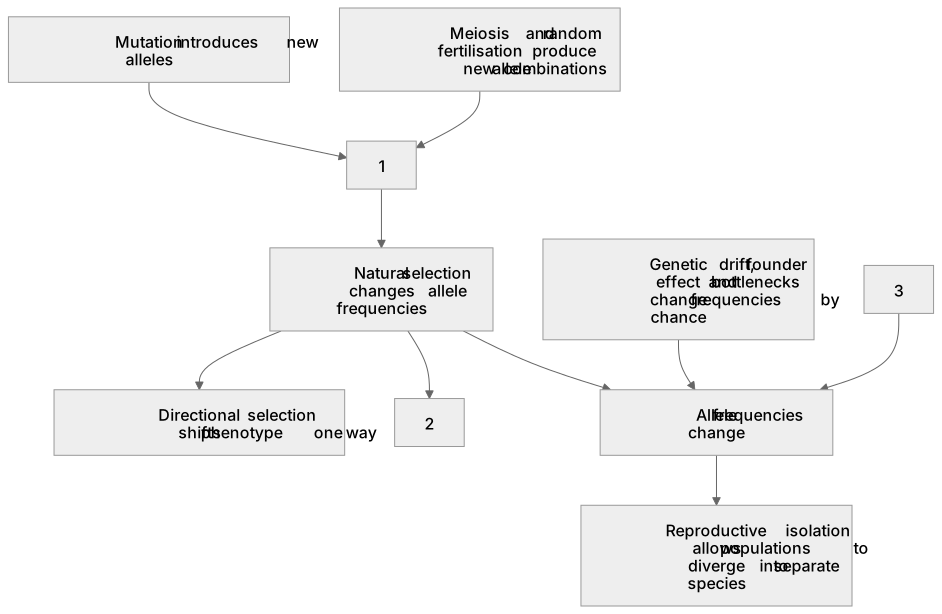
1Box 1
2Box 2
3Box 3
There is more to this lesson
The full lesson goes on to check your understanding and help you earn the marks. Create a free account to carry on, with your progress saved.
A week of Premium from your first lesson · Then the free plan continues · No card, no charge
Test your understanding of Patterns of inheritance: (e) the factors that can affect the evolution of a species
Active recall beats re-reading. Take an instant quiz now to test what you’ve learned and lock it into long-term memory.
A week of Premium from your first lesson · Then the free plan continues · No card, no charge