OCR · A-Level · Biology
Course version: H420 · Version from Sept 2025
(f) the use of the Hardy–Weinberg principle to calculate allele…
Full specification wording
Patterns of inheritance: (f) the use of the Hardy–Weinberg principle to calculate allele frequencies in populations
The Hardy–Weinberg principle models allele and genotype frequencies in an idealised population that is large, randomly mating, with no mutation, no migration and no selection.
Checked against the OCR H420 specification (opens in a new tab) on .
- Point 8 of 10
- 4 key terms
Study notes
From the checked teaching notes for this specification point.
The idea
The Hardy–Weinberg principle models allele and genotype frequencies in an idealised population that is large, randomly mating, with no mutation, no migration and no selection. For a gene with two alleles, let the dominant allele frequency be p and the recessive allele frequency be q, so p + q = 1. Genotype frequencies are then p² (homozygous dominant), 2pq (heterozygous) and q² (homozygous recessive), summing to 1. To calculate allele frequencies, start from the observable recessive phenotype frequency, which equals q²; take its square root to obtain q, then p = 1 − q. For example, if 9% of a population shows the recessive phenotype, q² = 0.09, so q = 0.3 and p = 0.7. Allele frequencies are proportions of the gene pool, not counts of individuals, and results are estimates valid only while the assumptions hold.
What earns the marks
- States that for two alleles p + q = 1, where p and q are the frequencies of the dominant and recessive alleles.
- States that genotype frequencies are p² for homozygous dominant, 2pq for heterozygous and q² for homozygous recessive, summing to 1.
- Identifies that the frequency of the recessive phenotype equals q², so q is the square root of that frequency.
- Calculates p as 1 − q after finding q, and can convert a proportion to a percentage or vice versa.
- Recognises that the calculation gives estimated allele frequencies and depends on assumptions such as a large population, random mating and no selection, mutation or migration.
Common mistakes and how to put them right
Treating the recessive phenotype frequency directly as q rather than q².
Put it right: Take the square root first.
Assuming the dominant phenotype frequency equals p² when it actually equals p² + 2pq.
Put it right: Use the recessive phenotype to find q².
Reporting allele frequencies as whole numbers of individuals.
Put it right: Frequencies are proportions of the gene pool between 0 and 1 (or percentages).
Forgetting that p + q must equal 1 and producing values that do not sum correctly.
Put it right: Check the sum after calculating.
Exam tips
- Write down p + q = 1 and p² + 2pq + q² = 1 before substituting numbers, so the algebra is visible.
- Identify which phenotype frequency is given and decide whether it corresponds to q² or to p² + 2pq before calculating.
- Keep frequencies as decimals through the working and only convert to a percentage at the end, checking that p + q = 1.
Try the lesson
The start of the Patterns of inheritance: (f) the use of the Hardy–Weinberg principle to calculate allele frequencies in populations lesson, made from checked teaching notes for this specification point.
Have a go first
In a Hardy–Weinberg population the dominant allele frequency p is 0.6. What is the frequency of the recessive allele q?
Listen
The Hardy–Weinberg principle models allele and genotype frequencies in an idealised population that is large, randomly mating, with no mutation, no migration and no selection. For a gene with two alleles, let the dominant allele frequency be p and the recessive allele frequency be q, so p + q = 1. Genotype frequencies are then p² (homozygous dominant), 2pq (heterozygous) and q² (homozygous recessive), summing to 1. To calculate allele frequencies, start from the observable recessive phenotype frequency, which equals q²; take its square root to obtain q, then p = 1 − q. For example, if 9% of a population shows the recessive phenotype, q² = 0.09, so q = 0.3 and p = 0.7. Allele frequencies are proportions of the gene pool, not counts of individuals, and results are estimates valid only while the assumptions hold. A strong answer earns marks for these points. States that for two alleles p + q = 1, where p and q are the frequencies of the dominant and recessive alleles. States that genotype frequencies are p² for homozygous dominant, 2pq for heterozygous and q² for homozygous recessive, summing to 1. Identifies that the frequency of the recessive phenotype equals q², so q is the square root of that frequency. Calculates p as 1 − q after finding q, and can convert a proportion to a percentage or vice versa. A common slip: Treating the recessive phenotype frequency directly as q rather than q². Instead, take the square root first. Exam tip: Write down p + q = 1 and p² + 2pq + q² = 1 before substituting numbers, so the algebra is visible.
See it
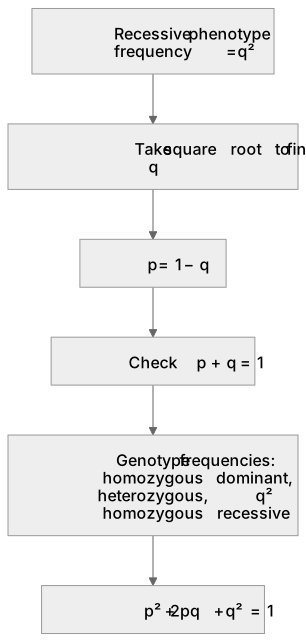
Put it in order
Put these steps in the order they happen.
- 1. p = 1 − q
- 2. Take square root to find q
- 3. Recessive phenotype frequency = q²
- 4. p² + 2pq + q² = 1
- 5. Genotype frequencies: p² homozygous dominant, 2pq heterozygous, q² homozygous recessive
- 6. Check p + q = 1
Key words
Say what each word means before you turn the card.
Hardy–Weinberg principle
Try answering aloud or in your head before turning the card.
Allele frequencies
Try answering aloud or in your head before turning the card.
Genotype frequencies
Try answering aloud or in your head before turning the card.
Recessive phenotype frequency
Try answering aloud or in your head before turning the card.
See every definition
- Hardy–Weinberg principle
- Models allele and genotype frequencies in an idealised population that is large, randomly mating, with no mutation, no migration and no selection.
- Allele frequencies
- Proportions of the gene pool, where for two alleles p + q = 1, with p the dominant and q the recessive allele frequency.
- Genotype frequencies
- p² for homozygous dominant, 2pq for heterozygous and q² for homozygous recessive, summing to 1.
- Recessive phenotype frequency
- Equals q², so q is the square root of that frequency and p is then found as 1 − q.
Label the diagram
Some boxes have lost their names. Pick the right name for each number.
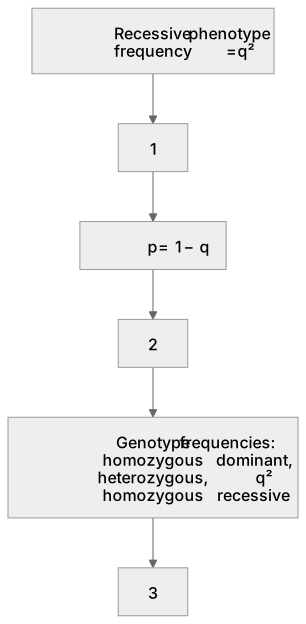
1Box 1
2Box 2
3Box 3
There is more to this lesson
The full lesson goes on to check your understanding and help you earn the marks. Create a free account to carry on, with your progress saved.
A week of Premium from your first lesson · Then the free plan continues · No card, no charge
Test your understanding of Patterns of inheritance: (f) the use of the Hardy–Weinberg principle to calculate allele frequencies in populations
Active recall beats re-reading. Take an instant quiz now to test what you’ve learned and lock it into long-term memory.
A week of Premium from your first lesson · Then the free plan continues · No card, no charge