OCR · A-Level · Biology
Course version: H420 · Version from Sept 2025
(h) (i) the principles of artificial selection and its uses
Full specification wording
Patterns of inheritance: (h) (i) the principles of artificial selection and its uses
Artificial selection is selective breeding in which humans choose which individuals reproduce, so allele frequencies in the population shift towards desired phenotypes.
Checked against the OCR H420 specification (opens in a new tab) on .
- Point 10 of 10
- 4 key terms
Study notes
From the checked teaching notes for this specification point.
The idea
Artificial selection is selective breeding in which humans choose which individuals reproduce, so allele frequencies in the population shift towards desired phenotypes. The principles: heritable variation must exist in the trait; humans identify individuals with the desired phenotype and use them as parents; offspring vary, so selection is repeated over successive generations; the population's gene pool changes as favoured alleles increase. Selection is directional towards a human-defined goal, not an environmental one. Uses include increasing crop yield, improving disease resistance in livestock, producing high-yielding dairy cattle, and developing breeds or varieties with particular traits.
What earns the marks
- Heritable variation in the trait must already exist in the population before selection can act.
- Humans select which individuals become parents, based on a desired phenotype, rather than the environment doing so.
- Selected parents pass on alleles, so the frequency of favourable alleles increases over successive generations.
- Selection is repeated across many generations, producing cumulative change in the population.
- Artificial selection is directional towards a human-defined goal, unlike natural selection which follows environmental pressures.
- Uses include improving crop yield, disease resistance, livestock productivity and particular breed or variety traits.
Common mistakes and how to put them right
Thinking artificial selection creates new variation.
Put it right: Variation must already exist; selection only changes allele frequencies.
Confusing artificial with natural selection.
Put it right: In artificial selection humans choose the parents; in natural selection the environment determines survival and reproduction.
Assuming one round of breeding is enough.
Put it right: Cumulative change requires repeated selection over many generations.
Exam tips
- State clearly that humans choose the breeding parents and explain why that changes allele frequencies.
- Link each use to a specific desired trait rather than saying only 'better crops' or 'better animals'.
- Contrast artificial with natural selection in one sentence to show understanding of the selecting agent.
Try the lesson
The start of the Patterns of inheritance: (h) (i) the principles of artificial selection and its uses lesson, made from checked teaching notes for this specification point.
Have a go first
In artificial selection, which individuals are chosen to breed in the next generation?
Listen
Artificial selection is selective breeding in which humans choose which individuals reproduce, so allele frequencies in the population shift towards desired phenotypes. The principles: heritable variation must exist in the trait; humans identify individuals with the desired phenotype and use them as parents; offspring vary, so selection is repeated over successive generations; the population's gene pool changes as favoured alleles increase. Selection is directional towards a human-defined goal, not an environmental one. Uses include increasing crop yield, improving disease resistance in livestock, producing high-yielding dairy cattle, and developing breeds or varieties with particular traits. A strong answer earns marks for these points. Heritable variation in the trait must already exist in the population before selection can act. Humans select which individuals become parents, based on a desired phenotype, rather than the environment doing so. Selected parents pass on alleles, so the frequency of favourable alleles increases over successive generations. Selection is repeated across many generations, producing cumulative change in the population. A common slip: Thinking artificial selection creates new variation. Instead, variation must already exist; selection only changes allele frequencies. Exam tip: State clearly that humans choose the breeding parents and explain why that changes allele frequencies.
See it
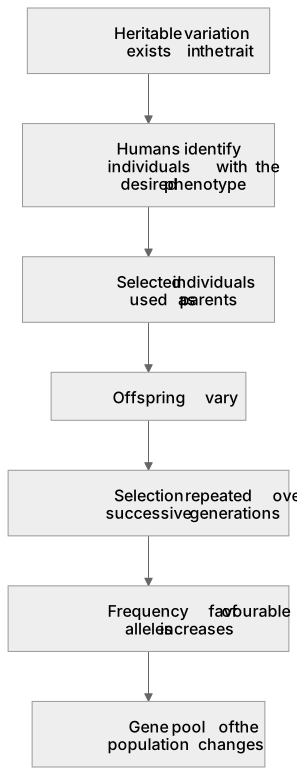
Put it in order
Put these steps in the order they happen.
- 1. Gene pool of the population changes
- 2. Frequency of favourable alleles increases
- 3. Selected individuals used as parents
- 4. Selection repeated over successive generations
- 5. Heritable variation exists in the trait
- 6. Humans identify individuals with the desired phenotype
- 7. Offspring vary
Key words
Say what each word means before you turn the card.
Heritable variation
Try answering aloud or in your head before turning the card.
Human-directed choice of breeding parents
Try answering aloud or in your head before turning the card.
Change in allele frequency over generations
Try answering aloud or in your head before turning the card.
Practical applications in agriculture and livestock
Try answering aloud or in your head before turning the card.
See every definition
- Heritable variation
- Variation in the trait that must already exist in the population before selection can act.
- Human-directed choice of breeding parents
- Humans identify individuals with the desired phenotype and use them as parents, rather than the environment doing so.
- Change in allele frequency over generations
- Selected parents pass on alleles, so the frequency of favourable alleles increases over successive generations.
- Practical applications in agriculture and livestock
- Uses include increasing crop yield, improving disease resistance in livestock, producing high-yielding dairy cattle, and developing breeds or varieties with particular traits.
Label the diagram
Some boxes have lost their names. Pick the right name for each number.
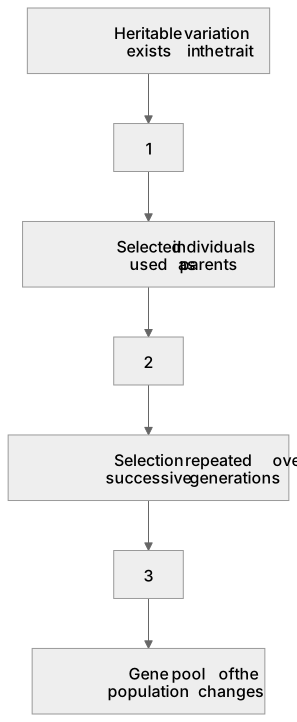
1Box 1
2Box 2
3Box 3
There is more to this lesson
The full lesson goes on to check your understanding and help you earn the marks. Create a free account to carry on, with your progress saved.
A week of Premium from your first lesson · Then the free plan continues · No card, no charge
Test your understanding of Patterns of inheritance: (h) (i) the principles of artificial selection and its uses
Active recall beats re-reading. Take an instant quiz now to test what you’ve learned and lock it into long-term memory.
A week of Premium from your first lesson · Then the free plan continues · No card, no charge