OCR · A-Level · Biology
Course version: H420 · Version from Sept 2025
(g) the role of isolating mechanisms in the evolution of new species
Full specification wording
Patterns of inheritance: (g) the role of isolating mechanisms in the evolution of new species
Speciation occurs when populations become reproductively isolated so that gene flow between them stops.
Checked against the OCR H420 specification (opens in a new tab) on .
- Point 9 of 10
- 4 key terms
Study notes
From the checked teaching notes for this specification point.
The idea
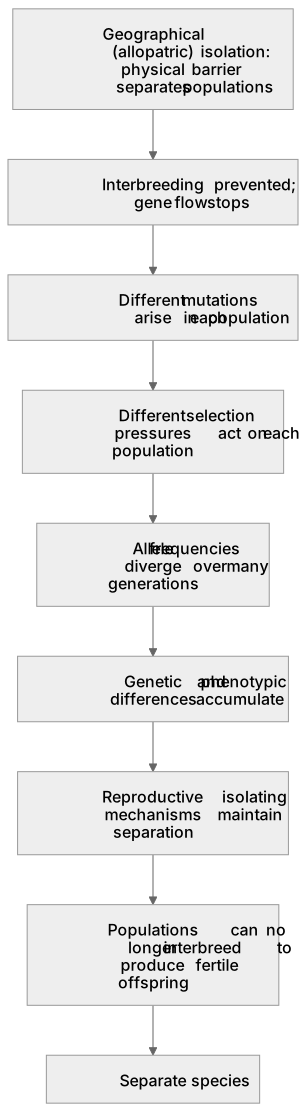
Speciation occurs when populations become reproductively isolated so that gene flow between them stops. Isolating mechanisms prevent interbreeding and so allow the separated gene pools to diverge. Geographical (allopatric) isolation, such as a river or mountain range separating populations, is a common starting point. Once separated, different mutations arise in each population, and natural selection acts differently where environments or selection pressures differ, changing allele frequencies. Over many generations the populations accumulate enough genetic and phenotypic difference that they can no longer interbreed to produce fertile offspring, so they are separate species.
What earns the marks
- States that speciation requires reproductive isolation so that gene flow between populations stops.
- Describes geographical (allopatric) isolation, where a physical barrier separates populations and prevents interbreeding.
- Explains that separated populations experience different selection pressures and accumulate different mutations, so allele frequencies diverge.
- Identifies reproductive isolating mechanisms such as temporal, behavioural or mechanical isolation, or hybrid infertility, that maintain separation.
- Concludes that accumulated differences eventually prevent the populations producing fertile offspring, so they become separate species.
Common mistakes and how to put them right
Confusing geographical isolation with reproductive isolation.
Put it right: A physical barrier starts separation but reproductive isolation is what maintains separate gene pools.
Claiming that individual organisms evolve or choose to change.
Put it right: Allele frequencies in populations change over generations through selection.
Assuming isolation alone creates a new species immediately.
Put it right: Divergence through mutation and selection over many generations is required.
Treating all isolating mechanisms as geographical.
Put it right: Recognise temporal, behavioural and mechanical reproductive barriers too.
Exam tips
- Use the sequence: isolation, no gene flow, different selection pressures, allele frequency change, reproductive isolation, new species.
- Name a specific isolating mechanism and explain how it prevents interbreeding rather than just naming it.
- Link divergence explicitly to mutation and natural selection acting on each population's gene pool.
Try the lesson
The start of the Patterns of inheritance: (g) the role of isolating mechanisms in the evolution of new species lesson, made from checked teaching notes for this specification point.
Have a go first
Two populations of the same species become separated by a river and can no longer interbreed. Which type of isolating mechanism does the river represent?
Listen
Speciation occurs when populations become reproductively isolated so that gene flow between them stops. Isolating mechanisms prevent interbreeding and so allow the separated gene pools to diverge. Geographical (allopatric) isolation, such as a river or mountain range separating populations, is a common starting point. Once separated, different mutations arise in each population, and natural selection acts differently where environments or selection pressures differ, changing allele frequencies. Over many generations the populations accumulate enough genetic and phenotypic difference that they can no longer interbreed to produce fertile offspring, so they are separate species. A strong answer earns marks for these points. States that speciation requires reproductive isolation so that gene flow between populations stops. Describes geographical (allopatric) isolation, where a physical barrier separates populations and prevents interbreeding. Explains that separated populations experience different selection pressures and accumulate different mutations, so allele frequencies diverge. Identifies reproductive isolating mechanisms such as temporal, behavioural or mechanical isolation, or hybrid infertility, that maintain separation. A common slip: Confusing geographical isolation with reproductive isolation. Instead, a physical barrier starts separation but reproductive isolation is what maintains separate gene pools. Exam tip: Use the sequence: isolation, no gene flow, different selection pressures, allele frequency change, reproductive isolation, new species.
See it
Key words
Say what each word means before you turn the card.
Reproductive isolation
Try answering aloud or in your head before turning the card.
Allopatric (geographical) isolation
Try answering aloud or in your head before turning the card.
Divergence through mutation and natural selection
Try answering aloud or in your head before turning the card.
Reproductive isolating mechanisms and speciation
Try answering aloud or in your head before turning the card.
See every definition
- Reproductive isolation
- A state in which populations are prevented from interbreeding so that gene flow between them stops.
- Allopatric (geographical) isolation
- A physical barrier, such as a river or mountain range, separates populations and prevents interbreeding.
- Divergence through mutation and natural selection
- Separated populations accumulate different mutations and experience different selection pressures, so allele frequencies diverge.
- Reproductive isolating mechanisms and speciation
- Mechanisms such as temporal, behavioural or mechanical isolation, or hybrid infertility, maintain separation until populations can no longer produce fertile offspring and become separate species.
Label the diagram
Some boxes have lost their names. Pick the right name for each number.
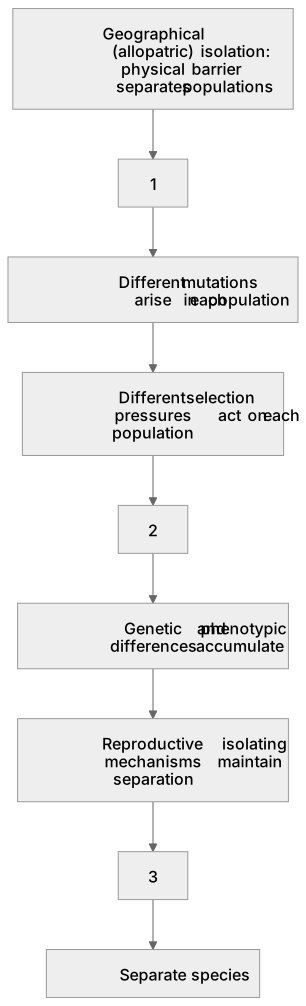
1Box 1
2Box 2
3Box 3
There is more to this lesson
The full lesson goes on to check your understanding and help you earn the marks. Create a free account to carry on, with your progress saved.
A week of Premium from your first lesson · Then the free plan continues · No card, no charge
Test your understanding of Patterns of inheritance: (g) the role of isolating mechanisms in the evolution of new species
Active recall beats re-reading. Take an instant quiz now to test what you’ve learned and lock it into long-term memory.
A week of Premium from your first lesson · Then the free plan continues · No card, no charge