OCR · A-Level · Biology
Course version: H420 · Version from Sept 2025
(ii) the use of phenotypic ratios to identify linkage (autosomal and sex…
Full specification wording
Patterns of inheritance: (ii) the use of phenotypic ratios to identify linkage (autosomal and sex linkage) and epistasis
Phenotypic ratios from genetic crosses act as a diagnostic tool.
Checked against the OCR H420 specification (opens in a new tab) on .
- Point 4 of 10
- 4 key terms
Study notes
From the checked teaching notes for this specification point.
The idea
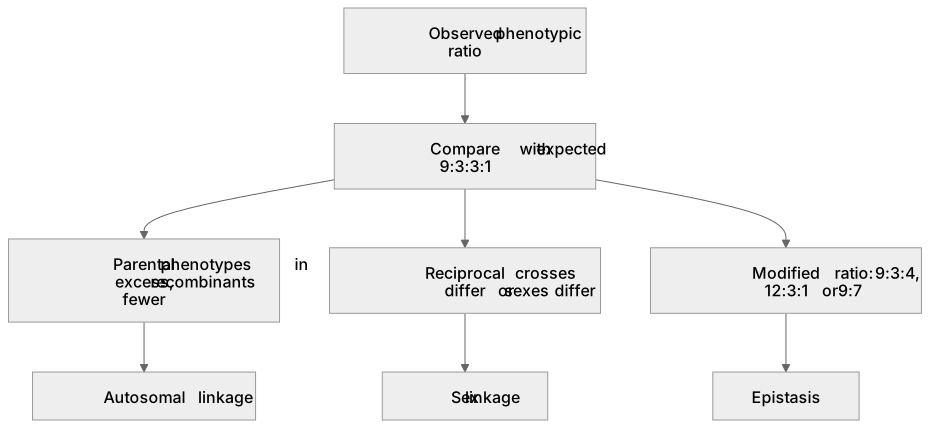
Phenotypic ratios from genetic crosses act as a diagnostic tool. For two genes on different chromosomes, independent assortment gives the familiar 9:3:3:1 ratio in a dihybrid F₂. When the genes are linked on the same autosome, parental allele combinations tend to be inherited together, so the offspring ratio departs from 9:3:3:1 and shows an excess of the two parental phenotypes with fewer recombinant types. Sex linkage is revealed when reciprocal crosses give different results and when phenotype frequencies differ between the sexes, because males carry one X and express X-linked alleles directly. Epistasis occurs when one gene masks or modifies another; a 9:3:4, 12:3:1 or 9:7 ratio signals interaction rather than independent assortment.
What earns the marks
- Independent assortment of two unlinked genes in a dihybrid cross gives an expected 9:3:3:1 phenotypic ratio in the F₂ generation.
- Linkage on the same autosome reduces recombination, so parental phenotypes appear in excess and the ratio deviates from 9:3:3:1, with recombinant classes fewer.
- Sex linkage is identified when reciprocal crosses differ or when phenotype frequencies differ between males and females, because males express a single X-linked allele.
- Epistasis is identified by a modified ratio such as 9:3:4, 12:3:1 or 9:7, showing one gene masking or altering the expression of another.
- Comparing observed ratios with the expected independent-assortment ratio allows the cause (linkage, sex linkage or epistasis) to be distinguished.
Common mistakes and how to put them right
Assuming any departure from 9:3:3:1 means epistasis.
Put it right: Is to check first whether parental classes dominate (linkage) or whether the sexes differ (sex linkage) before concluding epistasis.
Treating a 3:1 ratio as proof of linkage.
Put it right: Is that 3:1 arises from a monohybrid cross of one gene and says nothing about linkage between two genes.
Ignoring sex when analysing ratios.
Put it right: Is to tabulate male and female offspring separately, since unequal sex frequencies indicate sex linkage.
Believing linked genes always give a fixed ratio.
Put it right: Is that recombination frequency varies, so the ratio shifts with crossing over rather than being a single constant value.
Exam tips
- State the expected ratio for independent assortment first, then describe how the observed ratio departs from it.
- When a ratio is given, name the specific modified ratio (for example 9:3:4) and link it to the mechanism it indicates.
- For sex linkage, explicitly compare phenotype numbers in males and females rather than only totals.
Try the lesson
The start of the Patterns of inheritance: (ii) the use of phenotypic ratios to identify linkage (autosomal and sex linkage) and epistasis lesson, made from checked teaching notes for this specification point.
Have a go first
A cross produces offspring in a ratio of 9:3:4 instead of 9:3:3:1. What does this modified ratio indicate?
Listen
Phenotypic ratios from genetic crosses act as a diagnostic tool. For two genes on different chromosomes, independent assortment gives the familiar 9:3:3:1 ratio in a dihybrid F₂. When the genes are linked on the same autosome, parental allele combinations tend to be inherited together, so the offspring ratio departs from 9:3:3:1 and shows an excess of the two parental phenotypes with fewer recombinant types. Sex linkage is revealed when reciprocal crosses give different results and when phenotype frequencies differ between the sexes, because males carry one X and express X-linked alleles directly. Epistasis occurs when one gene masks or modifies another; a 9:3:4, 12:3:1 or 9:7 ratio signals interaction rather than independent assortment. A strong answer earns marks for these points. Independent assortment of two unlinked genes in a dihybrid cross gives an expected 9:3:3:1 phenotypic ratio in the F₂ generation. Linkage on the same autosome reduces recombination, so parental phenotypes appear in excess and the ratio deviates from 9:3:3:1, with recombinant classes fewer. Sex linkage is identified when reciprocal crosses differ or when phenotype frequencies differ between males and females, because males express a single X-linked allele. Epistasis is identified by a modified ratio such as 9:3:4, 12:3:1 or 9:7, showing one gene masking or altering the expression of another. A common slip: Assuming any departure from 9:3:3:1 means epistasis. Instead, is to check first whether parental classes dominate (linkage) or whether the sexes differ (sex linkage) before concluding epistasis. Exam tip: State the expected ratio for independent assortment first, then describe how the observed ratio departs from it.
See it
Key words
Say what each word means before you turn the card.
Independent assortment
Try answering aloud or in your head before turning the card.
Autosomal linkage
Try answering aloud or in your head before turning the card.
Sex linkage
Try answering aloud or in your head before turning the card.
Epistasis
Try answering aloud or in your head before turning the card.
See every definition
- Independent assortment
- Two genes on different chromosomes give the familiar 9:3:3:1 ratio in a dihybrid F₂.
- Autosomal linkage
- Genes linked on the same autosome tend to be inherited together, so the ratio departs from 9:3:3:1 with an excess of the two parental phenotypes and fewer recombinant types.
- Sex linkage
- Revealed when reciprocal crosses give different results and when phenotype frequencies differ between the sexes, because males carry one X and express X-linked alleles directly.
- Epistasis
- Occurs when one gene masks or modifies another, signalled by a 9:3:4, 12:3:1 or 9:7 ratio rather than independent assortment.
Label the diagram
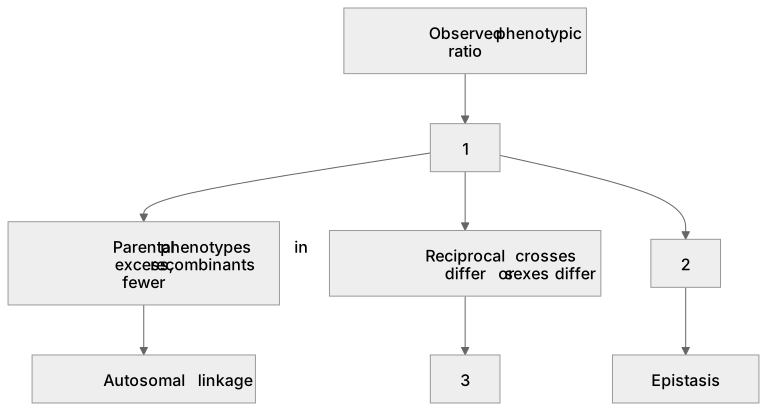
Some boxes have lost their names. Pick the right name for each number.
1Box 1
2Box 2
3Box 3
There is more to this lesson
The full lesson goes on to check your understanding and help you earn the marks. Create a free account to carry on, with your progress saved.
A week of Premium from your first lesson · Then the free plan continues · No card, no charge
Test your understanding of Patterns of inheritance: (ii) the use of phenotypic ratios to identify linkage (autosomal and sex linkage) and epistasis
Active recall beats re-reading. Take an instant quiz now to test what you’ve learned and lock it into long-term memory.
A week of Premium from your first lesson · Then the free plan continues · No card, no charge