OCR · A-Level · Biology
Course version: H420 · Version from Sept 2025
(b) the structure of a chloroplast and the sites of the two main stages of…
Full specification wording
Photosynthesis: (b) the structure of a chloroplast and the sites of the two main stages of photosynthesis
A chloroplast is a lens-shaped organelle bounded by a double membrane, the envelope.
Checked against the OCR H420 specification (opens in a new tab) on .
- Point 2 of 9
- 4 key terms
Study notes
From the checked teaching notes for this specification point.
The idea
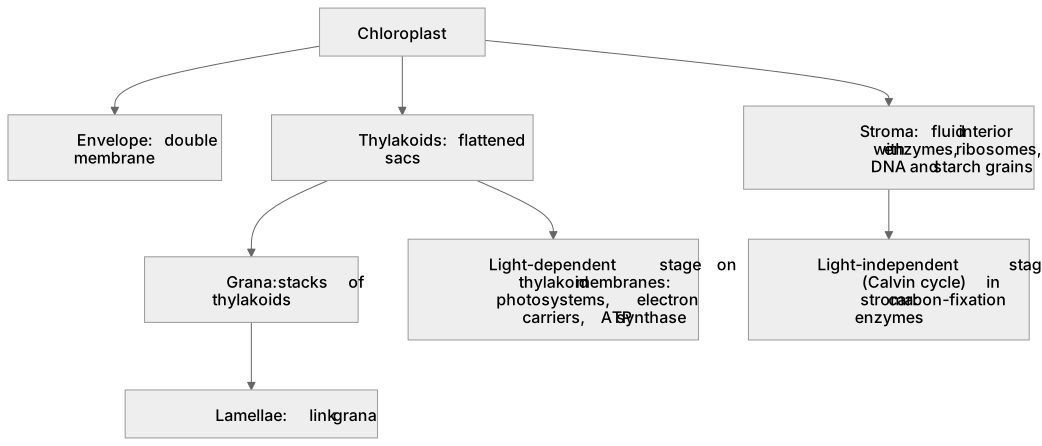
A chloroplast is a lens-shaped organelle bounded by a double membrane, the envelope. Its interior is filled with stroma, a fluid containing enzymes, ribosomes, DNA and starch grains. A third membrane system, the thylakoids, forms flattened sacs; stacked thylakoids are grana, and grana are joined by lamellae. The two main stages occur in different compartments. The light-dependent stage happens on the thylakoid membranes, where photosystems, electron carriers and ATP synthase are embedded. The light-independent stage (the Calvin cycle) happens in the stroma, where the enzymes for carbon fixation are located. So a question may ask which structure houses a named process, or which feature is absent from a given compartment. Match each process to its membrane or fluid, and remember the envelope is distinct from the thylakoid membranes.
What earns the marks
- The chloroplast is enclosed by a double membrane called the envelope.
- The stroma is the fluid interior containing enzymes, ribosomes, DNA and starch grains.
- Thylakoids are flattened sacs; stacks of thylakoids are grana, linked by lamellae.
- The light-dependent stage occurs on the thylakoid membranes, which hold photosystems, electron carriers and ATP synthase.
- The light-independent stage (Calvin cycle) occurs in the stroma, where carbon-fixation enzymes are found.
Common mistakes and how to put them right
Placing the light-independent stage on the thylakoid membranes.
Put it right by locating the Calvin cycle in the stroma.
Confusing the envelope with the thylakoid membranes.
Put it right: State that the envelope is the outer double membrane, separate from the internal thylakoids.
Describing grana as separate from thylakoids.
Put it right by saying grana are stacks of thylakoids joined by lamellae.
Exam tips
- Read the stem to see whether it asks for a structure or a site of a named stage, then match precisely.
- Eliminate options that swap the two compartments (thylakoid versus stroma) before choosing.
- Recall that the envelope is a double membrane, not a single one, when judging options.
Try the lesson
The start of the Photosynthesis: (b) the structure of a chloroplast and the sites of the two main stages of photosynthesis lesson, made from checked teaching notes for this specification point.
Have a go first
In a chloroplast, in which part does the light-dependent stage of photosynthesis take place?
Listen
A chloroplast is a lens-shaped organelle bounded by a double membrane, the envelope. Its interior is filled with stroma, a fluid containing enzymes, ribosomes, DNA and starch grains. A third membrane system, the thylakoids, forms flattened sacs; stacked thylakoids are grana, and grana are joined by lamellae. The two main stages occur in different compartments. The light-dependent stage happens on the thylakoid membranes, where photosystems, electron carriers and ATP synthase are embedded. The light-independent stage (the Calvin cycle) happens in the stroma, where the enzymes for carbon fixation are located. So a question may ask which structure houses a named process, or which feature is absent from a given compartment. Match each process to its membrane or fluid, and remember the envelope is distinct from the thylakoid membranes. A strong answer earns marks for these points. The chloroplast is enclosed by a double membrane called the envelope. The stroma is the fluid interior containing enzymes, ribosomes, DNA and starch grains. Thylakoids are flattened sacs; stacks of thylakoids are grana, linked by lamellae. The light-dependent stage occurs on the thylakoid membranes, which hold photosystems, electron carriers and ATP synthase. A common slip: Placing the light-independent stage on the thylakoid membranes. Instead, locating the Calvin cycle in the stroma. Exam tip: Read the stem to see whether it asks for a structure or a site of a named stage, then match precisely.
See it
Key words
Say what each word means before you turn the card.
Chloroplast ultrastructure
Try answering aloud or in your head before turning the card.
Compartmentalisation of photosynthesis
Try answering aloud or in your head before turning the card.
Light-dependent stage on thylakoid membranes
Try answering aloud or in your head before turning the card.
Calvin cycle in the stroma
Try answering aloud or in your head before turning the card.
See every definition
- Chloroplast ultrastructure
- A lens-shaped organelle bounded by a double membrane called the envelope, with a fluid interior called the stroma and a third membrane system of thylakoids forming flattened sacs.
- Compartmentalisation of photosynthesis
- The two main stages occur in different compartments: the light-dependent stage on the thylakoid membranes and the light-independent stage in the stroma.
- Light-dependent stage on thylakoid membranes
- This stage happens on the thylakoid membranes, where photosystems, electron carriers and ATP synthase are embedded.
- Calvin cycle in the stroma
- The light-independent stage happens in the stroma, where the enzymes for carbon fixation are located.
Label the diagram
Some boxes have lost their names. Pick the right name for each number.
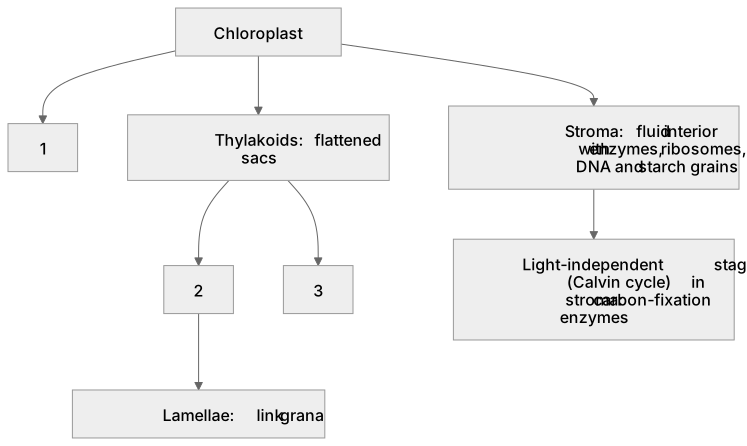
1Box 1
2Box 2
3Box 3
There is more to this lesson
The full lesson goes on to check your understanding and help you earn the marks. Create a free account to carry on, with your progress saved.
A week of Premium from your first lesson · Then the free plan continues · No card, no charge
Test your understanding of Photosynthesis: (b) the structure of a chloroplast and the sites of the two main stages of photosynthesis
Active recall beats re-reading. Take an instant quiz now to test what you’ve learned and lock it into long-term memory.
A week of Premium from your first lesson · Then the free plan continues · No card, no charge