OCR · A-Level · Biology
Course version: H420 · Version from Sept 2025
(g) the organisation of the mammalian nervous system
Full specification wording
Plant and animal responses: (g) the organisation of the mammalian nervous system
The mammalian nervous system is organised into the central nervous system (CNS) — the brain and spinal cord — and the peripheral nervous system (PNS), which links the CNS to the rest of the body.
Checked against the OCR H420 specification (opens in a new tab) on .
- Point 6 of 12
- 4 key terms
Study notes
From the checked teaching notes for this specification point.
The idea
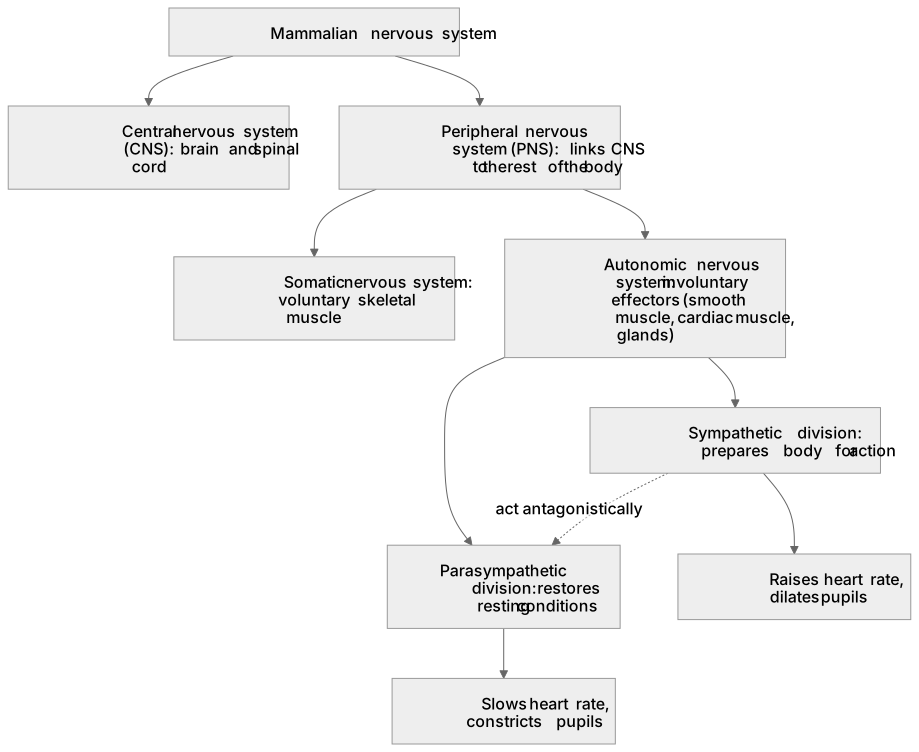
The mammalian nervous system is organised into the central nervous system (CNS) — the brain and spinal cord — and the peripheral nervous system (PNS), which links the CNS to the rest of the body. The PNS divides into the somatic nervous system, controlling voluntary skeletal muscle, and the autonomic nervous system, controlling involuntary effectors such as smooth muscle, cardiac muscle and glands. The autonomic system splits into the sympathetic division, which prepares the body for action (raising heart rate, dilating pupils), and the parasympathetic division, which restores resting conditions (slowing heart rate, constricting pupils). These two divisions act antagonistically. Sensory neurones carry impulses towards the CNS; motor neurones carry impulses away to effectors. Relay neurones connect the two within the CNS.
What earns the marks
- The CNS comprises the brain and spinal cord; the PNS comprises nerves connecting the CNS to the body.
- The somatic nervous system controls voluntary skeletal muscle; the autonomic nervous system controls involuntary effectors (smooth muscle, cardiac muscle, glands).
- The autonomic nervous system divides into sympathetic (fight-or-flight, e.g. increased heart rate) and parasympathetic (rest-and-digest, e.g. decreased heart rate) divisions, which act antagonistically.
- Sensory neurones carry impulses towards the CNS, motor neurones carry impulses away from the CNS, and relay neurones connect them within the CNS.
- A reflex arc passes receptor → sensory neurone → relay neurone (in spinal cord) → motor neurone → effector, giving a rapid protective response.
Common mistakes and how to put them right
Confusing the somatic and autonomic systems.
Put it right: Somatic controls voluntary skeletal muscle while autonomic controls involuntary effectors.
Thinking the sympathetic division calms the body.
Put it right: Sympathetic prepares for action and parasympathetic restores resting conditions.
Reversing sensory and motor neurone direction.
Put it right: Sensory neurones carry impulses towards the CNS and motor neurones away from it.
Exam tips
- Learn the CNS/PNS and somatic/autonomic/sympathetic/parasympathetic hierarchy as a labelled flow diagram.
- Link each autonomic division to a named physiological effect (heart rate, pupil diameter) to answer applied questions.
- Practise ordering the components of a reflex arc so you can identify the missing step in a diagram.
Try the lesson
The start of the Plant and animal responses: (g) the organisation of the mammalian nervous system lesson, made from checked teaching notes for this specification point.
Have a go first
Which division of the mammalian nervous system carries nerve impulses away from the central nervous system towards effectors such as muscles and glands?
Listen
The mammalian nervous system is organised into the central nervous system (CNS) — the brain and spinal cord — and the peripheral nervous system (PNS), which links the CNS to the rest of the body. The PNS divides into the somatic nervous system, controlling voluntary skeletal muscle, and the autonomic nervous system, controlling involuntary effectors such as smooth muscle, cardiac muscle and glands. The autonomic system splits into the sympathetic division, which prepares the body for action (raising heart rate, dilating pupils), and the parasympathetic division, which restores resting conditions (slowing heart rate, constricting pupils). These two divisions act antagonistically. Sensory neurones carry impulses towards the CNS; motor neurones carry impulses away to effectors. Relay neurones connect the two within the CNS. A strong answer earns marks for these points. The CNS comprises the brain and spinal cord; the PNS comprises nerves connecting the CNS to the body. The somatic nervous system controls voluntary skeletal muscle; the autonomic nervous system controls involuntary effectors (smooth muscle, cardiac muscle, glands). The autonomic nervous system divides into sympathetic (fight-or-flight, e.g. increased heart rate) and parasympathetic (rest-and-digest, e.g. decreased heart rate) divisions, which act antagonistically. Sensory neurones carry impulses towards the CNS, motor neurones carry impulses away from the CNS, and relay neurones connect them within the CNS. A common slip: Confusing the somatic and autonomic systems. Instead, somatic controls voluntary skeletal muscle while autonomic controls involuntary effectors. Exam tip: Learn the CNS/PNS and somatic/autonomic/sympathetic/parasympathetic hierarchy as a labelled flow diagram.
See it
Key words
Say what each word means before you turn the card.
Central nervous system (CNS)
Try answering aloud or in your head before turning the card.
Peripheral nervous system (PNS)
Try answering aloud or in your head before turning the card.
Autonomic nervous system
Try answering aloud or in your head before turning the card.
Sympathetic division
Try answering aloud or in your head before turning the card.
See every definition
- Central nervous system (CNS)
- The brain and spinal cord, which the peripheral nervous system links to the rest of the body.
- Peripheral nervous system (PNS)
- The nerves that link the central nervous system to the rest of the body.
- Autonomic nervous system
- The part of the peripheral nervous system controlling involuntary effectors such as smooth muscle, cardiac muscle and glands.
- Sympathetic division
- The autonomic division that prepares the body for action, raising heart rate and dilating pupils.
Label the diagram
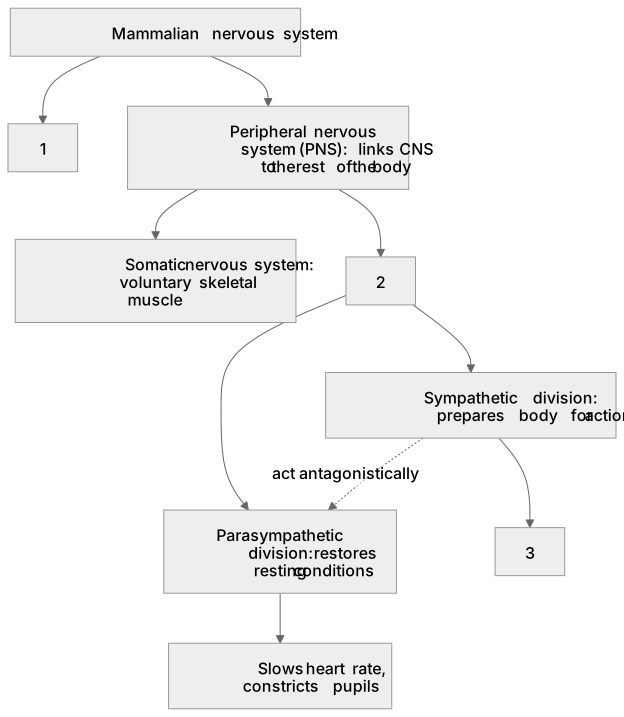
Some boxes have lost their names. Pick the right name for each number.
1Box 1
2Box 2
3Box 3
There is more to this lesson
The full lesson goes on to check your understanding and help you earn the marks. Create a free account to carry on, with your progress saved.
A week of Premium from your first lesson · Then the free plan continues · No card, no charge
Test your understanding of Plant and animal responses: (g) the organisation of the mammalian nervous system
Active recall beats re-reading. Take an instant quiz now to test what you’ve learned and lock it into long-term memory.
A week of Premium from your first lesson · Then the free plan continues · No card, no charge