OCR · A-Level · Biology
Course version: H420 · Version from Sept 2025
(h) the structure of the human brain and the functions of its parts
Full specification wording
Plant and animal responses: (h) the structure of the human brain and the functions of its parts
The human brain has several regions with distinct functions.
Checked against the OCR H420 specification (opens in a new tab) on .
- Point 7 of 12
- 4 key terms
Study notes
From the checked teaching notes for this specification point.
The idea
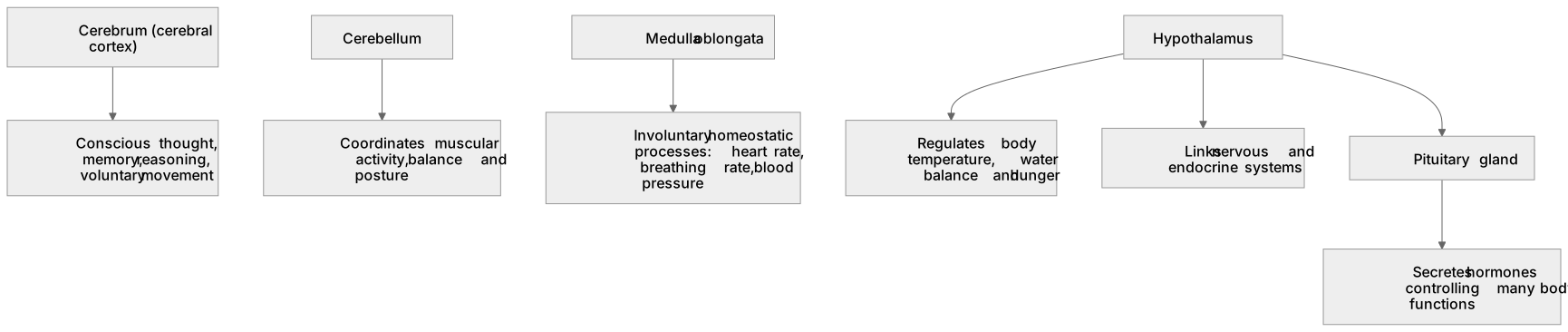
The human brain has several regions with distinct functions. The cerebrum, the largest part, is divided into two hemispheres and its outer cerebral cortex handles conscious thought, memory, reasoning and voluntary movement. The cerebellum, below and behind the cerebrum, coordinates muscular activity, balance and posture. The medulla oblongata, at the base of the brain, controls involuntary homeostatic processes such as heart rate, breathing rate and blood pressure. The hypothalamus regulates body temperature, water balance and hunger, and links the nervous and endocrine systems via the pituitary gland. The pituitary gland secretes hormones controlling many body functions. The brain is protected by the skull, meninges and cerebrospinal fluid.
What earns the marks
- The cerebrum (cerebral cortex) is responsible for conscious thought, memory, reasoning and voluntary movement.
- The cerebellum coordinates muscular activity, balance and posture.
- The medulla oblongata controls involuntary homeostatic processes such as heart rate, breathing rate and blood pressure.
- The hypothalamus regulates temperature, water balance and hunger and links the nervous and endocrine systems.
- The pituitary gland secretes hormones and is controlled by the hypothalamus.
Common mistakes and how to put them right
Attributing balance and coordination to the medulla.
Put it right: The cerebellum coordinates balance and posture.
Thinking the cerebrum controls involuntary homeostatic processes.
Put it right: The medulla oblongata controls heart rate, breathing and blood pressure.
Confusing the hypothalamus and pituitary.
Put it right: The hypothalamus regulates homeostasis and controls the pituitary, which secretes hormones.
Exam tips
- Match each brain region to a single clear function to avoid mixing them up in multiple-choice options.
- Use a labelled diagram of a mid-sagittal section to locate cerebrum, cerebellum, medulla, hypothalamus and pituitary.
- For applied questions, name the region and state the specific function it performs.
Try the lesson
The start of the Plant and animal responses: (h) the structure of the human brain and the functions of its parts lesson, made from checked teaching notes for this specification point.
Have a go first
Which part of the human brain is the largest region and is associated with conscious thought, memory and voluntary movement?
Listen
The human brain has several regions with distinct functions. The cerebrum, the largest part, is divided into two hemispheres and its outer cerebral cortex handles conscious thought, memory, reasoning and voluntary movement. The cerebellum, below and behind the cerebrum, coordinates muscular activity, balance and posture. The medulla oblongata, at the base of the brain, controls involuntary homeostatic processes such as heart rate, breathing rate and blood pressure. The hypothalamus regulates body temperature, water balance and hunger, and links the nervous and endocrine systems via the pituitary gland. The pituitary gland secretes hormones controlling many body functions. The brain is protected by the skull, meninges and cerebrospinal fluid. A strong answer earns marks for these points. The cerebrum (cerebral cortex) is responsible for conscious thought, memory, reasoning and voluntary movement. The cerebellum coordinates muscular activity, balance and posture. The medulla oblongata controls involuntary homeostatic processes such as heart rate, breathing rate and blood pressure. The hypothalamus regulates temperature, water balance and hunger and links the nervous and endocrine systems. A common slip: Attributing balance and coordination to the medulla. Instead, the cerebellum coordinates balance and posture. Exam tip: Match each brain region to a single clear function to avoid mixing them up in multiple-choice options.
See it
Key words
Say what each word means before you turn the card.
Cerebrum
Try answering aloud or in your head before turning the card.
Cerebellum
Try answering aloud or in your head before turning the card.
Medulla oblongata
Try answering aloud or in your head before turning the card.
Hypothalamus
Try answering aloud or in your head before turning the card.
See every definition
- Cerebrum
- The largest part, divided into two hemispheres, whose outer cerebral cortex handles conscious thought, memory, reasoning and voluntary movement.
- Cerebellum
- The region below and behind the cerebrum that coordinates muscular activity, balance and posture.
- Medulla oblongata
- The region at the base of the brain that controls involuntary homeostatic processes such as heart rate, breathing rate and blood pressure.
- Hypothalamus
- The region that regulates body temperature, water balance and hunger, and links the nervous and endocrine systems via the pituitary gland.
Label the diagram
Some boxes have lost their names. Pick the right name for each number.
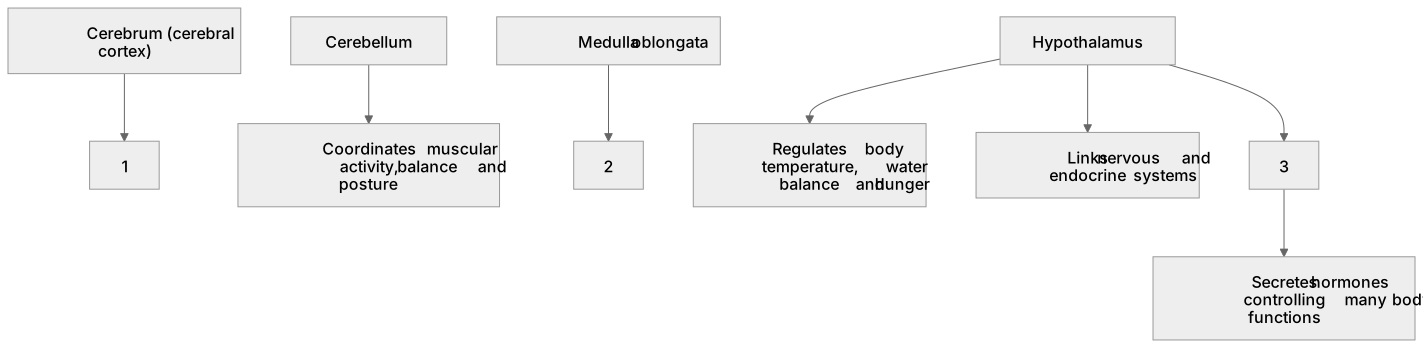
1Box 1
2Box 2
3Box 3
There is more to this lesson
The full lesson goes on to check your understanding and help you earn the marks. Create a free account to carry on, with your progress saved.
A week of Premium from your first lesson · Then the free plan continues · No card, no charge
Test your understanding of Plant and animal responses: (h) the structure of the human brain and the functions of its parts
Active recall beats re-reading. Take an instant quiz now to test what you’ve learned and lock it into long-term memory.
A week of Premium from your first lesson · Then the free plan continues · No card, no charge