OCR · A-Level · Biology
Course version: H420 · Version from Sept 2025
Plant and animal responses: (i) reflex actions
A reflex action is a rapid, involuntary and stereotyped response to a stimulus, coordinated by a reflex arc so that the brain is not required to make the decision.
Checked against the OCR H420 specification (opens in a new tab) on .
- Point 8 of 12
- 4 key terms
Study notes
From the checked teaching notes for this specification point.
The idea
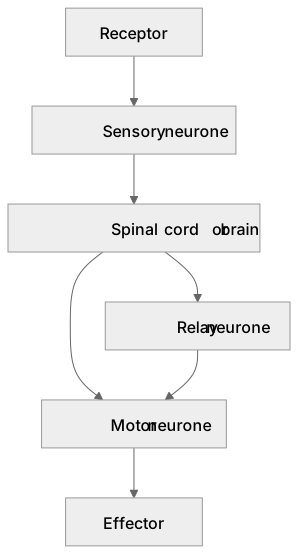
A reflex action is a rapid, involuntary and stereotyped response to a stimulus, coordinated by a reflex arc so that the brain is not required to make the decision. The simplest arc runs from receptor to sensory neurone, into the spinal cord or brain, then to a motor neurone and effector; the knee-jerk (patellar) reflex is monosynaptic, with the sensory neurone synapsing directly onto the motor neurone, so no relay neurone is involved. Most protective reflexes, such as the blinking reflex and the withdrawal reflex, are polysynaptic and do include relay neurones, which allows rapid protective responses and some modification by the brain.
What earns the marks
- Identifies a reflex action as a rapid, involuntary and stereotyped response to a stimulus.
- Describes the reflex arc as receptor, sensory neurone, coordinator (spinal cord or brain), motor neurone and effector.
- States that the knee-jerk reflex is monosynaptic, with the sensory neurone synapsing directly onto the motor neurone and no relay neurone.
- Explains that polysynaptic reflexes such as the blinking reflex and withdrawal reflex include one or more relay neurones.
- Recognises that reflex arcs bypass the need for conscious decision-making by the brain, although the brain can be informed and can modify some reflexes.
- Distinguishes the roles of sensory neurone, relay neurone and motor neurone within a named reflex pathway.
Common mistakes and how to put them right
Inserts a relay neurone into the knee-jerk reflex.
Put it right: Describe it instead as monosynaptic, with the sensory neurone synapsing directly onto the motor neurone.
Treats every reflex as identical in pathway.
Put it right: Distinguish monosynaptic reflexes such as the knee-jerk from polysynaptic reflexes such as blinking and withdrawal.
Describes a reflex as a voluntary or consciously controlled action.
Put it right: State that it is involuntary and stereotyped.
Omits the effector from the reflex arc.
Put it right: Include the muscle or gland that carries out the response.
Exam tips
- Learn one monosynaptic and two polysynaptic examples with their full pathways so you can compare them.
- When asked about a named reflex, name each neurone type in order and state whether a relay neurone is present.
- Use the terms involuntary, stereotyped and rapid precisely, since each carries a separate mark-worthy idea.
Try the lesson
The start of the Plant and animal responses: (i) reflex actions lesson, made from checked teaching notes for this specification point.
Have a go first
In a simple reflex arc, which structure detects the stimulus that begins the response?
Listen
A reflex action is a rapid, involuntary and stereotyped response to a stimulus, coordinated by a reflex arc so that the brain is not required to make the decision. The simplest arc runs from receptor to sensory neurone, into the spinal cord or brain, then to a motor neurone and effector; the knee-jerk (patellar) reflex is monosynaptic, with the sensory neurone synapsing directly onto the motor neurone, so no relay neurone is involved. Most protective reflexes, such as the blinking reflex and the withdrawal reflex, are polysynaptic and do include relay neurones, which allows rapid protective responses and some modification by the brain. A strong answer earns marks for these points. Identifies a reflex action as a rapid, involuntary and stereotyped response to a stimulus. Describes the reflex arc as receptor, sensory neurone, coordinator (spinal cord or brain), motor neurone and effector. States that the knee-jerk reflex is monosynaptic, with the sensory neurone synapsing directly onto the motor neurone and no relay neurone. Explains that polysynaptic reflexes such as the blinking reflex and withdrawal reflex include one or more relay neurones. Exam tip: Learn one monosynaptic and two polysynaptic examples with their full pathways so you can compare them.
See it
Key words
Say what each word means before you turn the card.
Reflex action
Try answering aloud or in your head before turning the card.
Reflex arc
Try answering aloud or in your head before turning the card.
Monosynaptic
Try answering aloud or in your head before turning the card.
Polysynaptic
Try answering aloud or in your head before turning the card.
See every definition
- Reflex action
- A rapid, involuntary and stereotyped response to a stimulus, coordinated by a reflex arc so that the brain is not required to make the decision.
- Reflex arc
- The pathway running from receptor to sensory neurone, into the spinal cord or brain, then to a motor neurone and effector.
- Monosynaptic
- Describes a reflex such as the knee-jerk in which the sensory neurone synapses directly onto the motor neurone, so no relay neurone is involved.
- Polysynaptic
- Describes reflexes such as the blinking reflex and the withdrawal reflex, which include one or more relay neurones.
Label the diagram
Some boxes have lost their names. Pick the right name for each number.
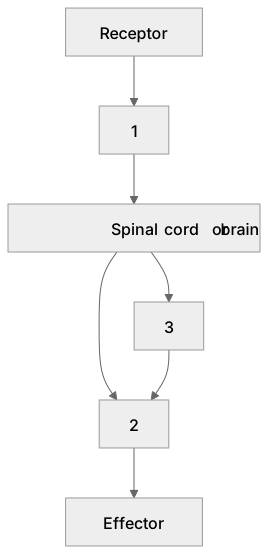
1Box 1
2Box 2
3Box 3
There is more to this lesson
The full lesson goes on to check your understanding and help you earn the marks. Create a free account to carry on, with your progress saved.
A week of Premium from your first lesson · Then the free plan continues · No card, no charge
Test your understanding of Plant and animal responses: (i) reflex actions
Active recall beats re-reading. Take an instant quiz now to test what you’ve learned and lock it into long-term memory.
A week of Premium from your first lesson · Then the free plan continues · No card, no charge