OCR · A-Level · Biology
Course version: H420 · Version from Sept 2025
(a) the factors that determine size of a population
Full specification wording
Populations and sustainability: (a) the factors that determine size of a population
Population size is the number of individuals of one species in a defined area.
Checked against the OCR H420 specification (opens in a new tab) on .
- Point 1 of 5
- 3 key terms
Study notes
From the checked teaching notes for this specification point.
The idea
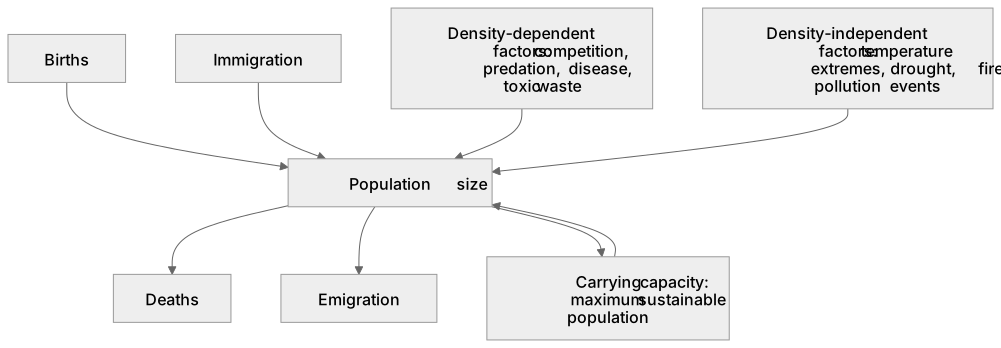
Population size is the number of individuals of one species in a defined area. It is set by births and immigration adding individuals and by deaths and emigration removing them, so change in population = (births + immigration) − (deaths + emigration). These rates are themselves controlled by density-dependent factors, whose effect grows as numbers rise (competition for food, space or light; predation; disease; accumulation of toxic waste), and density-independent factors, whose effect does not depend on numbers (temperature extremes, drought, fire, pollution events). Carrying capacity is the maximum population an ecosystem can sustain; when numbers exceed it, mortality rises and the population falls back. Reproductive potential, generation time and the availability of resources also shape how quickly a population grows.
What earns the marks
- Identifies births and immigration as additions and deaths and emigration as losses to population size.
- Distinguishes density-dependent factors (competition, predation, disease) from density-independent factors (temperature, drought, fire).
- Explains carrying capacity as the maximum sustainable population set by available resources.
- Links resource availability and reproductive potential to the rate at which a population can grow.
- Relates population factors to sustainability, for example keeping harvesting within carrying capacity.
Common mistakes and how to put them right
Treating emigration as an addition to a population.
Put it right: Emigration removes individuals, immigration adds them.
Assuming all limiting factors depend on density.
Put it right: Some, such as drought or fire, act regardless of population size.
Confusing carrying capacity with unlimited growth.
Put it right: Carrying capacity is the ceiling set by resources, beyond which mortality increases.
Exam tips
- Write the population change equation explicitly before substituting any figures.
- Classify each named factor as density-dependent or density-independent and say why.
- Use the term carrying capacity precisely when explaining why a population levels off.
Try the lesson
The start of the Populations and sustainability: (a) the factors that determine size of a population lesson, made from checked teaching notes for this specification point.
Have a go first
Which of these is a density-independent factor that could reduce a population of insects?
Listen
Population size is the number of individuals of one species in a defined area. It is set by births and immigration adding individuals and by deaths and emigration removing them, so change in population = (births + immigration) − (deaths + emigration). These rates are themselves controlled by density-dependent factors, whose effect grows as numbers rise (competition for food, space or light; predation; disease; accumulation of toxic waste), and density-independent factors, whose effect does not depend on numbers (temperature extremes, drought, fire, pollution events). Carrying capacity is the maximum population an ecosystem can sustain; when numbers exceed it, mortality rises and the population falls back. Reproductive potential, generation time and the availability of resources also shape how quickly a population grows. A strong answer earns marks for these points. Identifies births and immigration as additions and deaths and emigration as losses to population size. Distinguishes density-dependent factors (competition, predation, disease) from density-independent factors (temperature, drought, fire). Explains carrying capacity as the maximum sustainable population set by available resources. Links resource availability and reproductive potential to the rate at which a population can grow. A common slip: Treating emigration as an addition to a population. Instead, emigration removes individuals, immigration adds them. Exam tip: Write the population change equation explicitly before substituting any figures.
See it
Key words
Say what each word means before you turn the card.
Births, deaths, immigration and emigration
Try answering aloud or in your head before turning the card.
Carrying capacity and resource limits
Try answering aloud or in your head before turning the card.
Reproductive potential and sustainability
Try answering aloud or in your head before turning the card.
See every definition
- Births, deaths, immigration and emigration
- Births and immigration add individuals to a population, while deaths and emigration remove them, so change in population = (births + immigration) − (deaths + emigration).
- Carrying capacity and resource limits
- The maximum population an ecosystem can sustain; when numbers exceed it, mortality rises and the population falls back.
- Reproductive potential and sustainability
- Reproductive potential, generation time and the availability of resources shape how quickly a population grows, and population factors relate to sustainability, for example keeping harvesting within carrying capacity.
Label the diagram
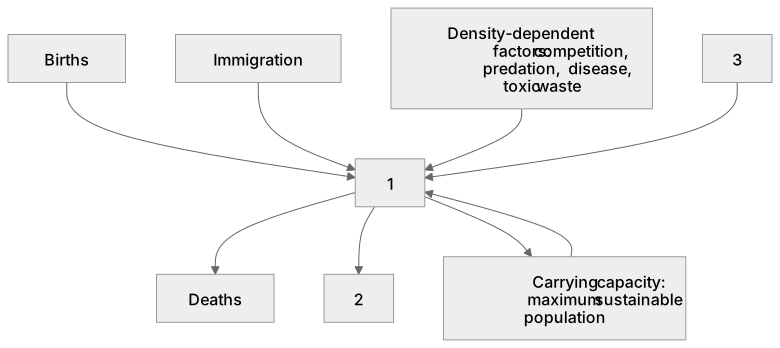
Some boxes have lost their names. Pick the right name for each number.
1Box 1
2Box 2
3Box 3
There is more to this lesson
The full lesson goes on to check your understanding and help you earn the marks. Create a free account to carry on, with your progress saved.
A week of Premium from your first lesson · Then the free plan continues · No card, no charge
Test your understanding of Populations and sustainability: (a) the factors that determine size of a population
Active recall beats re-reading. Take an instant quiz now to test what you’ve learned and lock it into long-term memory.
A week of Premium from your first lesson · Then the free plan continues · No card, no charge