OCR · A-Level · Biology
Course version: H420 · Version from Sept 2025
Populations and sustainability: (b) interactions between populations
A population is all the organisms of one species in a habitat.
Checked against the OCR H420 specification (opens in a new tab) on .
- Point 2 of 5
- 4 key terms
Study notes
From the checked teaching notes for this specification point.
The idea
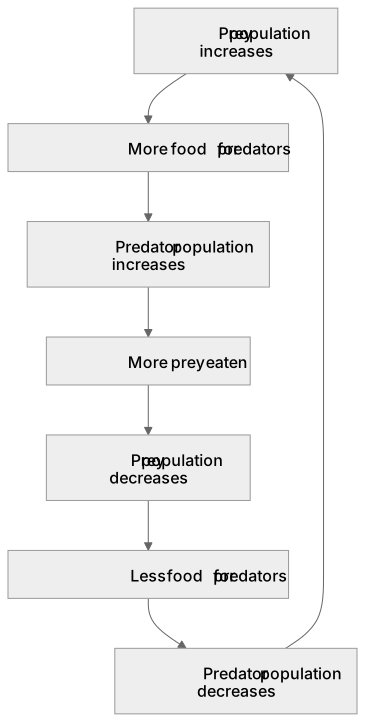
A population is all the organisms of one species in a habitat. Interactions between populations shape their sizes: predation, competition and mutualism each change birth and death rates. In predation, a rise in prey numbers supports more predators, whose increased numbers then reduce the prey, so the two populations oscillate out of phase. In interspecific competition, two species needing the same resource both grow more slowly, and the better-adapted species may exclude the other through competitive exclusion. Mutualism benefits both populations, for example nitrogen-fixing bacteria in root nodules supplying fixed nitrogen while receiving carbohydrates. Learners should predict how a change in one population alters another, and distinguish these interactions from abiotic factors such as temperature.
What earns the marks
- Defines a population as all organisms of one species in a habitat, and identifies an interaction as an effect of one population on another.
- Explains predation as a coupled cycle: more prey raises predator numbers, which then lowers prey numbers, so the peaks are out of phase.
- Explains interspecific competition as two species sharing a limiting resource, reducing both populations and potentially causing competitive exclusion.
- Describes mutualism as an interaction benefiting both populations, illustrated by nitrogen-fixing bacteria gaining carbohydrates while the plant gains fixed nitrogen.
- Distinguishes biotic interactions between populations from abiotic factors that also affect population size.
Common mistakes and how to put them right
Treating a population as all species in a habitat.
Put it right by defining it as one species only.
Assuming predator and prey peaks coincide.
Put it right by explaining the predator peak lags behind the prey peak.
Confusing mutualism with parasitism.
Put it right by stating that mutualism benefits both populations.
Exam tips
- Read the graph or scenario and state which population changes first, then trace the effect on the other.
- Use the terms interspecific competition and competitive exclusion precisely rather than 'fighting'.
- When asked to predict, give the direction of change and the mechanism linking the two populations.
Try the lesson
The start of the Populations and sustainability: (b) interactions between populations lesson, made from checked teaching notes for this specification point.
Have a go first
In a woodland, owls hunt and eat mice. Which term describes the interaction between the owl population and the mouse population?
Listen
A population is all the organisms of one species in a habitat. Interactions between populations shape their sizes: predation, competition and mutualism each change birth and death rates. In predation, a rise in prey numbers supports more predators, whose increased numbers then reduce the prey, so the two populations oscillate out of phase. In interspecific competition, two species needing the same resource both grow more slowly, and the better-adapted species may exclude the other through competitive exclusion. Mutualism benefits both populations, for example nitrogen-fixing bacteria in root nodules supplying fixed nitrogen while receiving carbohydrates. Learners should predict how a change in one population alters another, and distinguish these interactions from abiotic factors such as temperature. A strong answer earns marks for these points. Defines a population as all organisms of one species in a habitat, and identifies an interaction as an effect of one population on another. Explains predation as a coupled cycle: more prey raises predator numbers, which then lowers prey numbers, so the peaks are out of phase. Explains interspecific competition as two species sharing a limiting resource, reducing both populations and potentially causing competitive exclusion. Describes mutualism as an interaction benefiting both populations, illustrated by nitrogen-fixing bacteria gaining carbohydrates while the plant gains fixed nitrogen. A common slip: Treating a population as all species in a habitat. Instead, defining it as one species only. Exam tip: Read the graph or scenario and state which population changes first, then trace the effect on the other.
See it
Key words
Say what each word means before you turn the card.
Population
Try answering aloud or in your head before turning the card.
Predation
Try answering aloud or in your head before turning the card.
Interspecific competition
Try answering aloud or in your head before turning the card.
Mutualism
Try answering aloud or in your head before turning the card.
See every definition
- Population
- All the organisms of one species in a habitat.
- Predation
- An interaction in which a rise in prey numbers supports more predators, whose increased numbers then reduce the prey, so the two populations oscillate out of phase.
- Interspecific competition
- An interaction in which two species needing the same resource both grow more slowly, and the better-adapted species may exclude the other through competitive exclusion.
- Mutualism
- An interaction that benefits both populations, for example nitrogen-fixing bacteria in root nodules supplying fixed nitrogen while receiving carbohydrates.
Label the diagram
Some boxes have lost their names. Pick the right name for each number.
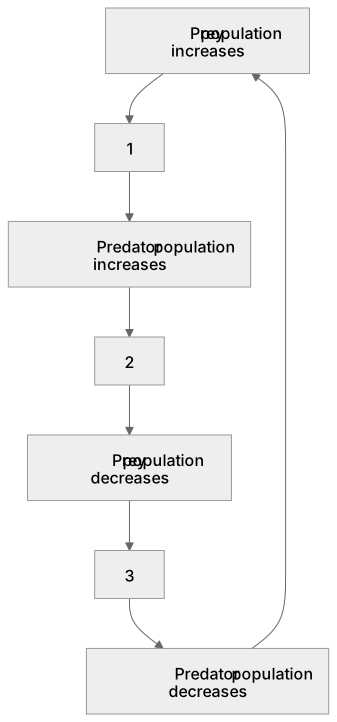
1Box 1
2Box 2
3Box 3
There is more to this lesson
The full lesson goes on to check your understanding and help you earn the marks. Create a free account to carry on, with your progress saved.
A week of Premium from your first lesson · Then the free plan continues · No card, no charge
Test your understanding of Populations and sustainability: (b) interactions between populations
Active recall beats re-reading. Take an instant quiz now to test what you’ve learned and lock it into long-term memory.
A week of Premium from your first lesson · Then the free plan continues · No card, no charge