OCR · A-Level · Biology
Course version: H420 · Version from Sept 2025
(e) the management of environmental resources and the effects of human…
Full specification wording
Populations and sustainability: (e) the management of environmental resources and the effects of human activities.
This specification point asks you to connect two ideas: how environmental resources are managed, and how human activities affect ecosystems.
Checked against the OCR H420 specification (opens in a new tab) on .
- Point 5 of 5
- 4 key terms
Study notes
From the checked teaching notes for this specification point.
The idea
This specification point asks you to connect two ideas: how environmental resources are managed, and how human activities affect ecosystems. Environmental resources include the land, water, air, minerals, forests and fisheries that humans use. Management means controlling how these are exploited so that use is sustainable — for example, setting fishing quotas, designating protected areas, rotating timber extraction, or regulating water abstraction. Human activities such as deforestation, overfishing, pollution, urbanisation and intensive agriculture can reduce biodiversity, degrade habitats and deplete resources.
What earns the marks
- Recognises that environmental resources include land, water, air, minerals, forests and fisheries used by humans.
- Identifies management strategies such as quotas, protected areas, rotation of extraction or regulation of abstraction that aim to make use sustainable.
- Distinguishes sustainable management from unsustainable exploitation in a given scenario.
- Links a named human activity (for example deforestation, overfishing, pollution, urbanisation or intensive agriculture) to a specific effect on a resource, habitat or population.
- Recognises that human activities can reduce biodiversity and deplete resources, and that management aims to limit these effects.
Common mistakes and how to put them right
Treating 'management' as simply using a resource.
Put it right: Management means controlling exploitation so it remains sustainable, not just extracting it.
Assuming any human activity is automatically harmful.
Put it right: The effect depends on the activity and whether it is managed; some activities can be managed sustainably.
Confusing a resource with a habitat.
Put it right: A resource is something humans use (e.g. a fishery), while a habitat is where organisms live; the two can overlap but are not identical.
Exam tips
- Read the stem carefully to see whether it asks about management, about effects, or about both, and eliminate options that answer the wrong clause.
- Match the named human activity in the option to a plausible, specific effect rather than accepting a vague 'damages the environment'.
- Reject options that describe exploitation without any control when the question asks about management.
Try the lesson
The start of the Populations and sustainability: (e) the management of environmental resources and the effects of human activities. lesson, made from checked teaching notes for this specification point.
Have a go first
Which human activity most directly reduces the amount of habitat available for wild populations when it converts land to built-up areas?
Listen
This specification point asks you to connect two ideas: how environmental resources are managed, and how human activities affect ecosystems. Environmental resources include the land, water, air, minerals, forests and fisheries that humans use. Management means controlling how these are exploited so that use is sustainable — for example, setting fishing quotas, designating protected areas, rotating timber extraction, or regulating water abstraction. Human activities such as deforestation, overfishing, pollution, urbanisation and intensive agriculture can reduce biodiversity, degrade habitats and deplete resources. A strong answer earns marks for these points. Recognises that environmental resources include land, water, air, minerals, forests and fisheries used by humans. Identifies management strategies such as quotas, protected areas, rotation of extraction or regulation of abstraction that aim to make use sustainable. Distinguishes sustainable management from unsustainable exploitation in a given scenario. Links a named human activity (for example deforestation, overfishing, pollution, urbanisation or intensive agriculture) to a specific effect on a resource, habitat or population. A common slip: Treating 'management' as simply using a resource. Instead, management means controlling exploitation so it remains sustainable, not just extracting it. Exam tip: Read the stem carefully to see whether it asks about management, about effects, or about both, and eliminate options that answer the wrong clause.
See it
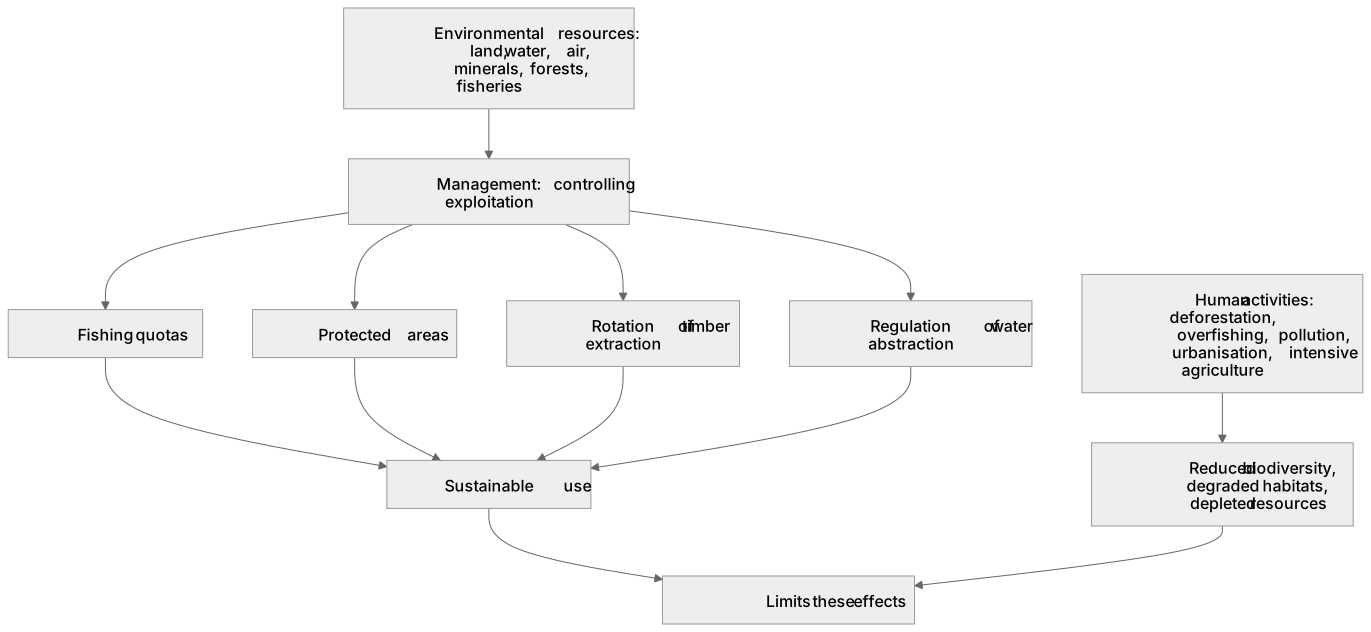
Key words
Say what each word means before you turn the card.
Sustainable use of environmental resources
Try answering aloud or in your head before turning the card.
Management strategies such as quotas and protected areas
Try answering aloud or in your head before turning the card.
Effects of human activities on ecosystems
Try answering aloud or in your head before turning the card.
Link between resource use and biodiversity
Try answering aloud or in your head before turning the card.
See every definition
- Sustainable use of environmental resources
- Controlling how environmental resources are exploited so that use is sustainable, for example by setting fishing quotas or designating protected areas.
- Management strategies such as quotas and protected areas
- Strategies such as quotas, protected areas, rotation of extraction or regulation of abstraction that aim to make use sustainable.
- Effects of human activities on ecosystems
- Activities such as deforestation, overfishing, pollution, urbanisation and intensive agriculture can reduce biodiversity, degrade habitats and deplete resources.
- Link between resource use and biodiversity
- Human activities can reduce biodiversity and deplete resources, and management aims to limit these effects.
Label the diagram
Some boxes have lost their names. Pick the right name for each number.
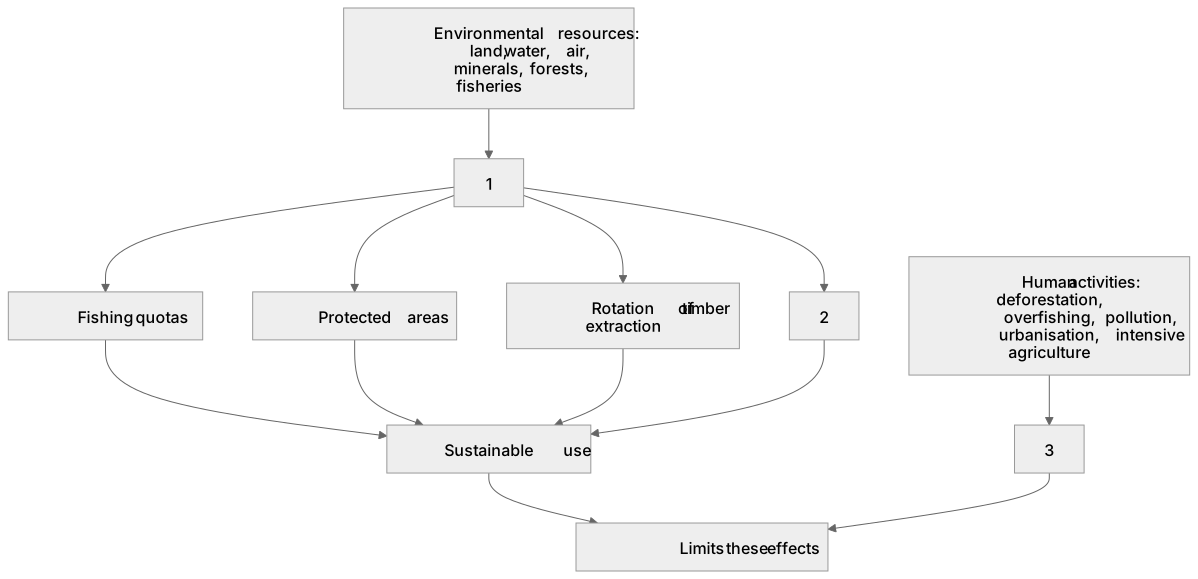
1Box 1
2Box 2
3Box 3
There is more to this lesson
The full lesson goes on to check your understanding and help you earn the marks. Create a free account to carry on, with your progress saved.
A week of Premium from your first lesson · Then the free plan continues · No card, no charge
Test your understanding of Populations and sustainability: (e) the management of environmental resources and the effects of human activities.
Active recall beats re-reading. Take an instant quiz now to test what you’ve learned and lock it into long-term memory.
A week of Premium from your first lesson · Then the free plan continues · No card, no charge