OCR · A-Level · Biology
Course version: H420 · Version from Sept 2025
(d) how the management of an ecosystem can provide resources in a…
Full specification wording
Populations and sustainability: (d) how the management of an ecosystem can provide resources in a sustainable way
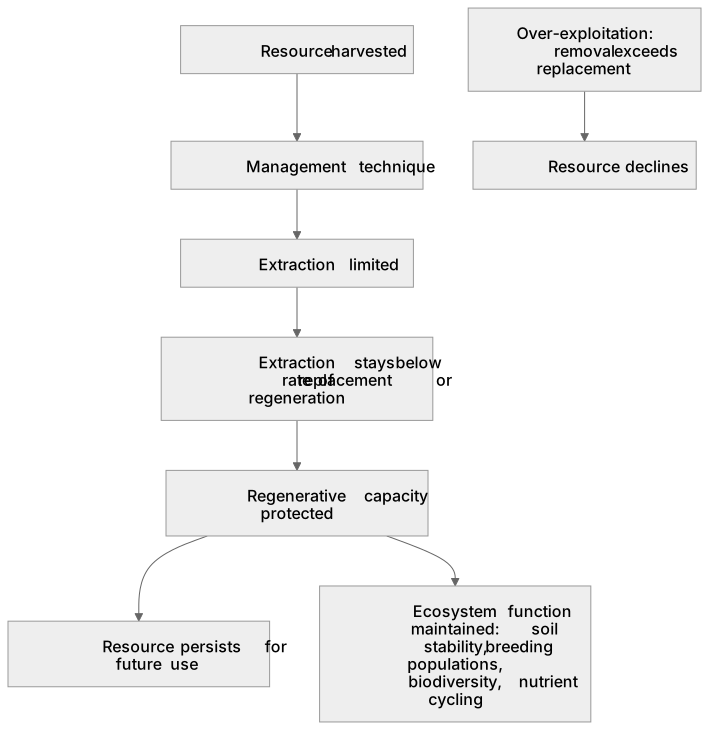
Sustainable management means harvesting resources at a rate the ecosystem can replace, so the resource and the ecosystem's functions persist for future use.
Checked against the OCR H420 specification (opens in a new tab) on .
- Point 4 of 5
- 4 key terms
Study notes
From the checked teaching notes for this specification point.
The idea
Sustainable management means harvesting resources at a rate the ecosystem can replace, so the resource and the ecosystem's functions persist for future use. Learners should connect management techniques to the specific resource taken and to the ecological processes that keep it renewable. For example, coppicing woodland lets trees regrow from cut stumps, giving timber and fuel repeatedly while roots hold soil and support habitat. Rotational grazing prevents overgrazing so grass regrows and soil is not compacted. Controlled fishing with quotas and minimum mesh sizes lets breeding stock survive and replenish populations. In each case the management limits extraction, protects the regenerative capacity of the population or system, and maintains biodiversity and nutrient cycling. A good answer names the resource, the management method and the mechanism that makes it sustainable.
What earns the marks
- Identifies the resource being harvested (for example timber, fish, grazing, water) and links it to a named ecosystem.
- Describes a specific management technique (coppicing, rotational grazing, quotas, mesh-size limits, replanting) rather than a vague claim of 'looking after' the ecosystem.
- Explains the mechanism that makes it sustainable: extraction stays below the rate of replacement or regeneration.
- Links management to maintaining ecosystem function, such as soil stability, breeding populations, biodiversity or nutrient cycling.
- Distinguishes sustainable use from over-exploitation, where removal exceeds replacement and the resource declines.
Common mistakes and how to put them right
Treating 'sustainable' as simply 'good for the environment' without explaining the rate of replacement.
Put it right: State that removal must not exceed the rate at which the resource regenerates.
Naming a management method without linking it to a resource or mechanism.
Put it right: Pair each method with the resource it protects and how regeneration is maintained.
Assuming any harvesting is unsustainable.
Put it right: Controlled, limited harvesting can be sustainable if breeding stock or regrowth is preserved.
Exam tips
- Read the stem to see which resource and ecosystem are named, then select the option that links method to regeneration.
- Eliminate options that describe over-exploitation or give no mechanism for replacement.
- Check that the chosen option names both the resource and how its supply is maintained.
Try the lesson
The start of the Populations and sustainability: (d) how the management of an ecosystem can provide resources in a sustainable way lesson, made from checked teaching notes for this specification point.
Have a go first
Which practice would allow a population of wild deer to be harvested for meat year after year without the population declining?
Listen
Sustainable management means harvesting resources at a rate the ecosystem can replace, so the resource and the ecosystem's functions persist for future use. Learners should connect management techniques to the specific resource taken and to the ecological processes that keep it renewable. For example, coppicing woodland lets trees regrow from cut stumps, giving timber and fuel repeatedly while roots hold soil and support habitat. Rotational grazing prevents overgrazing so grass regrows and soil is not compacted. Controlled fishing with quotas and minimum mesh sizes lets breeding stock survive and replenish populations. In each case the management limits extraction, protects the regenerative capacity of the population or system, and maintains biodiversity and nutrient cycling. A good answer names the resource, the management method and the mechanism that makes it sustainable. A strong answer earns marks for these points. Identifies the resource being harvested (for example timber, fish, grazing, water) and links it to a named ecosystem. Describes a specific management technique (coppicing, rotational grazing, quotas, mesh-size limits, replanting) rather than a vague claim of 'looking after' the ecosystem. Explains the mechanism that makes it sustainable: extraction stays below the rate of replacement or regeneration. Links management to maintaining ecosystem function, such as soil stability, breeding populations, biodiversity or nutrient cycling. A common slip: Treating 'sustainable' as simply 'good for the environment' without explaining the rate of replacement. Instead, state that removal must not exceed the rate at which the resource regenerates. Exam tip: Read the stem to see which resource and ecosystem are named, then select the option that links method to regeneration.
See it
Key words
Say what each word means before you turn the card.
Sustainable resource use
Try answering aloud or in your head before turning the card.
Regeneration and replacement rates
Try answering aloud or in your head before turning the card.
Ecosystem management techniques
Try answering aloud or in your head before turning the card.
Biodiversity and ecosystem function
Try answering aloud or in your head before turning the card.
See every definition
- Sustainable resource use
- Management of an ecosystem that provides resources at a rate the ecosystem can replace, so the resource and the ecosystem's functions persist for future use.
- Regeneration and replacement rates
- The rate at which a population or system regrows; extraction stays below this rate so the resource is not depleted.
- Ecosystem management techniques
- Specific methods such as coppicing, rotational grazing, quotas, mesh-size limits and replanting that limit extraction and protect regenerative capacity.
- Biodiversity and ecosystem function
- The variety of life and processes such as soil stability, breeding populations and nutrient cycling that management maintains.
Label the diagram
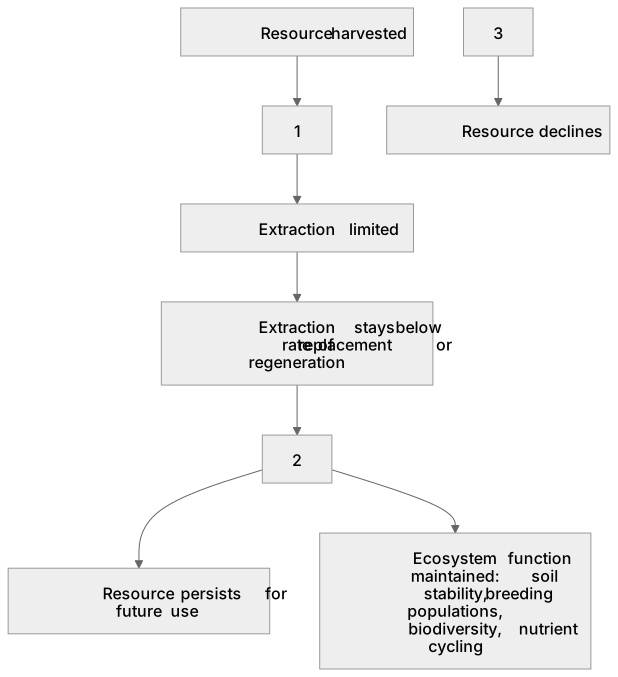
Some boxes have lost their names. Pick the right name for each number.
1Box 1
2Box 2
3Box 3
There is more to this lesson
The full lesson goes on to check your understanding and help you earn the marks. Create a free account to carry on, with your progress saved.
A week of Premium from your first lesson · Then the free plan continues · No card, no charge
Test your understanding of Populations and sustainability: (d) how the management of an ecosystem can provide resources in a sustainable way
Active recall beats re-reading. Take an instant quiz now to test what you’ve learned and lock it into long-term memory.
A week of Premium from your first lesson · Then the free plan continues · No card, no charge