OCR · A-Level · Biology
Course version: H420 · Version from Sept 2025
(d) make and record observations/measurements
Full specification wording
Practical skills - Use and application of scientific methods and practices: (d) make and record observations/measurements
This skill is about producing reliable primary data, not just looking at a specimen.
Checked against the OCR H420 specification (opens in a new tab) on .
- Point 1 of 2
- 4 key terms
Study notes
From the checked teaching notes for this specification point.
The idea
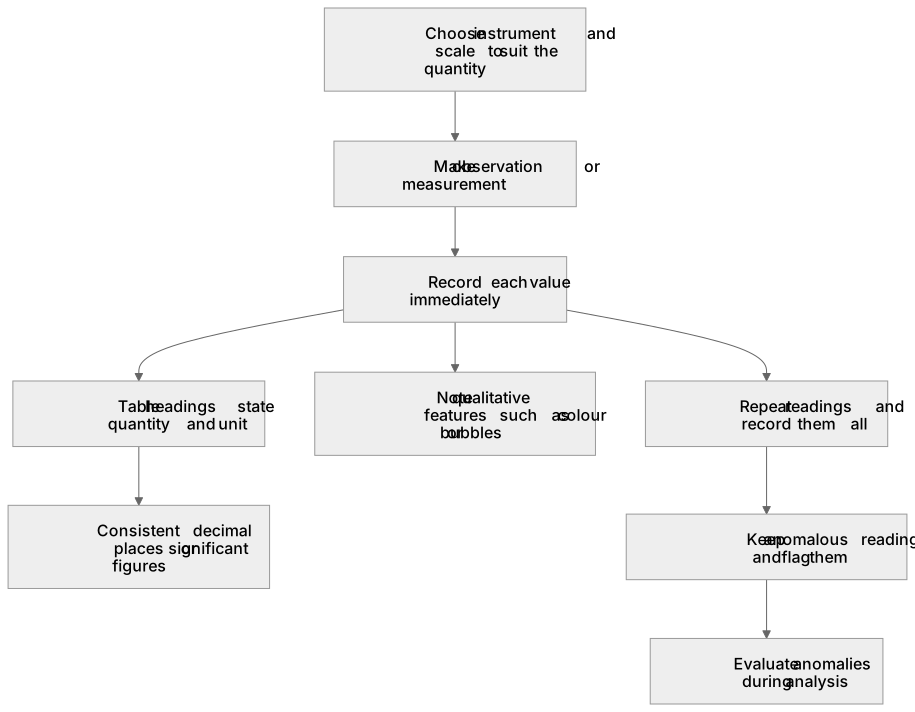
This skill is about producing reliable primary data, not just looking at a specimen. Making an observation means using an instrument or your senses in a controlled, repeatable way: for example, reading a colorimeter absorbance, timing a reaction with a stopwatch, or counting stomata in a field of view. Recording means writing each value immediately, with its unit, into a pre-prepared table whose headings state the quantity and unit, so raw data are never lost or reconstructed from memory. You must choose an appropriate scale or resolution, take readings at the stated intervals, and note qualitative features such as colour or bubble production where these are the observation. Repeat readings and record them all, including anomalous ones, rather than silently discarding them.
What earns the marks
- Identifies that observations and measurements must be recorded immediately and directly, not recalled later.
- Recognises that table headings should give the quantity and its unit, with consistent decimal places or significant figures.
- Accepts that qualitative observations (for example colour change or gas bubbles) are valid recorded data alongside numerical readings.
- States that anomalous readings should be recorded and flagged rather than deleted, so they can be evaluated.
- Appreciates that the resolution and scale of the instrument chosen must suit the quantity being measured.
Common mistakes and how to put them right
Thinking a measurement is only valid if it is numerical.
Put it right: Qualitative observations such as colour or presence of bubbles are legitimate recorded data when they are the intended observation.
Recording values without units or with units only in the body of the table.
Put it right: Put the quantity and unit in the column heading and keep the cells as numbers.
Discarding an odd reading to make results look tidy.
Put it right: Record all readings and identify anomalies during analysis so the evaluation is honest.
Exam tips
- Read the question stem to see whether it asks about making, recording or both, and address each part explicitly.
- When judging a table, check headings for quantity plus unit and check that the number of decimal places is consistent.
- Link the choice of instrument or scale to the precision needed, rather than choosing the most elaborate equipment available.
Try the lesson
The start of the Practical skills - Use and application of scientific methods and practices: (d) make and record observations/measurements lesson, made from checked teaching notes for this specification point.
Have a go first
A student measures the length of an onion root tip cell using a microscope with a calibrated eyepiece graticule. The cell spans 4.5 graticule divisions. Each division is 10 μm. What is the length of the cell?
Listen
This skill is about producing reliable primary data, not just looking at a specimen. Making an observation means using an instrument or your senses in a controlled, repeatable way: for example, reading a colorimeter absorbance, timing a reaction with a stopwatch, or counting stomata in a field of view. Recording means writing each value immediately, with its unit, into a pre-prepared table whose headings state the quantity and unit, so raw data are never lost or reconstructed from memory. You must choose an appropriate scale or resolution, take readings at the stated intervals, and note qualitative features such as colour or bubble production where these are the observation. Repeat readings and record them all, including anomalous ones, rather than silently discarding them. A strong answer earns marks for these points. Identifies that observations and measurements must be recorded immediately and directly, not recalled later. Recognises that table headings should give the quantity and its unit, with consistent decimal places or significant figures. Accepts that qualitative observations (for example colour change or gas bubbles) are valid recorded data alongside numerical readings. States that anomalous readings should be recorded and flagged rather than deleted, so they can be evaluated. A common slip: Thinking a measurement is only valid if it is numerical. Instead, qualitative observations such as colour or presence of bubbles are legitimate recorded data when they are the intended observation. Exam tip: Read the question stem to see whether it asks about making, recording or both, and address each part explicitly.
See it
Key words
Say what each word means before you turn the card.
Reliability of primary data
Try answering aloud or in your head before turning the card.
Appropriate apparatus and resolution
Try answering aloud or in your head before turning the card.
Correct tabulation with units
Try answering aloud or in your head before turning the card.
Honest treatment of anomalous results
Try answering aloud or in your head before turning the card.
See every definition
- Reliability of primary data
- Producing primary data in a controlled, repeatable way, taking repeat readings and recording them all rather than discarding any.
- Appropriate apparatus and resolution
- Choosing an instrument and scale whose resolution and scale suit the quantity being measured, with readings taken at the stated intervals.
- Correct tabulation with units
- Writing each value immediately into a pre-prepared table whose headings state the quantity and unit, with consistent decimal places or significant figures.
- Honest treatment of anomalous results
- Recording anomalous readings and flagging them rather than silently discarding them, so they can be evaluated during analysis.
Label the diagram
Some boxes have lost their names. Pick the right name for each number.
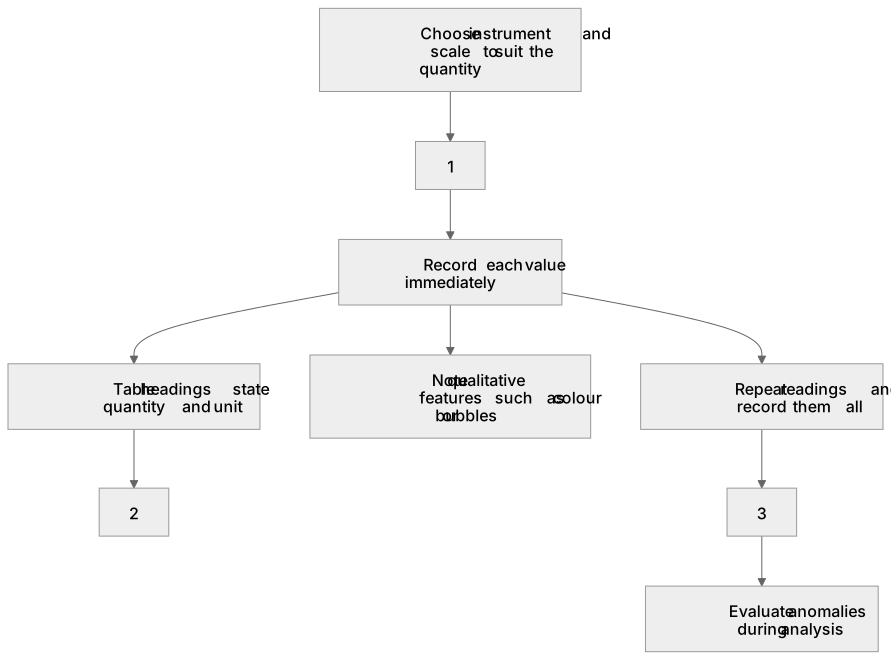
1Box 1
2Box 2
3Box 3
There is more to this lesson
The full lesson goes on to check your understanding and help you earn the marks. Create a free account to carry on, with your progress saved.
A week of Premium from your first lesson · Then the free plan continues · No card, no charge
Test your understanding of Practical skills - Use and application of scientific methods and practices: (d) make and record observations/measurements
Active recall beats re-reading. Take an instant quiz now to test what you’ve learned and lock it into long-term memory.
A week of Premium from your first lesson · Then the free plan continues · No card, no charge