OCR · A-Level · Biology
Course version: H420 · Version from Sept 2025
Respiration: (b) the structure of the mitochondrion
The mitochondrion is the site of the later stages of aerobic respiration, and its structure is adapted to that role.
Checked against the OCR H420 specification (opens in a new tab) on .
- Point 2 of 13
- 4 key terms
Study notes
From the checked teaching notes for this specification point.
The idea
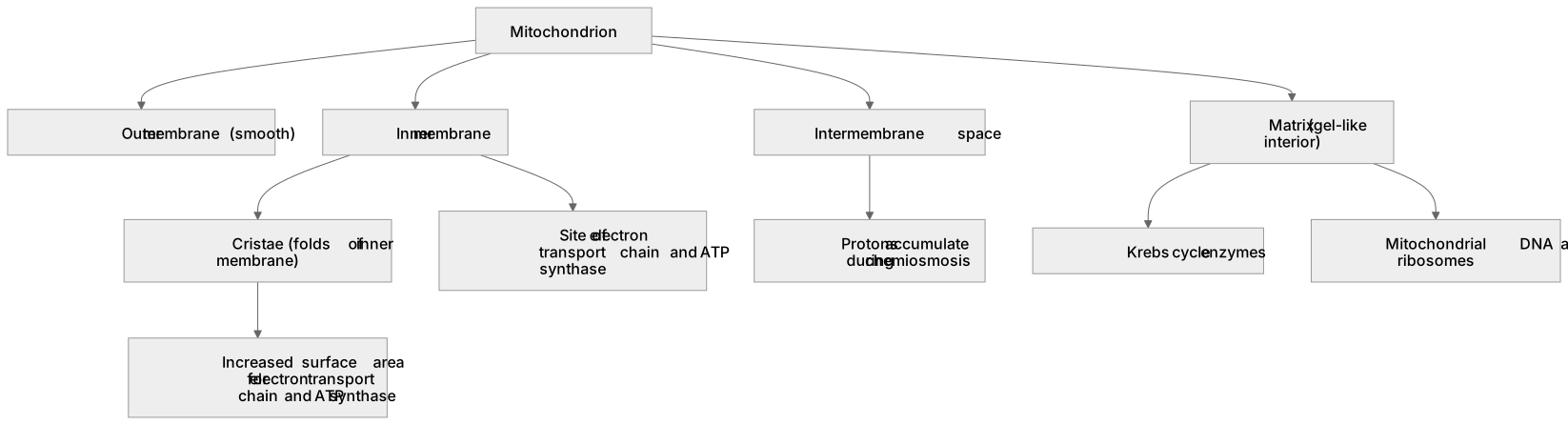
The mitochondrion is the site of the later stages of aerobic respiration, and its structure is adapted to that role. It has a double membrane: a smooth outer membrane and an inner membrane folded into cristae that increase surface area. The inner membrane holds the electron transport chain and ATP synthase, and it encloses the matrix, a gel-like space containing enzymes for the Krebs cycle, mitochondrial DNA and ribosomes. The intermembrane space lies between the two membranes and is where protons accumulate during chemiosmosis. A useful method is to link each structure to its function: cristae to surface area for the electron transport chain, matrix to Krebs cycle enzymes, and the inner membrane to proton movement and ATP synthesis.
What earns the marks
- The mitochondrion is surrounded by a double membrane consisting of a smooth outer membrane and an inner membrane.
- The inner membrane is folded into cristae, which increase the surface area available for the electron transport chain and ATP synthase.
- The inner membrane is the site of the electron transport chain and ATP synthase, where oxidative phosphorylation occurs.
- The matrix is the gel-like interior containing enzymes of the Krebs cycle, mitochondrial DNA and ribosomes.
- The intermembrane space lies between the outer and inner membranes and is where protons accumulate during chemiosmosis.
- The structure is adapted to aerobic respiration by maximising surface area and compartmentalising the reactions of respiration.
Common mistakes and how to put them right
Confusing the cristae with the matrix.
Put it right: Cristae are folds of the inner membrane, while the matrix is the enclosed fluid space containing Krebs cycle enzymes.
Stating that the outer membrane is folded.
Put it right: It is the inner membrane that folds into cristae, while the outer membrane is smooth.
Placing the Krebs cycle enzymes in the intermembrane space.
Put it right: The Krebs cycle enzymes are in the matrix, and the intermembrane space is where protons accumulate.
Exam tips
- Always pair a named structure with its function, for example cristae with increased surface area for the electron transport chain.
- Use precise terms: inner membrane, outer membrane, cristae, matrix and intermembrane space, rather than vague words like 'inside'.
- When describing adaptation, explain how the folding increases surface area rather than just naming the cristae.
Try the lesson
The start of the Respiration: (b) the structure of the mitochondrion lesson, made from checked teaching notes for this specification point.
Have a go first
Which part of a mitochondrion is folded into cristae?
Listen
The mitochondrion is the site of the later stages of aerobic respiration, and its structure is adapted to that role. It has a double membrane: a smooth outer membrane and an inner membrane folded into cristae that increase surface area. The inner membrane holds the electron transport chain and ATP synthase, and it encloses the matrix, a gel-like space containing enzymes for the Krebs cycle, mitochondrial DNA and ribosomes. The intermembrane space lies between the two membranes and is where protons accumulate during chemiosmosis. A useful method is to link each structure to its function: cristae to surface area for the electron transport chain, matrix to Krebs cycle enzymes, and the inner membrane to proton movement and ATP synthesis. A strong answer earns marks for these points. The mitochondrion is surrounded by a double membrane consisting of a smooth outer membrane and an inner membrane. The inner membrane is folded into cristae, which increase the surface area available for the electron transport chain and ATP synthase. The inner membrane is the site of the electron transport chain and ATP synthase, where oxidative phosphorylation occurs. The matrix is the gel-like interior containing enzymes of the Krebs cycle, mitochondrial DNA and ribosomes. A common slip: Confusing the cristae with the matrix. Instead, cristae are folds of the inner membrane, while the matrix is the enclosed fluid space containing Krebs cycle enzymes. Exam tip: Always pair a named structure with its function, for example cristae with increased surface area for the electron transport chain.
See it
Key words
Say what each word means before you turn the card.
Double membrane and compartmentalisation
Try answering aloud or in your head before turning the card.
Cristae and surface area for the electron transport chain
Try answering aloud or in your head before turning the card.
Matrix containing Krebs cycle enzymes, DNA and ribosomes
Try answering aloud or in your head before turning the card.
Intermembrane space and proton accumulation
Try answering aloud or in your head before turning the card.
See every definition
- Double membrane and compartmentalisation
- A smooth outer membrane and an inner membrane surround the mitochondrion, compartmentalising the reactions of respiration.
- Cristae and surface area for the electron transport chain
- Folds of the inner membrane that increase the surface area available for the electron transport chain and ATP synthase.
- Matrix containing Krebs cycle enzymes, DNA and ribosomes
- The gel-like interior enclosed by the inner membrane, containing enzymes of the Krebs cycle, mitochondrial DNA and ribosomes.
- Intermembrane space and proton accumulation
- The space lying between the outer and inner membranes, where protons accumulate during chemiosmosis.
Label the diagram
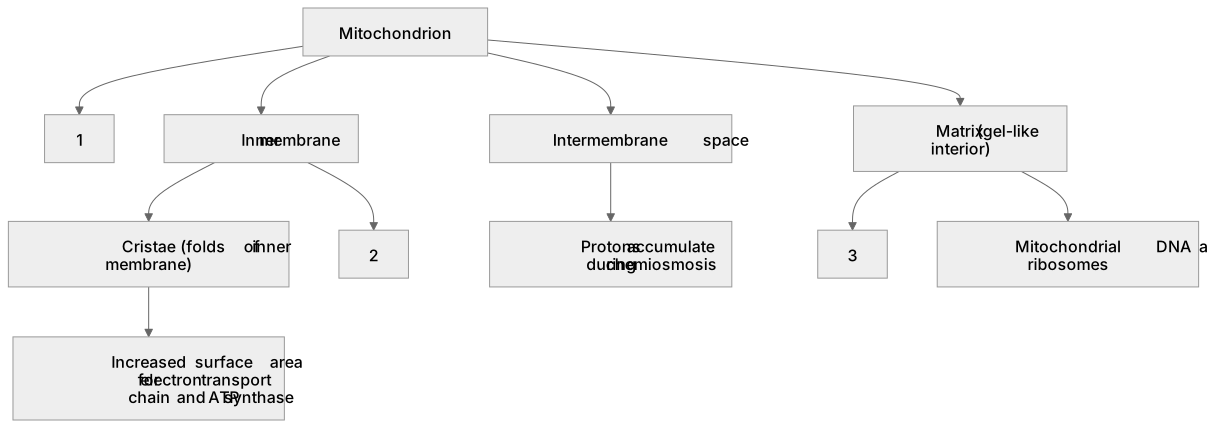
Some boxes have lost their names. Pick the right name for each number.
1Box 1
2Box 2
3Box 3
There is more to this lesson
The full lesson goes on to check your understanding and help you earn the marks. Create a free account to carry on, with your progress saved.
A week of Premium from your first lesson · Then the free plan continues · No card, no charge
Test your understanding of Respiration: (b) the structure of the mitochondrion
Active recall beats re-reading. Take an instant quiz now to test what you’ve learned and lock it into long-term memory.
A week of Premium from your first lesson · Then the free plan continues · No card, no charge