OCR · A-Level · Biology
Course version: H420 · Version from Sept 2025
Respiration: (c) the process and site of glycolysis
Glycolysis is the first stage of respiration and happens in the cytoplasm, not inside a mitochondrion, so it needs no organelle membranes.
Checked against the OCR H420 specification (opens in a new tab) on .
- Point 3 of 13
- 4 key terms
Study notes
From the checked teaching notes for this specification point.
The idea
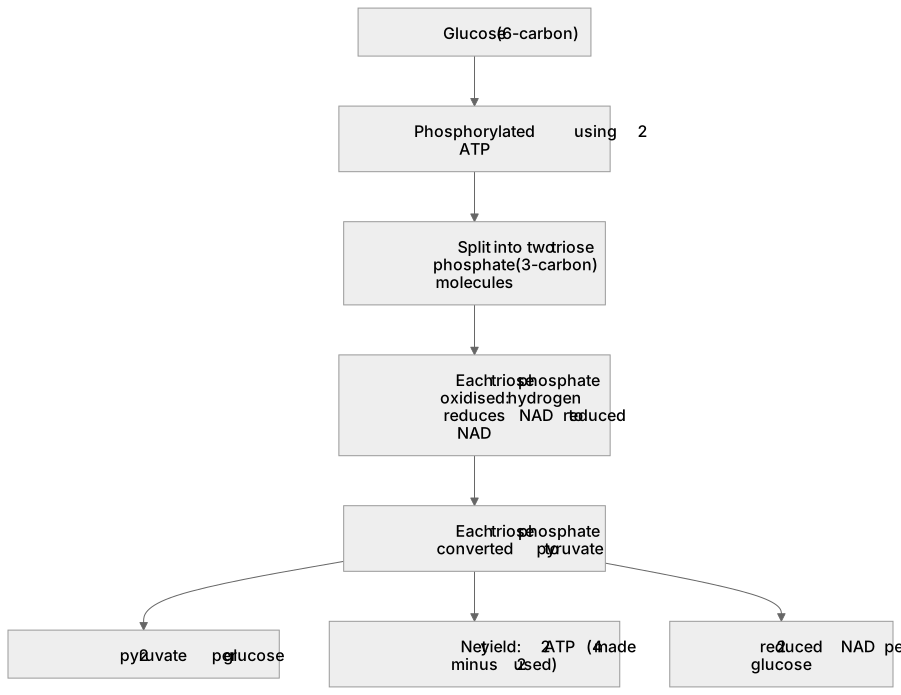
Glycolysis is the first stage of respiration and happens in the cytoplasm, not inside a mitochondrion, so it needs no organelle membranes. Glucose (a 6-carbon sugar) is phosphorylated by two ATP molecules, then split into two 3-carbon triose phosphate molecules. Each triose phosphate is oxidised, losing hydrogen that is picked up by NAD to form reduced NAD, and each is converted to pyruvate. Because two triose phosphates are processed, the net yield per glucose is 2 ATP (4 made minus 2 used), 2 reduced NAD and 2 pyruvate. The pathway is anaerobic and reversible in part, and it is the substrate-level phosphorylation step that regenerates ATP. Learn the site, the inputs, the splitting, the oxidation and the net products, and be ready to explain why the net ATP is two rather than four.
What earns the marks
- Glycolysis occurs in the cytoplasm of the cell, not in the mitochondrion.
- Glucose is phosphorylated using 2 ATP, then split into two triose phosphate (3-carbon) molecules.
- Each triose phosphate is oxidised, and the hydrogen removed reduces NAD to form reduced NAD.
- Each triose phosphate is converted to pyruvate, giving 2 pyruvate per glucose.
- Net yield per glucose is 2 ATP (4 produced minus 2 used) and 2 reduced NAD.
- Glycolysis is anaerobic and does not require oxygen or mitochondrial membranes.
Common mistakes and how to put them right
Saying glycolysis happens in the mitochondrial matrix.
Put it right: Correct it to the cytoplasm.
Giving a gross yield of 4 ATP without subtracting the 2 ATP used, so the net figure is wrongly stated.
Put it right: The net is 2 ATP.
Forgetting that NAD is reduced (gains hydrogen) rather than oxidised during the oxidation of triose phosphate.
Exam tips
- Anchor the answer with the site first, then work through the steps in order: phosphorylation, splitting, oxidation, pyruvate formation.
- Always state net ATP and show the subtraction (4 made minus 2 used) to demonstrate understanding.
- Use precise terms: triose phosphate, pyruvate, reduced NAD, substrate-level phosphorylation.
Try the lesson
The start of the Respiration: (c) the process and site of glycolysis lesson, made from checked teaching notes for this specification point.
Have a go first
In which part of a eukaryotic cell does glycolysis take place?
Listen
Glycolysis is the first stage of respiration and happens in the cytoplasm, not inside a mitochondrion, so it needs no organelle membranes. Glucose (a 6-carbon sugar) is phosphorylated by two ATP molecules, then split into two 3-carbon triose phosphate molecules. Each triose phosphate is oxidised, losing hydrogen that is picked up by NAD to form reduced NAD, and each is converted to pyruvate. Because two triose phosphates are processed, the net yield per glucose is 2 ATP (4 made minus 2 used), 2 reduced NAD and 2 pyruvate. The pathway is anaerobic and reversible in part, and it is the substrate-level phosphorylation step that regenerates ATP. Learn the site, the inputs, the splitting, the oxidation and the net products, and be ready to explain why the net ATP is two rather than four. A strong answer earns marks for these points. Glycolysis occurs in the cytoplasm of the cell, not in the mitochondrion. Glucose is phosphorylated using 2 ATP, then split into two triose phosphate (3-carbon) molecules. Each triose phosphate is oxidised, and the hydrogen removed reduces NAD to form reduced NAD. Each triose phosphate is converted to pyruvate, giving 2 pyruvate per glucose. Exam tip: Anchor the answer with the site first, then work through the steps in order: phosphorylation, splitting, oxidation, pyruvate formation.
See it
Key words
Say what each word means before you turn the card.
Location of glycolysis in the cytoplasm
Try answering aloud or in your head before turning the card.
Phosphorylation and splitting of glucose
Try answering aloud or in your head before turning the card.
Oxidation and reduction of NAD
Try answering aloud or in your head before turning the card.
Net ATP and pyruvate yield
Try answering aloud or in your head before turning the card.
See every definition
- Location of glycolysis in the cytoplasm
- Glycolysis happens in the cytoplasm, not inside a mitochondrion, so it needs no organelle membranes.
- Phosphorylation and splitting of glucose
- Glucose, a 6-carbon sugar, is phosphorylated by two ATP molecules, then split into two 3-carbon triose phosphate molecules.
- Oxidation and reduction of NAD
- Each triose phosphate is oxidised, losing hydrogen that is picked up by NAD to form reduced NAD.
- Net ATP and pyruvate yield
- Because two triose phosphates are processed, the net yield per glucose is 2 ATP (4 made minus 2 used), 2 reduced NAD and 2 pyruvate.
Label the diagram
Some boxes have lost their names. Pick the right name for each number.
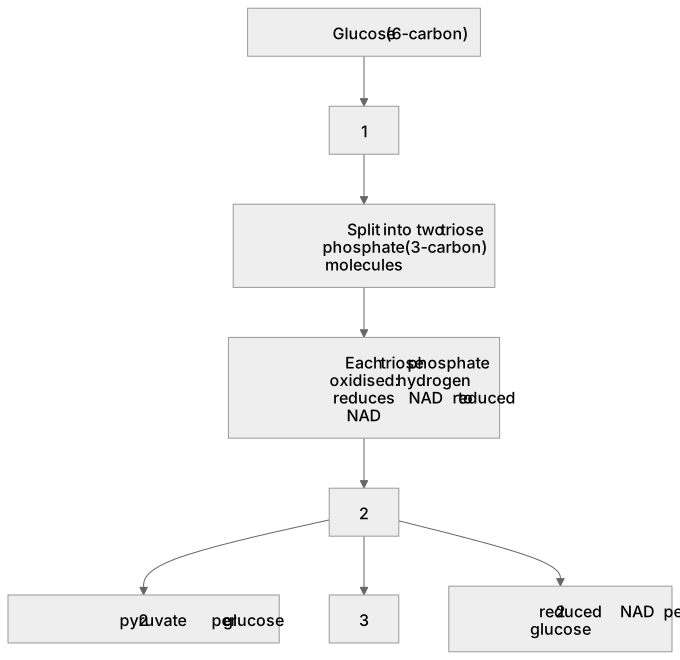
1Box 1
2Box 2
3Box 3
There is more to this lesson
The full lesson goes on to check your understanding and help you earn the marks. Create a free account to carry on, with your progress saved.
A week of Premium from your first lesson · Then the free plan continues · No card, no charge
Test your understanding of Respiration: (c) the process and site of glycolysis
Active recall beats re-reading. Take an instant quiz now to test what you’ve learned and lock it into long-term memory.
A week of Premium from your first lesson · Then the free plan continues · No card, no charge