OCR · A-Level · Biology
Course version: H420 · Version from Sept 2025
Respiration: (d) the link reaction and its site in the cell
The link reaction joins glycolysis to the Krebs cycle and takes place in the mitochondrial matrix.
Checked against the OCR H420 specification (opens in a new tab) on .
- Point 4 of 13
- 4 key terms
Study notes
From the checked teaching notes for this specification point.
The idea
The link reaction joins glycolysis to the Krebs cycle and takes place in the mitochondrial matrix. Pyruvate made in the cytoplasm is moved into the mitochondrion. There it is decarboxylated, losing a carbon as carbon dioxide, and dehydrogenated, with the removed hydrogen reducing NAD to reduced NAD. The remaining 2-carbon acetyl group combines with coenzyme A to form acetyl coenzyme A, which then delivers the acetyl group into the Krebs cycle. Per pyruvate the link reaction removes one carbon dioxide and produces one reduced NAD; because glycolysis gives two pyruvate per glucose, the totals per glucose are 2 carbon dioxide and 2 reduced NAD. No ATP is made directly in the link reaction.
What earns the marks
- The link reaction occurs in the mitochondrial matrix.
- Pyruvate is decarboxylated, releasing carbon dioxide (one carbon removed).
- Pyruvate is dehydrogenated, and the hydrogen reduces NAD to form reduced NAD.
- The remaining 2-carbon acetyl group combines with coenzyme A to form acetyl coenzyme A.
- Per glucose, two pyruvate give 2 carbon dioxide and 2 reduced NAD, with no ATP produced directly.
Common mistakes and how to put them right
Placing the link reaction in the cytoplasm.
Put it right: Correct it to the mitochondrial matrix.
Claiming the link reaction produces ATP directly.
Put it right: It produces reduced NAD and carbon dioxide but no ATP.
Saying the whole pyruvate enters the Krebs cycle.
Put it right: Only the 2-carbon acetyl group is passed on via acetyl coenzyme A.
Exam tips
- Name the site (mitochondrial matrix) before describing the chemistry.
- Use the paired terms decarboxylation (loses CO₂) and dehydrogenation (reduces NAD) to structure the answer.
- Scale up to per glucose by doubling the per-pyruvate products.
Try the lesson
The start of the Respiration: (d) the link reaction and its site in the cell lesson, made from checked teaching notes for this specification point.
Have a go first
In which part of a eukaryotic cell does the link reaction take place?
Listen
The link reaction joins glycolysis to the Krebs cycle and takes place in the mitochondrial matrix. Pyruvate made in the cytoplasm is moved into the mitochondrion. There it is decarboxylated, losing a carbon as carbon dioxide, and dehydrogenated, with the removed hydrogen reducing NAD to reduced NAD. The remaining 2-carbon acetyl group combines with coenzyme A to form acetyl coenzyme A, which then delivers the acetyl group into the Krebs cycle. Per pyruvate the link reaction removes one carbon dioxide and produces one reduced NAD; because glycolysis gives two pyruvate per glucose, the totals per glucose are 2 carbon dioxide and 2 reduced NAD. No ATP is made directly in the link reaction. A strong answer earns marks for these points. The link reaction occurs in the mitochondrial matrix. Pyruvate is decarboxylated, releasing carbon dioxide (one carbon removed). Pyruvate is dehydrogenated, and the hydrogen reduces NAD to form reduced NAD. The remaining 2-carbon acetyl group combines with coenzyme A to form acetyl coenzyme A. Exam tip: Name the site (mitochondrial matrix) before describing the chemistry.
See it
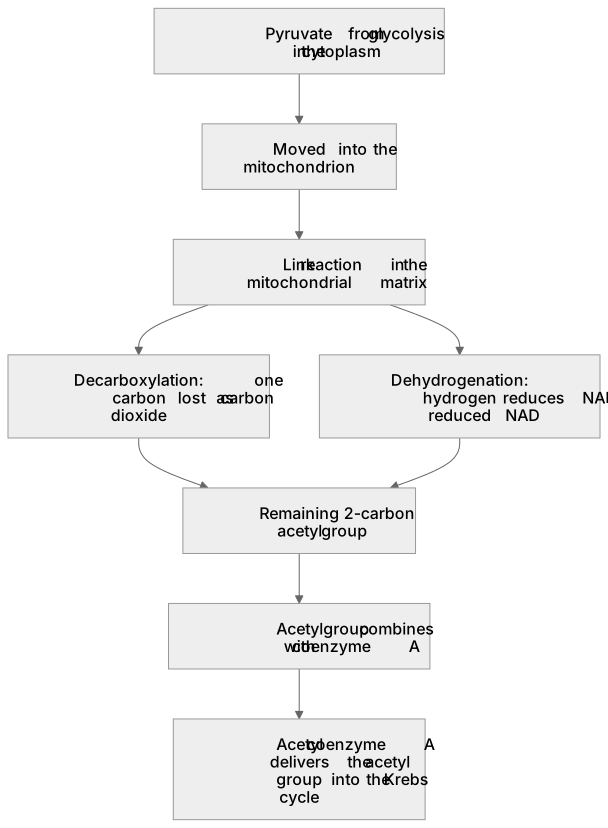
Key words
Say what each word means before you turn the card.
Mitochondrial matrix
Try answering aloud or in your head before turning the card.
Decarboxylation
Try answering aloud or in your head before turning the card.
Dehydrogenation
Try answering aloud or in your head before turning the card.
Acetyl coenzyme A
Try answering aloud or in your head before turning the card.
See every definition
- Mitochondrial matrix
- The site in the cell where the link reaction takes place, after pyruvate made in the cytoplasm is moved into the mitochondrion.
- Decarboxylation
- The loss of a carbon as carbon dioxide when pyruvate is converted, removing one carbon per pyruvate.
- Dehydrogenation
- The removal of hydrogen from pyruvate, with the removed hydrogen reducing NAD to reduced NAD.
- Acetyl coenzyme A
- Formed when the remaining 2-carbon acetyl group combines with coenzyme A, delivering the acetyl group into the Krebs cycle.
Label the diagram
Some boxes have lost their names. Pick the right name for each number.
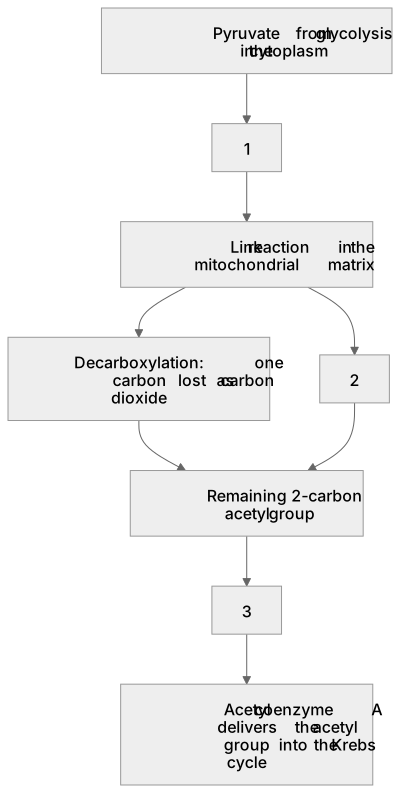
1Box 1
2Box 2
3Box 3
There is more to this lesson
The full lesson goes on to check your understanding and help you earn the marks. Create a free account to carry on, with your progress saved.
A week of Premium from your first lesson · Then the free plan continues · No card, no charge
Test your understanding of Respiration: (d) the link reaction and its site in the cell
Active recall beats re-reading. Take an instant quiz now to test what you’ve learned and lock it into long-term memory.
A week of Premium from your first lesson · Then the free plan continues · No card, no charge