OCR · A-Level · Biology
Course version: H420 · Version from Sept 2025
Respiration: (h) the chemiosmotic theory
The chemiosmotic theory explains how ATP is synthesised using a proton gradient across a membrane.
Checked against the OCR H420 specification (opens in a new tab) on .
- Point 8 of 13
- 4 key terms
Study notes
From the checked teaching notes for this specification point.
The idea
The chemiosmotic theory explains how ATP is synthesised using a proton gradient across a membrane. During electron transport, energy pumps protons (H⁺) across the inner mitochondrial membrane from the matrix into the intermembrane space, creating an electrochemical gradient. Protons then diffuse back through ATP synthase, a membrane protein that acts as a channel and enzyme. The flow of protons down their gradient provides the energy to phosphorylate ADP, forming ATP. This coupling of electron transport to ATP synthesis via a proton gradient is chemiosmosis. The theory applies to mitochondria and chloroplasts, where membranes separate proton pools.
What earns the marks
- Protons are pumped across the inner mitochondrial membrane, creating a gradient.
- The gradient stores potential energy (electrochemical gradient).
- Protons flow back through ATP synthase down the gradient.
- ATP synthase uses this flow to phosphorylate ADP to ATP.
- The theory links electron transport to ATP synthesis via chemiosmosis.
Common mistakes and how to put them right
Thinking ATP synthase pumps protons.
Put it right: Correct it to protons flowing through ATP synthase.
Ignoring the membrane requirement.
Put it right: Correct it to a proton-impermeable membrane needed to maintain the gradient.
Confusing chemiosmosis with substrate-level phosphorylation.
Put it right: Correct it to gradient-driven ATP synthesis.
Exam tips
- Define the proton gradient and its role clearly.
- Name ATP synthase as both channel and enzyme.
- Explain that the energy comes from the proton gradient, not directly from electrons.
Try the lesson
The start of the Respiration: (h) the chemiosmotic theory lesson, made from checked teaching notes for this specification point.
Have a go first
According to the chemiosmotic theory, what directly drives the synthesis of ATP by ATP synthase?
Listen
The chemiosmotic theory explains how ATP is synthesised using a proton gradient across a membrane. During electron transport, energy pumps protons (H⁺) across the inner mitochondrial membrane from the matrix into the intermembrane space, creating an electrochemical gradient. Protons then diffuse back through ATP synthase, a membrane protein that acts as a channel and enzyme. The flow of protons down their gradient provides the energy to phosphorylate ADP, forming ATP. This coupling of electron transport to ATP synthesis via a proton gradient is chemiosmosis. The theory applies to mitochondria and chloroplasts, where membranes separate proton pools. A strong answer earns marks for these points. Protons are pumped across the inner mitochondrial membrane, creating a gradient. The gradient stores potential energy (electrochemical gradient). Protons flow back through ATP synthase down the gradient. ATP synthase uses this flow to phosphorylate ADP to ATP. Exam tip: Define the proton gradient and its role clearly.
See it
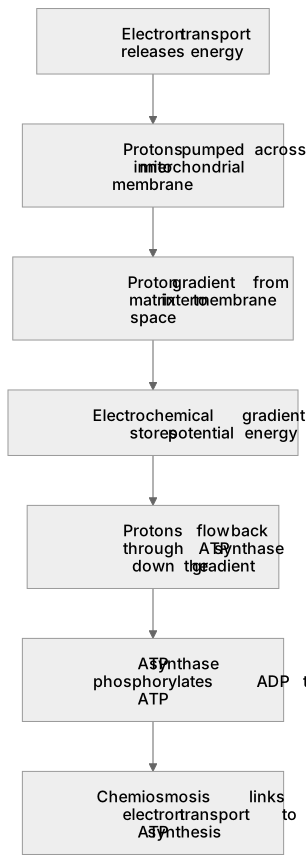
Put it in order
Put these steps in the order they happen.
- 1. Chemiosmosis links electron transport to ATP synthesis
- 2. ATP synthase phosphorylates ADP to ATP
- 3. Proton gradient from matrix to intermembrane space
- 4. Protons flow back through ATP synthase down the gradient
- 5. Electron transport releases energy
- 6. Protons pumped across inner mitochondrial membrane
- 7. Electrochemical gradient stores potential energy
Key words
Say what each word means before you turn the card.
Proton gradient
Try answering aloud or in your head before turning the card.
Electrochemical gradient
Try answering aloud or in your head before turning the card.
ATP synthase
Try answering aloud or in your head before turning the card.
Coupling of electron transport to ATP synthesis
Try answering aloud or in your head before turning the card.
See every definition
- Proton gradient
- Energy from electron transport pumps protons across the inner mitochondrial membrane from the matrix into the intermembrane space, creating a gradient.
- Electrochemical gradient
- The gradient created across the inner mitochondrial membrane stores potential energy.
- ATP synthase
- A membrane protein that acts as a channel and enzyme, through which protons diffuse back down their gradient.
- Coupling of electron transport to ATP synthesis
- The flow of protons down their gradient provides the energy to phosphorylate ADP, forming ATP, which is chemiosmosis.
Label the diagram
Some boxes have lost their names. Pick the right name for each number.
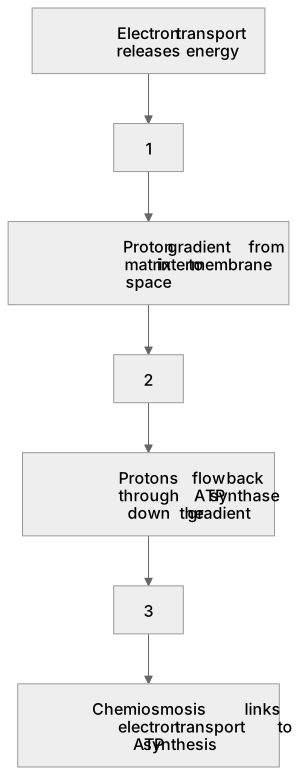
1Box 1
2Box 2
3Box 3
There is more to this lesson
The full lesson goes on to check your understanding and help you earn the marks. Create a free account to carry on, with your progress saved.
A week of Premium from your first lesson · Then the free plan continues · No card, no charge
Test your understanding of Respiration: (h) the chemiosmotic theory
Active recall beats re-reading. Take an instant quiz now to test what you’ve learned and lock it into long-term memory.
A week of Premium from your first lesson · Then the free plan continues · No card, no charge