OCR · A-Level · Biology
Course version: H420 · Version from Sept 2025
Respiration: (i) (i) the process of anaerobic respiration in eukaryotes
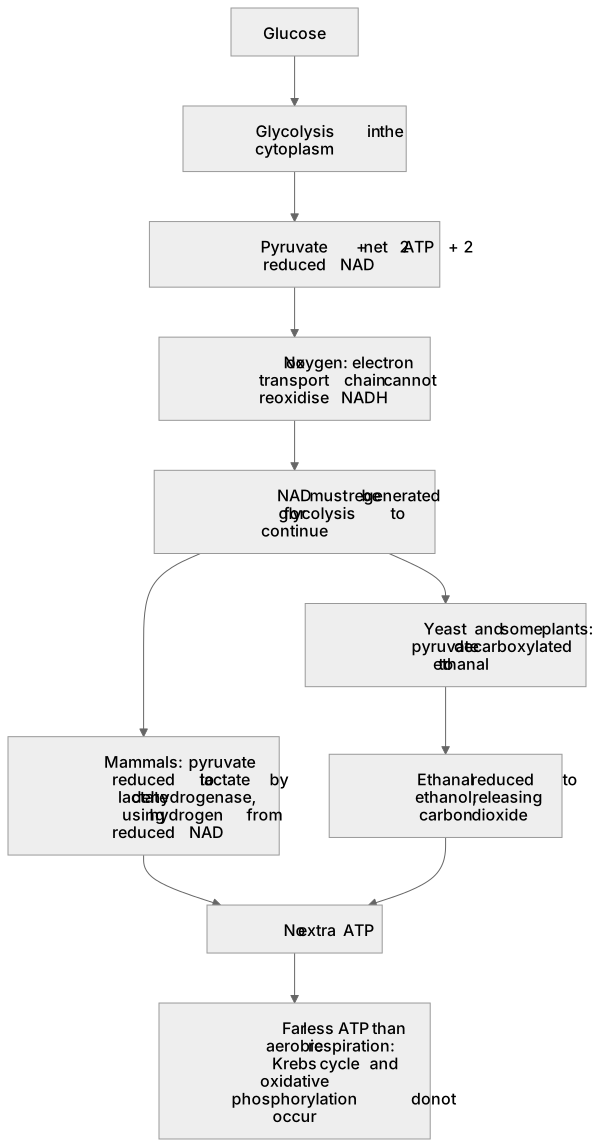
Anaerobic respiration in eukaryotes begins with glycolysis in the cytoplasm, where glucose is converted to pyruvate with a net gain of 2 ATP and 2 reduced NAD.
Checked against the OCR H420 specification (opens in a new tab) on .
- Point 9 of 13
- 4 key terms
Study notes
From the checked teaching notes for this specification point.
The idea
Anaerobic respiration in eukaryotes begins with glycolysis in the cytoplasm, where glucose is converted to pyruvate with a net gain of 2 ATP and 2 reduced NAD. Without oxygen, the electron transport chain cannot reoxidise NADH, so NAD must be regenerated for glycolysis to continue. In mammals, pyruvate is reduced to lactate, catalysed by lactate dehydrogenase, using the hydrogen from reduced NAD; this yields no extra ATP. In yeast and some plants, pyruvate is decarboxylated to ethanal, which is then reduced to ethanol, releasing carbon dioxide. The ATP yield is much lower than in aerobic respiration because the Krebs cycle and oxidative phosphorylation do not operate.
What earns the marks
- Glycolysis occurs in the cytoplasm and converts glucose to pyruvate, producing a net gain of 2 ATP and 2 reduced NAD.
- In the absence of oxygen, the electron transport chain cannot reoxidise NADH, so NAD must be regenerated to allow glycolysis to continue.
- In mammals, pyruvate is reduced to lactate by lactate dehydrogenase, using hydrogen from reduced NAD, with no additional ATP produced.
- In yeast and some plant cells, pyruvate is decarboxylated to ethanal, which is reduced to ethanol, releasing carbon dioxide.
- Anaerobic respiration yields far less ATP than aerobic respiration because the Krebs cycle and oxidative phosphorylation do not occur.
Common mistakes and how to put them right
Thinking anaerobic respiration produces large amounts of ATP.
Put it right: It yields only the net 2 ATP from glycolysis.
Believing oxygen is used in anaerobic respiration.
Put it right: The pathway operates when oxygen is absent and the electron transport chain cannot function.
Confusing the products in different eukaryotes.
Put it right: Mammals produce lactate, whereas yeast and some plants produce ethanol and carbon dioxide.
Exam tips
- State the location of glycolysis (cytoplasm) and its net ATP yield explicitly.
- Explain the purpose of regenerating NAD so that glycolysis can continue.
- Name the enzyme and the hydrogen donor when describing lactate formation.
Try the lesson
The start of the Respiration: (i) (i) the process of anaerobic respiration in eukaryotes lesson, made from checked teaching notes for this specification point.
Have a go first
In a eukaryotic cell such as a human muscle fibre, which product is formed when pyruvate is reduced in the absence of oxygen?
Listen
Anaerobic respiration in eukaryotes begins with glycolysis in the cytoplasm, where glucose is converted to pyruvate with a net gain of 2 ATP and 2 reduced NAD. Without oxygen, the electron transport chain cannot reoxidise NADH, so NAD must be regenerated for glycolysis to continue. In mammals, pyruvate is reduced to lactate, catalysed by lactate dehydrogenase, using the hydrogen from reduced NAD; this yields no extra ATP. In yeast and some plants, pyruvate is decarboxylated to ethanal, which is then reduced to ethanol, releasing carbon dioxide. The ATP yield is much lower than in aerobic respiration because the Krebs cycle and oxidative phosphorylation do not operate. A strong answer earns marks for these points. Glycolysis occurs in the cytoplasm and converts glucose to pyruvate, producing a net gain of 2 ATP and 2 reduced NAD. In the absence of oxygen, the electron transport chain cannot reoxidise NADH, so NAD must be regenerated to allow glycolysis to continue. In mammals, pyruvate is reduced to lactate by lactate dehydrogenase, using hydrogen from reduced NAD, with no additional ATP produced. In yeast and some plant cells, pyruvate is decarboxylated to ethanal, which is reduced to ethanol, releasing carbon dioxide. Exam tip: State the location of glycolysis (cytoplasm) and its net ATP yield explicitly.
See it
Key words
Say what each word means before you turn the card.
Glycolysis and its net ATP yield
Try answering aloud or in your head before turning the card.
Regeneration of NAD in the absence of oxygen
Try answering aloud or in your head before turning the card.
Lactate fermentation in mammals
Try answering aloud or in your head before turning the card.
Ethanol fermentation in yeast and some plants
Try answering aloud or in your head before turning the card.
See every definition
- Glycolysis and its net ATP yield
- Occurs in the cytoplasm, where glucose is converted to pyruvate with a net gain of 2 ATP and 2 reduced NAD.
- Regeneration of NAD in the absence of oxygen
- Without oxygen the electron transport chain cannot reoxidise NADH, so NAD must be regenerated for glycolysis to continue.
- Lactate fermentation in mammals
- Pyruvate is reduced to lactate by lactate dehydrogenase, using the hydrogen from reduced NAD, and yields no extra ATP.
- Ethanol fermentation in yeast and some plants
- Pyruvate is decarboxylated to ethanal, which is then reduced to ethanol, releasing carbon dioxide.
Label the diagram
Some boxes have lost their names. Pick the right name for each number.
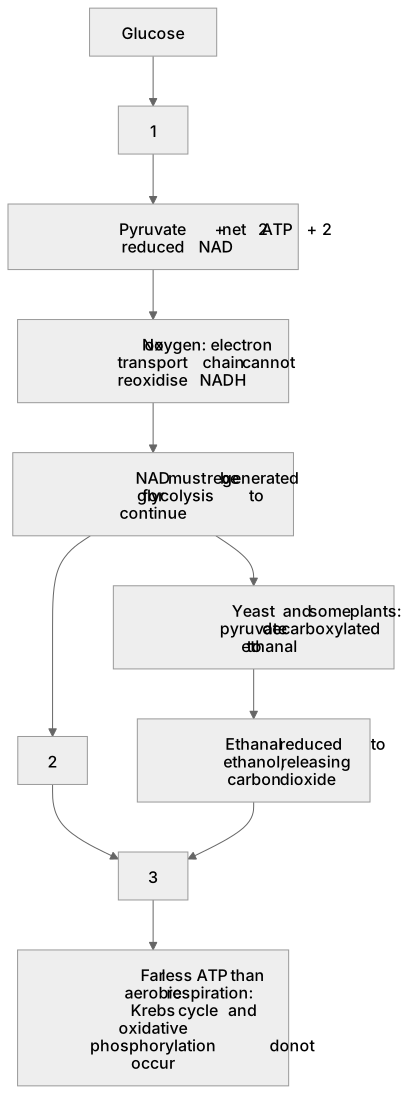
1Box 1
2Box 2
3Box 3
There is more to this lesson
The full lesson goes on to check your understanding and help you earn the marks. Create a free account to carry on, with your progress saved.
A week of Premium from your first lesson · Then the free plan continues · No card, no charge
Test your understanding of Respiration: (i) (i) the process of anaerobic respiration in eukaryotes
Active recall beats re-reading. Take an instant quiz now to test what you’ve learned and lock it into long-term memory.
A week of Premium from your first lesson · Then the free plan continues · No card, no charge