OCR · A-Level · Biology
Course version: H420 · Version from Sept 2025
Respiration: (k) the use and interpretation of the respiratory quotient (RQ)
The respiratory quotient (RQ) is the ratio of carbon dioxide produced to oxygen consumed during respiration: RQ = CO₂ produced ÷ O₂ consumed.
Checked against the OCR H420 specification (opens in a new tab) on .
- Point 12 of 13
- 4 key terms
Study notes
From the checked teaching notes for this specification point.
The idea
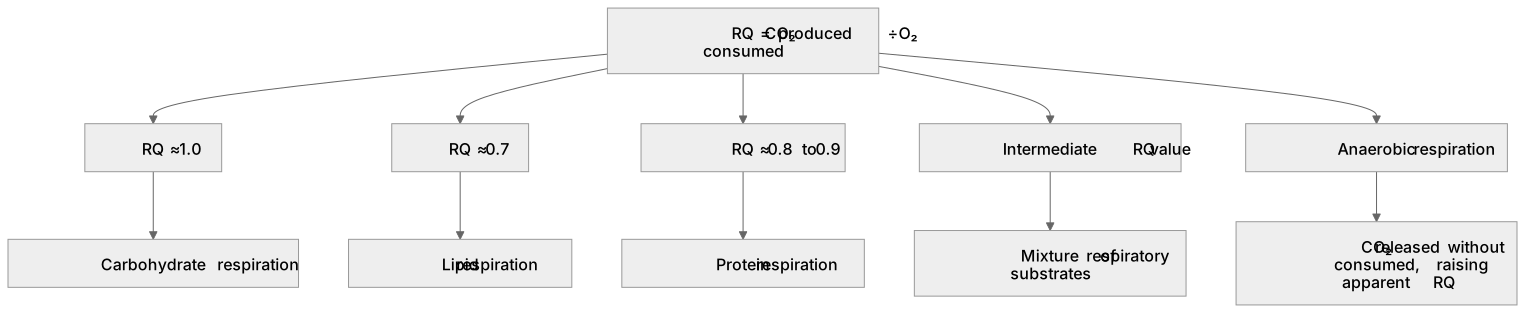
The respiratory quotient (RQ) is the ratio of carbon dioxide produced to oxygen consumed during respiration: RQ = CO₂ produced ÷ O₂ consumed. It is used to identify which respiratory substrate is being respired. For carbohydrates such as glucose, RQ is about 1.0 because equal volumes of CO₂ are produced and O₂ used. For lipids, RQ is about 0.7 because they contain much hydrogen and little oxygen, so more O₂ is needed to oxidise them. For proteins, RQ is about 0.8 to 0.9. A value between these indicates a mixture of substrates.
What earns the marks
- RQ = CO₂ produced ÷ O₂ consumed, expressed as a ratio.
- An RQ of approximately 1.0 indicates carbohydrate respiration.
- An RQ of approximately 0.7 indicates lipid respiration.
- An RQ of approximately 0.8 to 0.9 indicates protein respiration.
- Intermediate RQ values indicate a mixture of respiratory substrates being respired.
- Anaerobic respiration can raise the apparent RQ because CO₂ is released without oxygen being consumed.
Common mistakes and how to put them right
Inverting the ratio to O₂ ÷ CO₂.
Put it right: RQ is CO₂ produced divided by O₂ consumed.
Assuming a high RQ always means lipid use.
Put it right: High RQ near 1.0 indicates carbohydrate, while low RQ near 0.7 indicates lipid.
Ignoring anaerobic respiration when interpreting an unusually high RQ.
Put it right: Anaerobic respiration releases CO₂ without O₂ uptake, raising the apparent RQ.
Exam tips
- Write the RQ formula before substituting values to avoid inverting the ratio.
- Compare your calculated RQ with the reference values (1.0 carbohydrate, 0.7 lipid, 0.8–0.9 protein) to identify the substrate.
- Check whether anaerobic respiration could be occurring before concluding a substrate from an unusual RQ.
Try the lesson
The start of the Respiration: (k) the use and interpretation of the respiratory quotient (RQ) lesson, made from checked teaching notes for this specification point.
Have a go first
What respiratory quotient value is expected when carbohydrate is the sole respiratory substrate?
Listen
The respiratory quotient (RQ) is the ratio of carbon dioxide produced to oxygen consumed during respiration: RQ = CO₂ produced ÷ O₂ consumed. It is used to identify which respiratory substrate is being respired. For carbohydrates such as glucose, RQ is about 1.0 because equal volumes of CO₂ are produced and O₂ used. For lipids, RQ is about 0.7 because they contain much hydrogen and little oxygen, so more O₂ is needed to oxidise them. For proteins, RQ is about 0.8 to 0.9. A value between these indicates a mixture of substrates. A strong answer earns marks for these points. RQ = CO₂ produced ÷ O₂ consumed, expressed as a ratio. An RQ of approximately 1.0 indicates carbohydrate respiration. An RQ of approximately 0.7 indicates lipid respiration. An RQ of approximately 0.8 to 0.9 indicates protein respiration. A common slip: Inverting the ratio to O₂ ÷ CO₂. Instead, RQ is CO₂ produced divided by O₂ consumed. Exam tip: Write the RQ formula before substituting values to avoid inverting the ratio.
See it
Key words
Say what each word means before you turn the card.
Respiratory quotient formula
Try answering aloud or in your head before turning the card.
Identifying respiratory substrates
Try answering aloud or in your head before turning the card.
Mixtures of substrates
Try answering aloud or in your head before turning the card.
Anaerobic respiration effects
Try answering aloud or in your head before turning the card.
See every definition
- Respiratory quotient formula
- The ratio of carbon dioxide produced to oxygen consumed during respiration, calculated as CO₂ produced ÷ O₂ consumed.
- Identifying respiratory substrates
- Using the RQ value to identify which respiratory substrate is being respired, comparing it with reference values of about 1.0 for carbohydrate, 0.7 for lipid and 0.8 to 0.9 for protein.
- Mixtures of substrates
- A value between the reference ranges indicates a mixture of substrates being respired.
- Anaerobic respiration effects
- Anaerobic respiration can distort results because CO₂ is produced without O₂ uptake, raising the apparent RQ.
Label the diagram
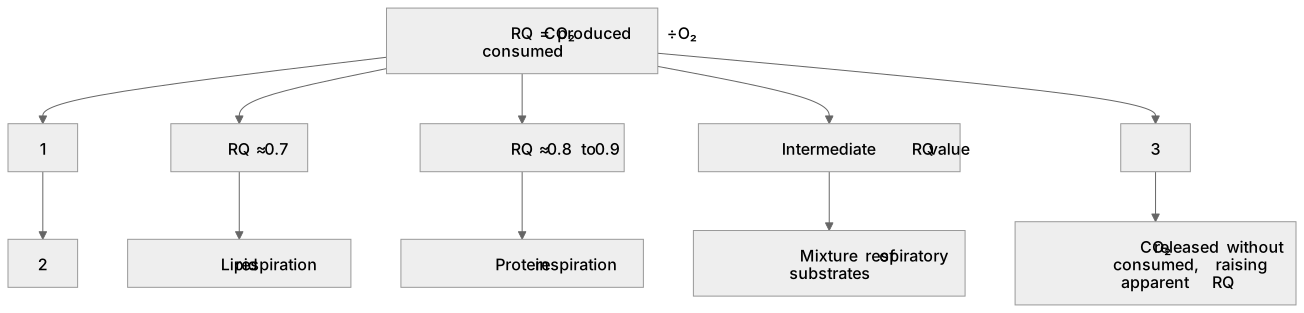
Some boxes have lost their names. Pick the right name for each number.
1Box 1
2Box 2
3Box 3
There is more to this lesson
The full lesson goes on to check your understanding and help you earn the marks. Create a free account to carry on, with your progress saved.
A week of Premium from your first lesson · Then the free plan continues · No card, no charge
Test your understanding of Respiration: (k) the use and interpretation of the respiratory quotient (RQ)
Active recall beats re-reading. Take an instant quiz now to test what you’ve learned and lock it into long-term memory.
A week of Premium from your first lesson · Then the free plan continues · No card, no charge