OCR · A-Level · Biology
Course version: H420 · Version from Sept 2025
(j) the difference in relative energy values of carbohydrates, lipids and…
Full specification wording
Respiration: (j) the difference in relative energy values of carbohydrates, lipids and proteins as respiratory substrates
Respiratory substrates are oxidised to release energy, but equal masses do not yield equal energy.
Checked against the OCR H420 specification (opens in a new tab) on .
- Point 11 of 13
- 4 key terms
Study notes
From the checked teaching notes for this specification point.
The idea
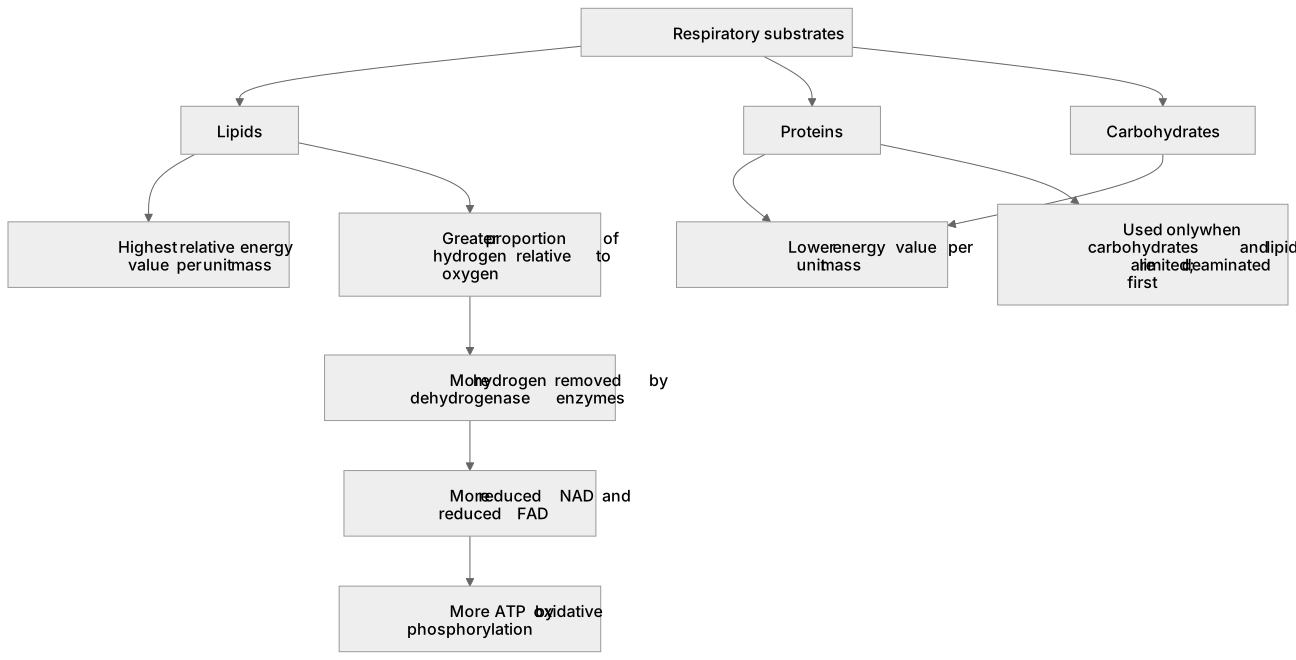
Respiratory substrates are oxidised to release energy, but equal masses do not yield equal energy. Lipids store more energy per gram than carbohydrates because they contain proportionally more hydrogen and less oxygen, so more hydrogen atoms are available to be removed and passed to NAD and FAD, feeding oxidative phosphorylation. Proteins release roughly similar energy per gram to carbohydrates but are usually respired only when other substrates are scarce, being deaminated first. A useful comparison is per gram: lipid highest, then protein and carbohydrate close together. Learners should link the energy value to the proportion of hydrogen and to the yield of reduced coenzymes and ATP, not simply memorise a ranking.
What earns the marks
- Lipids have the highest relative energy value per unit mass of the three substrates.
- Carbohydrates and proteins have lower, broadly similar energy values per unit mass than lipids.
- The higher energy value of lipids reflects a greater proportion of hydrogen relative to oxygen, giving more hydrogen for dehydrogenase enzymes to remove.
- More hydrogen removal produces more reduced NAD and reduced FAD, so more ATP is generated by oxidative phosphorylation.
- Proteins are typically used as a respiratory substrate only when carbohydrates and lipids are limited, and must be deaminated first.
Common mistakes and how to put them right
Assuming all substrates release the same energy per gram because they are all oxidised.
Put it right by comparing energy per gram and linking it to hydrogen content.
Claiming proteins have the highest energy value.
Put it right by ranking lipids highest, with proteins and carbohydrates lower and close together.
Treating energy value as fixed per molecule rather than per unit mass.
Put it right by stating the comparison is per gram of substrate.
Exam tips
- State the comparison explicitly as per gram or per unit mass, since energy values depend on the basis of comparison.
- Link the ranking to hydrogen content and the yield of reduced coenzymes rather than only quoting a number.
- When a question gives data, read the units and compare like with like before choosing an option.
Try the lesson
The start of the Respiration: (j) the difference in relative energy values of carbohydrates, lipids and proteins as respiratory substrates lesson, made from checked teaching notes for this specification point.
Have a go first
Which respiratory substrate releases the greatest amount of energy per gram when respired?
Listen
Respiratory substrates are oxidised to release energy, but equal masses do not yield equal energy. Lipids store more energy per gram than carbohydrates because they contain proportionally more hydrogen and less oxygen, so more hydrogen atoms are available to be removed and passed to NAD and FAD, feeding oxidative phosphorylation. Proteins release roughly similar energy per gram to carbohydrates but are usually respired only when other substrates are scarce, being deaminated first. A useful comparison is per gram: lipid highest, then protein and carbohydrate close together. Learners should link the energy value to the proportion of hydrogen and to the yield of reduced coenzymes and ATP, not simply memorise a ranking. A strong answer earns marks for these points. Lipids have the highest relative energy value per unit mass of the three substrates. Carbohydrates and proteins have lower, broadly similar energy values per unit mass than lipids. The higher energy value of lipids reflects a greater proportion of hydrogen relative to oxygen, giving more hydrogen for dehydrogenase enzymes to remove. More hydrogen removal produces more reduced NAD and reduced FAD, so more ATP is generated by oxidative phosphorylation. A common slip: Assuming all substrates release the same energy per gram because they are all oxidised. Instead, comparing energy per gram and linking it to hydrogen content. Exam tip: State the comparison explicitly as per gram or per unit mass, since energy values depend on the basis of comparison.
See it
Key words
Say what each word means before you turn the card.
Energy value of respiratory substrates
Try answering aloud or in your head before turning the card.
Hydrogen content and reduced coenzymes
Try answering aloud or in your head before turning the card.
Oxidative phosphorylation and ATP yield
Try answering aloud or in your head before turning the card.
Order of substrate use in respiration
Try answering aloud or in your head before turning the card.
See every definition
- Energy value of respiratory substrates
- The energy released when a substrate is oxidised, compared per gram or per unit mass, since equal masses do not yield equal energy.
- Hydrogen content and reduced coenzymes
- Lipids contain proportionally more hydrogen and less oxygen, so more hydrogen is removed and passed to NAD and FAD, producing more reduced coenzymes.
- Oxidative phosphorylation and ATP yield
- More hydrogen removal produces more reduced NAD and reduced FAD, so more ATP is generated by oxidative phosphorylation.
- Order of substrate use in respiration
- Proteins are typically used as a respiratory substrate only when carbohydrates and lipids are limited, and must be deaminated first.
Label the diagram
Some boxes have lost their names. Pick the right name for each number.
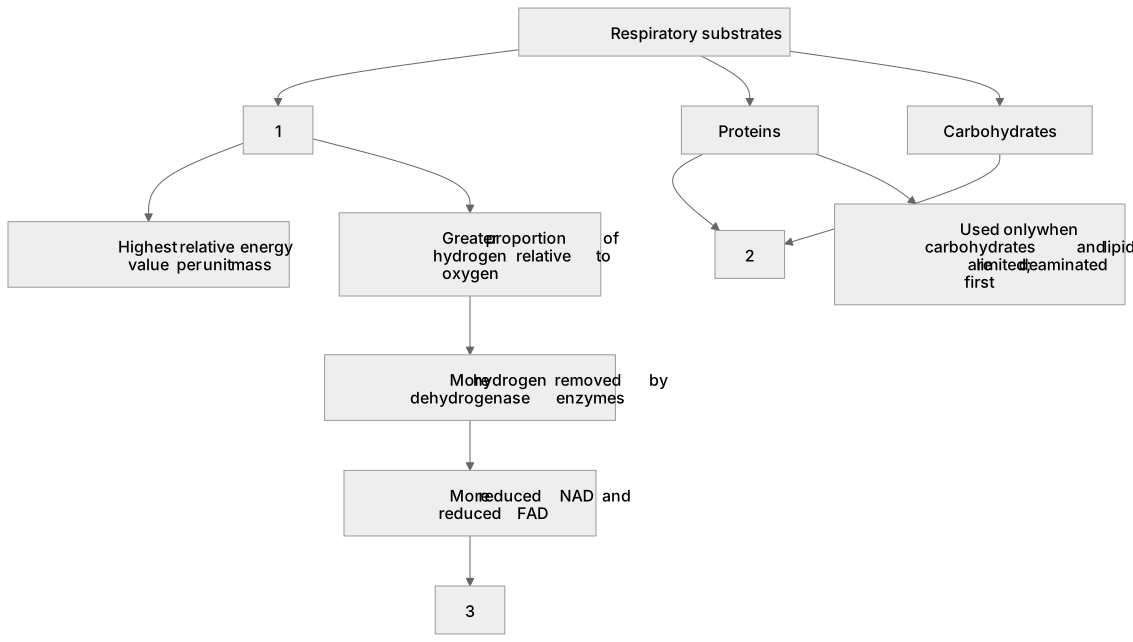
1Box 1
2Box 2
3Box 3
There is more to this lesson
The full lesson goes on to check your understanding and help you earn the marks. Create a free account to carry on, with your progress saved.
A week of Premium from your first lesson · Then the free plan continues · No card, no charge
Test your understanding of Respiration: (j) the difference in relative energy values of carbohydrates, lipids and proteins as respiratory substrates
Active recall beats re-reading. Take an instant quiz now to test what you’ve learned and lock it into long-term memory.
A week of Premium from your first lesson · Then the free plan continues · No card, no charge