OCR · A-Level · Biology
Course version: H420 · Version from Sept 2025
Transport in animals: (d) the formation of tissue fluid from plasma
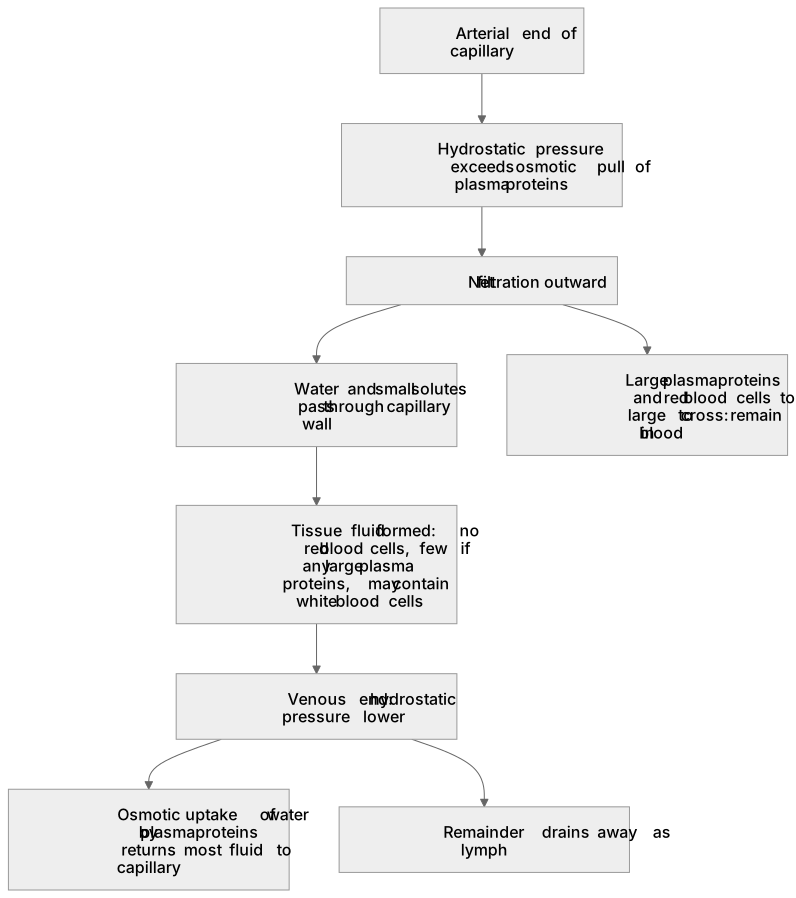
At the arterial end of a capillary, hydrostatic pressure from the heart's pumping is higher than the opposing osmotic pull of plasma proteins.
Checked against the OCR H420 specification (opens in a new tab) on .
- Point 4 of 10
- 4 key terms
Study notes
From the checked teaching notes for this specification point.
The idea
At the arterial end of a capillary, hydrostatic pressure from the heart's pumping is higher than the opposing osmotic pull of plasma proteins. This net outward force pushes water and small dissolved solutes out through the capillary wall into the surrounding spaces, forming tissue fluid. Large plasma proteins and blood cells are held back because they are too big to pass through the capillary wall, so tissue fluid contains no red blood cells and few, if any, large plasma proteins, though it can carry white blood cells that have left the blood. At the venous end, hydrostatic pressure has fallen and the osmotic effect of the retained plasma proteins draws most fluid back into the capillary; the remainder drains away as lymph.
What earns the marks
- Tissue fluid forms at the arterial end of capillaries where hydrostatic (blood) pressure exceeds the osmotic pull of plasma proteins, giving net filtration outward.
- Only water and small solutes are forced out; large plasma proteins and red blood cells are too large to cross the capillary wall and remain in the blood.
- Tissue fluid therefore lacks red blood cells and large plasma proteins, but may contain white blood cells that have migrated out of capillaries.
- At the venous end hydrostatic pressure is lower, so osmotic uptake of water by plasma proteins returns most fluid to the capillary, with excess draining as lymph.
- The capillary wall is thin and permeable, allowing exchange between plasma and tissue fluid surrounding cells.
Common mistakes and how to put them right
Saying tissue fluid contains no cells at all.
Put it right by stating it lacks red blood cells but can contain white blood cells.
Claiming plasma proteins freely enter tissue fluid.
Put it right by explaining they are too large to cross the capillary wall and stay in the blood.
Thinking tissue fluid is formed along the whole capillary equally.
Put it right by locating net filtration at the arterial end and net reabsorption at the venous end.
Exam tips
- Link each force to a named end of the capillary so the pressure argument is explicit.
- State which components are excluded and why (size relative to capillary wall), not just that fluid leaves.
- Use the terms hydrostatic pressure and osmotic effect precisely rather than 'pressure' alone.
Try the lesson
The start of the Transport in animals: (d) the formation of tissue fluid from plasma lesson, made from checked teaching notes for this specification point.
Have a go first
How does the balance of pressures change along a capillary from the arteriole end to the venule end, and what is the consequence for fluid movement?
Listen
At the arterial end of a capillary, hydrostatic pressure from the heart's pumping is higher than the opposing osmotic pull of plasma proteins. This net outward force pushes water and small dissolved solutes out through the capillary wall into the surrounding spaces, forming tissue fluid. Large plasma proteins and blood cells are held back because they are too big to pass through the capillary wall, so tissue fluid contains no red blood cells and few, if any, large plasma proteins, though it can carry white blood cells that have left the blood. At the venous end, hydrostatic pressure has fallen and the osmotic effect of the retained plasma proteins draws most fluid back into the capillary; the remainder drains away as lymph. A strong answer earns marks for these points. Tissue fluid forms at the arterial end of capillaries where hydrostatic (blood) pressure exceeds the osmotic pull of plasma proteins, giving net filtration outward. Only water and small solutes are forced out; large plasma proteins and red blood cells are too large to cross the capillary wall and remain in the blood. Tissue fluid therefore lacks red blood cells and large plasma proteins, but may contain white blood cells that have migrated out of capillaries. At the venous end hydrostatic pressure is lower, so osmotic uptake of water by plasma proteins returns most fluid to the capillary, with excess draining as lymph. A common slip: Saying tissue fluid contains no cells at all. Instead, stating it lacks red blood cells but can contain white blood cells. Exam tip: Link each force to a named end of the capillary so the pressure argument is explicit.
See it
Key words
Say what each word means before you turn the card.
Capillary structure and permeability
Try answering aloud or in your head before turning the card.
Hydrostatic versus osmotic forces
Try answering aloud or in your head before turning the card.
Selective retention of large molecules and cells
Try answering aloud or in your head before turning the card.
Return of fluid and drainage as lymph
Try answering aloud or in your head before turning the card.
See every definition
- Capillary structure and permeability
- The capillary wall is thin and permeable, allowing exchange between plasma and tissue fluid surrounding cells.
- Hydrostatic versus osmotic forces
- At the arterial end, hydrostatic pressure from the heart's pumping is higher than the opposing osmotic pull of plasma proteins, giving net filtration outward.
- Selective retention of large molecules and cells
- Large plasma proteins and blood cells are held back because they are too big to pass through the capillary wall.
- Return of fluid and drainage as lymph
- At the venous end, hydrostatic pressure has fallen and the osmotic effect of the retained plasma proteins draws most fluid back into the capillary; the remainder drains away as lymph.
Label the diagram
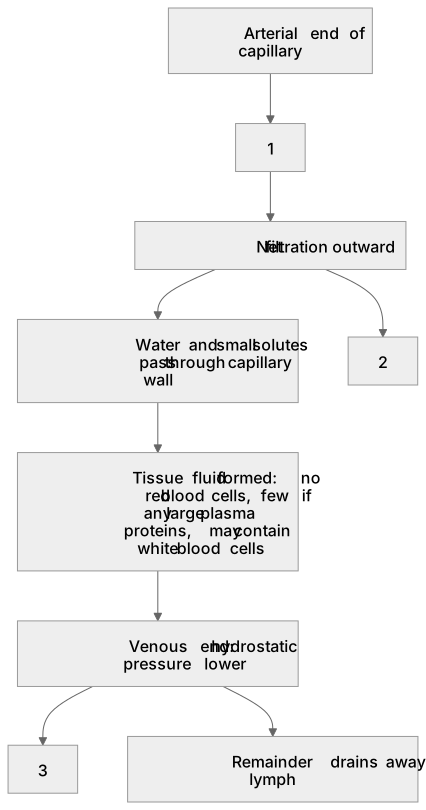
Some boxes have lost their names. Pick the right name for each number.
1Box 1
2Box 2
3Box 3
There is more to this lesson
The full lesson goes on to check your understanding and help you earn the marks. Create a free account to carry on, with your progress saved.
A week of Premium from your first lesson · Then the free plan continues · No card, no charge
Test your understanding of Transport in animals: (d) the formation of tissue fluid from plasma
Active recall beats re-reading. Take an instant quiz now to test what you’ve learned and lock it into long-term memory.
A week of Premium from your first lesson · Then the free plan continues · No card, no charge