OCR · A-Level · Biology
Course version: H420 · Version from Sept 2025
Transport in animals: (f) the cardiac cycle
The cardiac cycle is the sequence of events in one complete heartbeat, described through the coordinated contraction (systole) and relaxation (diastole) of the atria and ventricles.
Checked against the OCR H420 specification (opens in a new tab) on .
- Point 6 of 10
- 4 key terms
Study notes
From the checked teaching notes for this specification point.
The idea
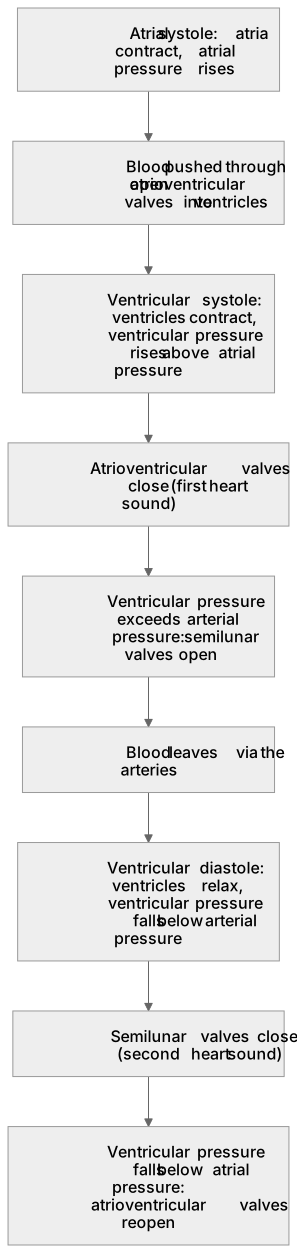
The cardiac cycle is the sequence of events in one complete heartbeat, described through the coordinated contraction (systole) and relaxation (diastole) of the atria and ventricles. Teach it as pressure-driven flow: blood moves from higher to lower pressure, and valves open and close passively in response to pressure differences. Atrial systole follows ventricular diastole, pushing the remaining blood through the open atrioventricular valves; ventricular systole then raises ventricular pressure, closing the atrioventricular valves (first heart sound) and opening the semilunar valves once ventricular pressure exceeds arterial pressure. Ventricular diastole lowers ventricular pressure, closing the semilunar valves (second heart sound) and reopening the atrioventricular valves.
What earns the marks
- States that the cardiac cycle is the sequence of contraction (systole) and relaxation (diastole) of the atria and ventricles in one heartbeat.
- Explains that blood flows from regions of higher pressure to lower pressure, so pressure changes drive flow through the heart.
- Describes atrial systole: atria contract, raising atrial pressure and pushing blood through the open atrioventricular valves into the ventricles.
- Describes ventricular diastole: ventricles relax, ventricular pressure falls below arterial pressure, semilunar valves close, and when ventricular pressure falls below atrial pressure the atrioventricular valves reopen.
- Explains that valve opening and closing is passive, driven by pressure differences across the valve, not by active muscle contraction of the valve itself.
- Interprets a pressure–time graph, identifying systole and diastole and the points at which the atrioventricular and semilunar valves open and close.
Common mistakes and how to put them right
Thinking valves are actively opened and closed by muscles.
Put it right by explaining that valves open and close passively in response to pressure differences across them.
Believing blood is actively pumped by the atria into the arteries.
Put it right by stating that atria deliver blood to the ventricles and the ventricles generate the pressure that ejects blood into the arteries.
Confusing systole with relaxation.
Put it right by defining systole as contraction and diastole as relaxation.
Assuming the semilunar valves open during atrial systole.
Put it right by linking semilunar valve opening to ventricular pressure exceeding arterial pressure during ventricular systole.
Exam tips
- For each valve event, name the pressure change that causes it, since questions often test the link between pressure and valve action rather than the event alone.
- When reading a pressure–time graph, locate the crossover points between atrial, ventricular and arterial pressure curves, as these mark valve opening and closing.
- Sequence the stages explicitly (atrial systole, ventricular systole, ventricular diastole) so the order of events is unambiguous.
Try the lesson
The start of the Transport in animals: (f) the cardiac cycle lesson, made from checked teaching notes for this specification point.
Have a go first
During which phase of the cardiac cycle do the atrioventricular valves close?
Listen
The cardiac cycle is the sequence of events in one complete heartbeat, described through the coordinated contraction (systole) and relaxation (diastole) of the atria and ventricles. Teach it as pressure-driven flow: blood moves from higher to lower pressure, and valves open and close passively in response to pressure differences. Atrial systole follows ventricular diastole, pushing the remaining blood through the open atrioventricular valves; ventricular systole then raises ventricular pressure, closing the atrioventricular valves (first heart sound) and opening the semilunar valves once ventricular pressure exceeds arterial pressure. Ventricular diastole lowers ventricular pressure, closing the semilunar valves (second heart sound) and reopening the atrioventricular valves. A strong answer earns marks for these points. States that the cardiac cycle is the sequence of contraction (systole) and relaxation (diastole) of the atria and ventricles in one heartbeat. Explains that blood flows from regions of higher pressure to lower pressure, so pressure changes drive flow through the heart. Describes atrial systole: atria contract, raising atrial pressure and pushing blood through the open atrioventricular valves into the ventricles. Describes ventricular systole: ventricles contract, ventricular pressure rises above atrial pressure, closing the atrioventricular valves, and once it exceeds arterial pressure the semilunar valves open and blood leaves via the arteries. A common slip: Thinking valves are actively opened and closed by muscles. Instead, explaining that valves open and close passively in response to pressure differences across them. Exam tip: For each valve event, name the pressure change that causes it, since questions often test the link between pressure and valve action rather than the event alone.
See it
Key words
Say what each word means before you turn the card.
Pressure-driven flow through the heart
Try answering aloud or in your head before turning the card.
Systole and diastole of atria and ventricles
Try answering aloud or in your head before turning the card.
Passive valve action governed by pressure differences
Try answering aloud or in your head before turning the card.
Interpreting pressure–time graphs of the cardiac cycle
Try answering aloud or in your head before turning the card.
See every definition
- Pressure-driven flow through the heart
- Blood moves from higher to lower pressure, so pressure changes drive flow through the heart.
- Systole and diastole of atria and ventricles
- The coordinated contraction (systole) and relaxation (diastole) of the atria and ventricles in one heartbeat.
- Passive valve action governed by pressure differences
- Valves open and close passively in response to pressure differences across them, not by active muscle contraction of the valve itself.
- Interpreting pressure–time graphs of the cardiac cycle
- Identifying systole and diastole and the points at which the atrioventricular and semilunar valves open and close.
Label the diagram
Some boxes have lost their names. Pick the right name for each number.
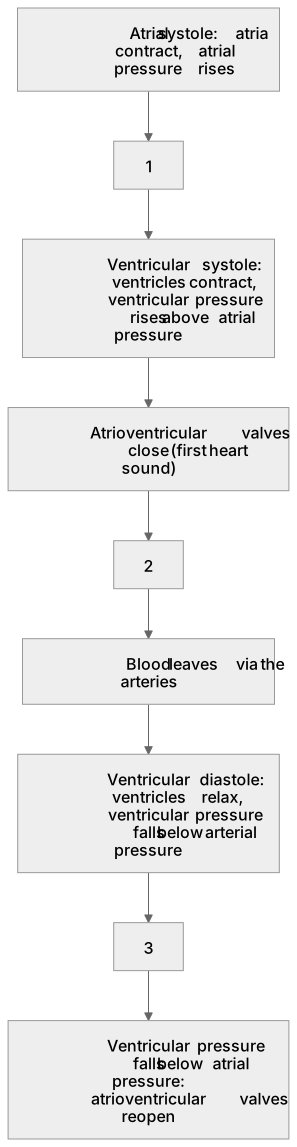
1Box 1
2Box 2
3Box 3
There is more to this lesson
The full lesson goes on to check your understanding and help you earn the marks. Create a free account to carry on, with your progress saved.
A week of Premium from your first lesson · Then the free plan continues · No card, no charge
Test your understanding of Transport in animals: (f) the cardiac cycle
Active recall beats re-reading. Take an instant quiz now to test what you’ve learned and lock it into long-term memory.
A week of Premium from your first lesson · Then the free plan continues · No card, no charge