OCR · A-Level · Biology
Course version: H420 · Version from Sept 2025
(d) the transport of water into the plant, through the plant and to the…
Full specification wording
Transport in plants: (d) the transport of water into the plant, through the plant and to the air surrounding the leaves
Water moves from soil into root hair cells by osmosis, down a water potential gradient, because the soil solution has higher water potential than root hair cell sap.
Checked against the OCR H420 specification (opens in a new tab) on .
- Point 6 of 8
- 4 key terms
Study notes
From the checked teaching notes for this specification point.
The idea
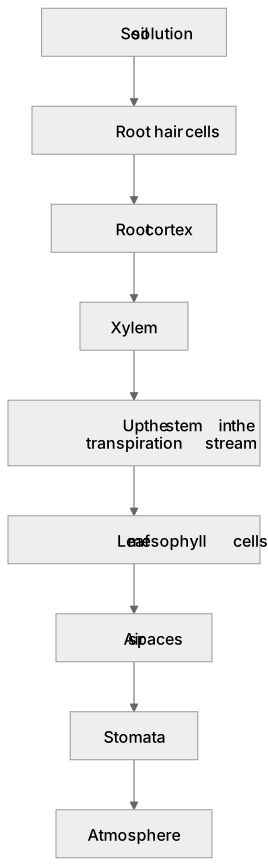
Water moves from soil into root hair cells by osmosis, down a water potential gradient, because the soil solution has higher water potential than root hair cell sap. It travels across the root cortex to the xylem, then up the stem in the transpiration stream. Cohesion between water molecules and adhesion to xylem walls, together with tension created by evaporation at the leaves, pull water upward. In the leaf, water moves by osmosis into mesophyll cells and evaporates from their moist surfaces into air spaces, then diffuses out through stomata as water vapour. The water potential gradient from soil to atmosphere drives the whole pathway, and the transpiration stream also carries dissolved mineral ions.
What earns the marks
- Water enters root hair cells by osmosis from the soil, down a water potential gradient, because soil solution has higher water potential than root hair cell contents.
- Water moves across the root cortex to the xylem and then upward through the plant in the transpiration stream.
- Cohesion between water molecules and adhesion to xylem walls, combined with tension from evaporation, pull water up the xylem.
- In leaves, water moves by osmosis into mesophyll cells, evaporates into air spaces and diffuses out through stomata as water vapour.
- The continuous water potential gradient from soil to atmosphere drives movement, and the transpiration stream also transports dissolved mineral ions.
Common mistakes and how to put them right
Saying water is actively pumped up the xylem.
Put it right: Movement is driven by tension from evaporation plus cohesion and adhesion, not by a pump.
Reversing the water potential gradient, claiming water moves from lower to higher water potential.
Put it right: Osmosis moves water from higher to lower water potential.
Treating transpiration as liquid water leaving the leaf.
Put it right: Water evaporates inside the leaf and leaves as vapour diffusing through stomata.
Exam tips
- Describe the pathway in order: soil, root hair cell, cortex, xylem, leaf mesophyll, air spaces, stomata, atmosphere.
- Link each stage to osmosis or to cohesion, adhesion and tension, using the water potential gradient to explain direction.
- Mention that the transpiration stream also carries mineral ions, showing understanding of the xylem's dual role.
Try the lesson
The start of the Transport in plants: (d) the transport of water into the plant, through the plant and to the air surrounding the leaves lesson, made from checked teaching notes for this specification point.
Have a go first
By which process does water vapour leave a leaf and enter the air surrounding it?
Listen
Water moves from soil into root hair cells by osmosis, down a water potential gradient, because the soil solution has higher water potential than root hair cell sap. It travels across the root cortex to the xylem, then up the stem in the transpiration stream. Cohesion between water molecules and adhesion to xylem walls, together with tension created by evaporation at the leaves, pull water upward. In the leaf, water moves by osmosis into mesophyll cells and evaporates from their moist surfaces into air spaces, then diffuses out through stomata as water vapour. The water potential gradient from soil to atmosphere drives the whole pathway, and the transpiration stream also carries dissolved mineral ions. A strong answer earns marks for these points. Water enters root hair cells by osmosis from the soil, down a water potential gradient, because soil solution has higher water potential than root hair cell contents. Water moves across the root cortex to the xylem and then upward through the plant in the transpiration stream. Cohesion between water molecules and adhesion to xylem walls, combined with tension from evaporation, pull water up the xylem. In leaves, water moves by osmosis into mesophyll cells, evaporates into air spaces and diffuses out through stomata as water vapour. Exam tip: Describe the pathway in order: soil, root hair cell, cortex, xylem, leaf mesophyll, air spaces, stomata, atmosphere.
See it
Key words
Say what each word means before you turn the card.
Osmosis
Try answering aloud or in your head before turning the card.
Transpiration stream
Try answering aloud or in your head before turning the card.
Cohesion and adhesion
Try answering aloud or in your head before turning the card.
Water potential gradient
Try answering aloud or in your head before turning the card.
See every definition
- Osmosis
- Movement of water down a water potential gradient, from the soil solution with higher water potential into root hair cell contents.
- Transpiration stream
- The upward movement of water through the plant, which also carries dissolved mineral ions.
- Cohesion and adhesion
- Cohesion between water molecules and adhesion to xylem walls, combined with tension from evaporation, pull water up the xylem.
- Water potential gradient
- The continuous gradient from soil to atmosphere that drives the whole pathway of water movement.
Label the diagram
Some boxes have lost their names. Pick the right name for each number.
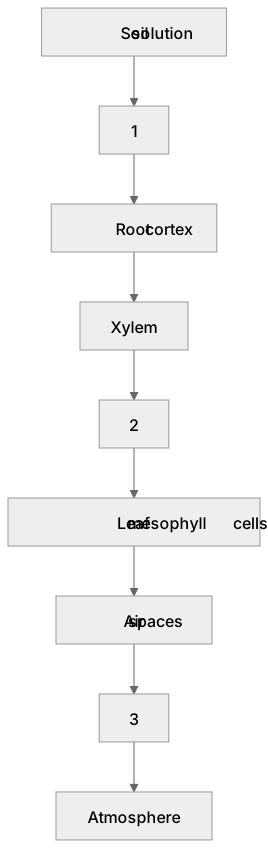
1Box 1
2Box 2
3Box 3
There is more to this lesson
The full lesson goes on to check your understanding and help you earn the marks. Create a free account to carry on, with your progress saved.
A week of Premium from your first lesson · Then the free plan continues · No card, no charge
Test your understanding of Transport in plants: (d) the transport of water into the plant, through the plant and to the air surrounding the leaves
Active recall beats re-reading. Take an instant quiz now to test what you’ve learned and lock it into long-term memory.
A week of Premium from your first lesson · Then the free plan continues · No card, no charge