OCR · A-Level · Biology
Course version: H420 · Version from Sept 2025
(ii) practical investigations to estimate transpiration rates
Full specification wording
Transport in plants: (ii) practical investigations to estimate transpiration rates
Transpiration is the loss of water vapour from aerial parts of a plant, mainly through stomata.
Checked against the OCR H420 specification (opens in a new tab) on .
- Point 5 of 8
- 4 key terms
Study notes
From the checked teaching notes for this specification point.
The idea
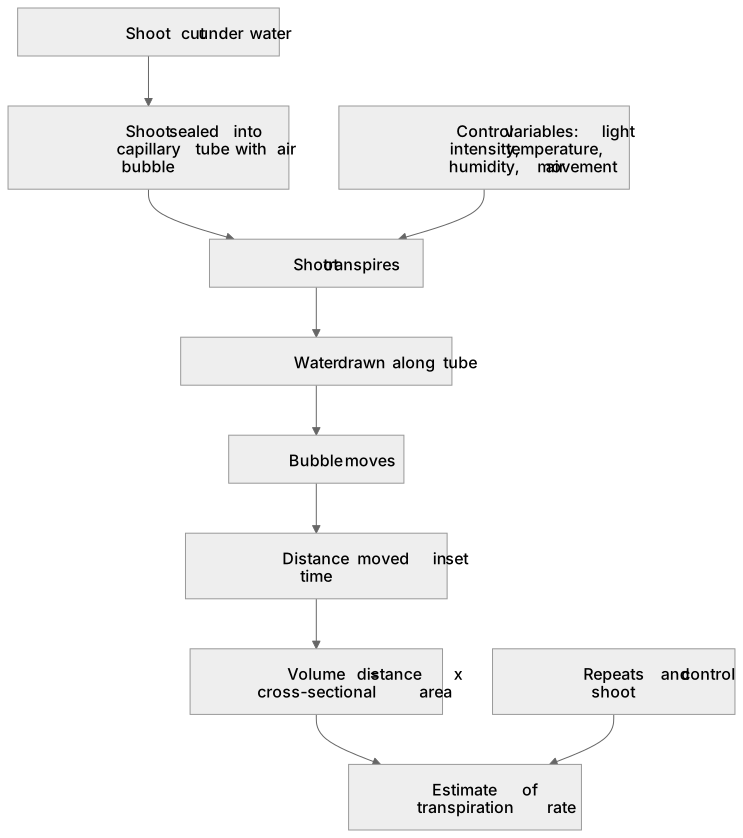
Transpiration is the loss of water vapour from aerial parts of a plant, mainly through stomata. Practical investigations estimate the rate indirectly by measuring water uptake, usually with a potometer. A shoot is cut under water and sealed into a capillary tube containing an air bubble; as the shoot transpires, water is drawn along the tube and the bubble moves. The distance moved in a set time, converted to volume using the tube's cross-sectional area, gives an estimate of rate. Learners must control variables: light intensity, temperature, humidity and air movement all affect stomatal behaviour, so only one should be varied while others are held constant. Repeats and a control shoot help reliability. The estimate assumes water uptake equals water lost, which is only approximately true because some water is used in photosynthesis and turgor.
What earns the marks
- Transpiration is water loss as vapour, mainly through stomata, and is estimated indirectly by measuring water uptake with a potometer.
- A shoot is cut under water and sealed into a capillary tube with an air bubble; the bubble moves as water is drawn in, and distance moved per unit time estimates rate.
- Volume transpired is calculated from bubble distance multiplied by the capillary tube's cross-sectional area, giving a rate per unit time.
- Environmental variables such as light intensity, temperature, humidity and air movement must be controlled so only the chosen variable changes.
- Repeats and a control improve reliability, and the method assumes water uptake approximately equals water lost, though some water is used in photosynthesis and turgor.
Common mistakes and how to put them right
Thinking a potometer measures transpiration directly.
Put it right: It measures water uptake, which only approximates transpiration because some water is retained for photosynthesis and turgor.
Failing to cut the shoot under water or to seal joints, which lets air enter and breaks the water column so the bubble does not move reliably.
Changing several environmental factors at once, so any change in bubble movement cannot be attributed to the variable being tested.
Exam tips
- State clearly that the potometer estimates rather than measures transpiration, and explain the assumption behind that estimate.
- Name the controlled variables explicitly (light intensity, temperature, humidity, air movement) and say why each must be held constant.
- Describe how bubble distance is converted to a rate using the tube's cross-sectional area, and mention repeats for reliability.
Try the lesson
The start of the Transport in plants: (ii) practical investigations to estimate transpiration rates lesson, made from checked teaching notes for this specification point.
Have a go first
Why is a shoot often cut under water when setting up a potometer?
Listen
Transpiration is the loss of water vapour from aerial parts of a plant, mainly through stomata. Practical investigations estimate the rate indirectly by measuring water uptake, usually with a potometer. A shoot is cut under water and sealed into a capillary tube containing an air bubble; as the shoot transpires, water is drawn along the tube and the bubble moves. The distance moved in a set time, converted to volume using the tube's cross-sectional area, gives an estimate of rate. Learners must control variables: light intensity, temperature, humidity and air movement all affect stomatal behaviour, so only one should be varied while others are held constant. Repeats and a control shoot help reliability. The estimate assumes water uptake equals water lost, which is only approximately true because some water is used in photosynthesis and turgor. A strong answer earns marks for these points. Transpiration is water loss as vapour, mainly through stomata, and is estimated indirectly by measuring water uptake with a potometer. A shoot is cut under water and sealed into a capillary tube with an air bubble; the bubble moves as water is drawn in, and distance moved per unit time estimates rate. Volume transpired is calculated from bubble distance multiplied by the capillary tube's cross-sectional area, giving a rate per unit time. Environmental variables such as light intensity, temperature, humidity and air movement must be controlled so only the chosen variable changes. Exam tip: State clearly that the potometer estimates rather than measures transpiration, and explain the assumption behind that estimate.
See it
Key words
Say what each word means before you turn the card.
Transpiration
Try answering aloud or in your head before turning the card.
Potometer
Try answering aloud or in your head before turning the card.
Rate calculation
Try answering aloud or in your head before turning the card.
Control of environmental variables
Try answering aloud or in your head before turning the card.
See every definition
- Transpiration
- The loss of water vapour from aerial parts of a plant, mainly through stomata.
- Potometer
- Apparatus used to estimate transpiration rate indirectly by measuring water uptake, with a shoot sealed into a capillary tube containing an air bubble.
- Rate calculation
- Volume transpired is calculated from bubble distance multiplied by the capillary tube's cross-sectional area, giving a rate per unit time.
- Control of environmental variables
- Light intensity, temperature, humidity and air movement all affect stomatal behaviour, so only one should be varied while others are held constant.
Label the diagram
Some boxes have lost their names. Pick the right name for each number.
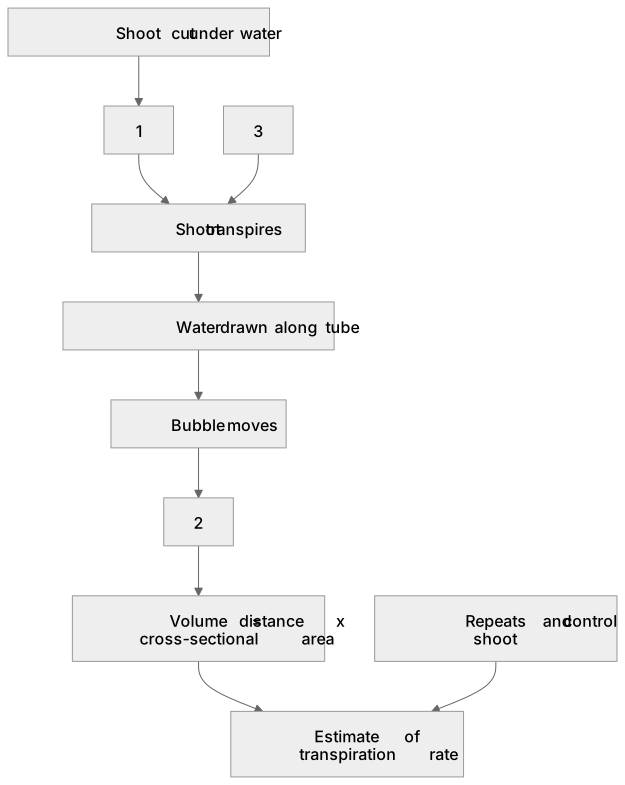
1Box 1
2Box 2
3Box 3
There is more to this lesson
The full lesson goes on to check your understanding and help you earn the marks. Create a free account to carry on, with your progress saved.
A week of Premium from your first lesson · Then the free plan continues · No card, no charge
Test your understanding of Transport in plants: (ii) practical investigations to estimate transpiration rates
Active recall beats re-reading. Take an instant quiz now to test what you’ve learned and lock it into long-term memory.
A week of Premium from your first lesson · Then the free plan continues · No card, no charge