OCR · A-Level · Biology
Course version: H420 · Version from Sept 2025
(b) use of appropriate instrumentation to record quantitative…
Full specification wording
Use of apparatus and techniques: (b) use of appropriate instrumentation to record quantitative measurements, such as a colorimeter or potometer
Choosing appropriate instrumentation means matching the instrument to the quantity being measured and the precision required.
Checked against the OCR H420 specification (opens in a new tab) on .
- Point 2 of 14
- 4 key terms
Study notes
From the checked teaching notes for this specification point.
The idea
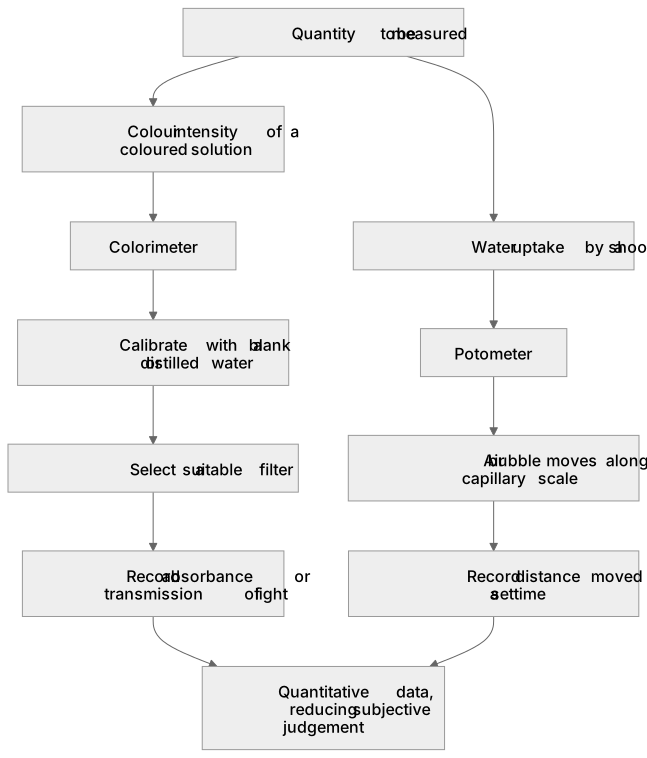
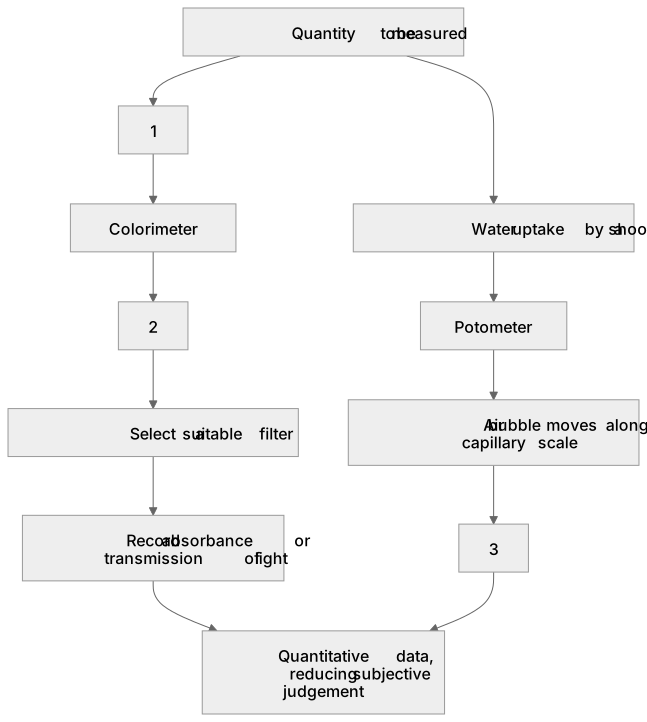
Choosing appropriate instrumentation means matching the instrument to the quantity being measured and the precision required. A colorimeter records the absorbance or transmission of light through a coloured solution, so it quantifies colour change objectively rather than by eye; it is calibrated with a blank or distilled water before use and a suitable filter is selected. A potometer records the rate of water uptake by a shoot as a proxy for transpiration rate; a bubble of air moves along a capillary scale as the shoot takes up water, and the distance moved in a set time is recorded. Both instruments give quantitative data, reducing subjective judgement. The choice depends on what is being measured: colour intensity for a colorimeter, water uptake for a potometer.
What earns the marks
- Matches the instrument to the quantity measured: a colorimeter measures absorbance or transmission of light through a coloured solution.
- Explains that a colorimeter is calibrated with a blank (e.g. distilled water) and an appropriate filter is selected before readings are taken.
- Describes a potometer as recording the rate of water uptake by a shoot, with an air bubble moving along a capillary scale as a proxy for transpiration.
- Recognises that both instruments produce quantitative data, reducing subjective judgement compared with visual estimation.
- Selects the appropriate instrument for a stated investigation, e.g. a colorimeter for colour change and a potometer for water uptake.
Common mistakes and how to put them right
Claiming a colorimeter measures the colour directly by eye.
Put it right by stating it measures absorbance or transmission of light quantitatively.
Using a potometer to measure transpiration directly.
Put it right by explaining it measures water uptake, which is used as a proxy for transpiration rate.
Omitting calibration of the colorimeter with a blank.
Put it right by including calibration with distilled water or a blank solution before readings.
Assuming any filter will do for a colorimeter.
Put it right by selecting a filter of appropriate wavelength for the colour being measured.
Exam tips
- Identify the variable being measured in the stem, then match it to the instrument designed for that variable.
- Reject options that describe qualitative visual judgement when the question asks for quantitative recording.
- Check that the described procedure includes calibration or a control step, since appropriate use of instrumentation depends on it.
Try the lesson
The start of the Use of apparatus and techniques: (b) use of appropriate instrumentation to record quantitative measurements, such as a colorimeter or potometer lesson, made from checked teaching notes for this specification point.
Have a go first
A student needs to measure the rate at which a leafy shoot takes up water. Which instrument is designed for this measurement?
Listen
Choosing appropriate instrumentation means matching the instrument to the quantity being measured and the precision required. A colorimeter records the absorbance or transmission of light through a coloured solution, so it quantifies colour change objectively rather than by eye; it is calibrated with a blank or distilled water before use and a suitable filter is selected. A potometer records the rate of water uptake by a shoot as a proxy for transpiration rate; a bubble of air moves along a capillary scale as the shoot takes up water, and the distance moved in a set time is recorded. Both instruments give quantitative data, reducing subjective judgement. The choice depends on what is being measured: colour intensity for a colorimeter, water uptake for a potometer. A strong answer earns marks for these points. Matches the instrument to the quantity measured: a colorimeter measures absorbance or transmission of light through a coloured solution. Explains that a colorimeter is calibrated with a blank (e.g. distilled water) and an appropriate filter is selected before readings are taken. Describes a potometer as recording the rate of water uptake by a shoot, with an air bubble moving along a capillary scale as a proxy for transpiration. Recognises that both instruments produce quantitative data, reducing subjective judgement compared with visual estimation. A common slip: Claiming a colorimeter measures the colour directly by eye. Instead, stating it measures absorbance or transmission of light quantitatively. Exam tip: Identify the variable being measured in the stem, then match it to the instrument designed for that variable.
See it
Key words
Say what each word means before you turn the card.
Matching instrument to measurement
Try answering aloud or in your head before turning the card.
Colorimetry and calibration
Try answering aloud or in your head before turning the card.
Potometry as a proxy measure
Try answering aloud or in your head before turning the card.
Quantitative versus subjective recording
Try answering aloud or in your head before turning the card.
See every definition
- Matching instrument to measurement
- Choosing appropriate instrumentation means matching the instrument to the quantity being measured and the precision required.
- Colorimetry and calibration
- A colorimeter records the absorbance or transmission of light through a coloured solution and is calibrated with a blank or distilled water before use, with a suitable filter selected.
- Potometry as a proxy measure
- A potometer records the rate of water uptake by a shoot as a proxy for transpiration rate, with an air bubble moving along a capillary scale.
- Quantitative versus subjective recording
- Both instruments give quantitative data, reducing subjective judgement compared with visual estimation.
Label the diagram
Some boxes have lost their names. Pick the right name for each number.
1Box 1
2Box 2
3Box 3
There is more to this lesson
The full lesson goes on to check your understanding and help you earn the marks. Create a free account to carry on, with your progress saved.
A week of Premium from your first lesson · Then the free plan continues · No card, no charge
Test your understanding of Use of apparatus and techniques: (b) use of appropriate instrumentation to record quantitative measurements, such as a colorimeter or potometer
Active recall beats re-reading. Take an instant quiz now to test what you’ve learned and lock it into long-term memory.
A week of Premium from your first lesson · Then the free plan continues · No card, no charge