OCR · A-Level · Biology
Course version: H420 · Version from Sept 2025
(c) use of laboratory glassware apparatus for a variety of experimental…
Full specification wording
Use of apparatus and techniques: (c) use of laboratory glassware apparatus for a variety of experimental techniques to include serial dilutions
This practical technique requires you to select and correctly use laboratory glassware — such as graduated pipettes, burettes, volumetric pipettes, measuring cylinders and volumetric flasks —…
Checked against the OCR H420 specification (opens in a new tab) on .
- Point 3 of 14
- 4 key terms
Study notes
From the checked teaching notes for this specification point.
The idea
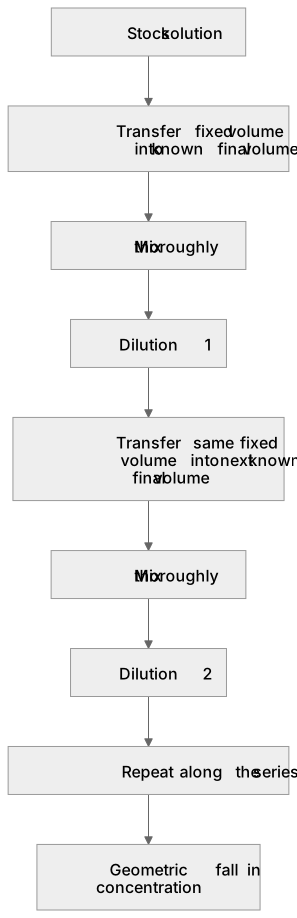
This practical technique requires you to select and correctly use laboratory glassware — such as graduated pipettes, burettes, volumetric pipettes, measuring cylinders and volumetric flasks — across a range of experimental procedures, and specifically to carry out serial dilutions. A serial dilution is a stepwise series in which each dilution is made from the previous one, giving a geometric fall in concentration. For example, to make a 1:10 series you transfer a fixed volume of stock into a known final volume, mix thoroughly, then take the same fixed volume from that tube into the next, repeating along the series. Correct glassware choice matters: a volumetric pipette delivers one accurate fixed volume, a measuring cylinder suits approximate volumes, and a volumetric flask makes up to a single calibrated volume.
What earns the marks
- Selects glassware matched to the accuracy required: volumetric pipette or burette for precise fixed volumes, measuring cylinder for approximate volumes, volumetric flask for making up to a calibrated volume.
- Describes a serial dilution as a stepwise series in which each dilution is prepared from the previous one, producing a geometric decrease in concentration.
- States that a fixed volume is transferred at each step into a known final volume and mixed thoroughly before the next transfer.
- Explains that reading the meniscus at eye level and correct rinsing/mixing reduce systematic error in the delivered volumes.
- Recognises that the dilution factor multiplies along the series, so overall dilution after n steps is the product of the individual factors.
Common mistakes and how to put them right
Thinking a serial dilution is several independent dilutions made directly from the stock.
Put it right: Each step is made from the previous dilution, so errors and factors compound along the series.
Choosing a measuring cylinder when a precise fixed volume is needed.
Put it right: Match glassware to the accuracy required, using a volumetric pipette for accurate fixed volumes.
Reading the meniscus from above or below eye level.
Put it right: Align the eye with the meniscus to avoid parallax error in the volume reading.
Exam tips
- Link each named piece of glassware to the accuracy it provides rather than listing apparatus without purpose.
- When describing a serial dilution, state the fixed transfer volume, the final volume and the mixing step explicitly.
- Check whether a question asks for the overall dilution factor and multiply the individual step factors correctly.
Try the lesson
The start of the Use of apparatus and techniques: (c) use of laboratory glassware apparatus for a variety of experimental techniques to include serial dilutions lesson, made from checked teaching notes for this specification point.
Have a go first
Which glassware is used to make up a solution to an exact final volume, such as 250 cm³, before use in a dilution series?
Listen
This practical technique requires you to select and correctly use laboratory glassware — such as graduated pipettes, burettes, volumetric pipettes, measuring cylinders and volumetric flasks — across a range of experimental procedures, and specifically to carry out serial dilutions. A serial dilution is a stepwise series in which each dilution is made from the previous one, giving a geometric fall in concentration. For example, to make a 1:10 series you transfer a fixed volume of stock into a known final volume, mix thoroughly, then take the same fixed volume from that tube into the next, repeating along the series. Correct glassware choice matters: a volumetric pipette delivers one accurate fixed volume, a measuring cylinder suits approximate volumes, and a volumetric flask makes up to a single calibrated volume. A strong answer earns marks for these points. Selects glassware matched to the accuracy required: volumetric pipette or burette for precise fixed volumes, measuring cylinder for approximate volumes, volumetric flask for making up to a calibrated volume. Describes a serial dilution as a stepwise series in which each dilution is prepared from the previous one, producing a geometric decrease in concentration. States that a fixed volume is transferred at each step into a known final volume and mixed thoroughly before the next transfer. Explains that reading the meniscus at eye level and correct rinsing/mixing reduce systematic error in the delivered volumes. A common slip: Thinking a serial dilution is several independent dilutions made directly from the stock. Instead, each step is made from the previous dilution, so errors and factors compound along the series. Exam tip: Link each named piece of glassware to the accuracy it provides rather than listing apparatus without purpose.
See it
Key words
Say what each word means before you turn the card.
Serial dilution
Try answering aloud or in your head before turning the card.
Volumetric pipette
Try answering aloud or in your head before turning the card.
Measuring cylinder
Try answering aloud or in your head before turning the card.
Volumetric flask
Try answering aloud or in your head before turning the card.
See every definition
- Serial dilution
- A stepwise series in which each dilution is made from the previous one, giving a geometric fall in concentration.
- Volumetric pipette
- A piece of laboratory glassware that delivers one accurate fixed volume.
- Measuring cylinder
- A piece of laboratory glassware that suits approximate volumes.
- Volumetric flask
- A piece of laboratory glassware that makes up to a single calibrated volume.
There is more to this lesson
The full lesson goes on to check your understanding and help you earn the marks. Create a free account to carry on, with your progress saved.
A week of Premium from your first lesson · Then the free plan continues · No card, no charge
Test your understanding of Use of apparatus and techniques: (c) use of laboratory glassware apparatus for a variety of experimental techniques to include serial dilutions
Active recall beats re-reading. Take an instant quiz now to test what you’ve learned and lock it into long-term memory.
A week of Premium from your first lesson · Then the free plan continues · No card, no charge