OCR · A-Level · Biology
Course version: H420 · Version from Sept 2025
(f) use of qualitative reagents to identify biological molecules
Full specification wording
Use of apparatus and techniques: (f) use of qualitative reagents to identify biological molecules
Qualitative reagents give a visible change when a particular biological molecule is present, so they confirm identity rather than measure amount.
Checked against the OCR H420 specification (opens in a new tab) on .
- Point 6 of 14
- 4 key terms
Study notes
From the checked teaching notes for this specification point.
The idea
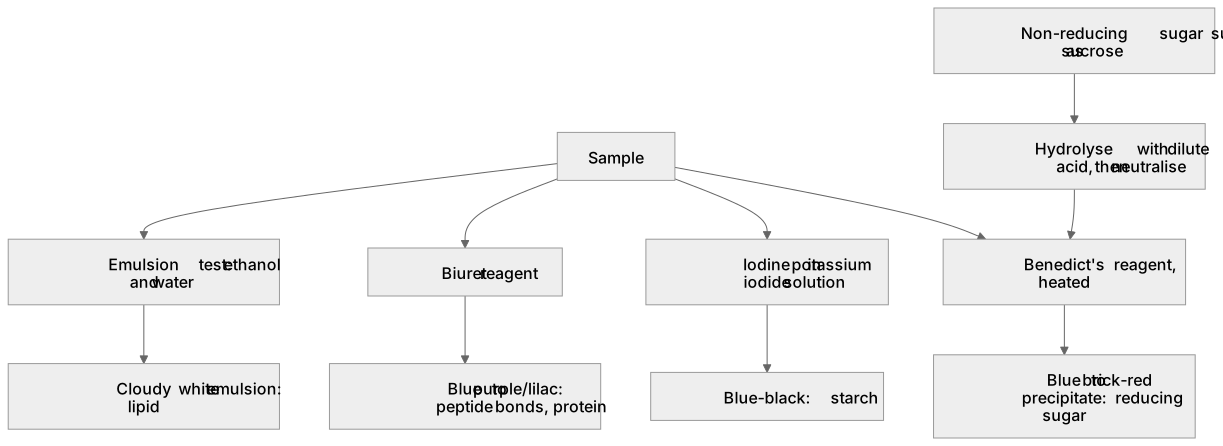
Qualitative reagents give a visible change when a particular biological molecule is present, so they confirm identity rather than measure amount. Benedict's reagent, heated with a reducing sugar such as glucose, turns from blue to a brick-red precipitate of copper(I) oxide; a non-reducing sugar such as sucrose needs prior hydrolysis with dilute acid, then neutralisation, before it gives that result. Iodine in potassium iodide solution turns blue-black with starch. Biuret reagent turns from blue to purple or lilac when peptide bonds are present, so it detects protein. Emulsion tests with ethanol and water give a cloudy white emulsion with lipids. Each test needs the correct sample volume, reagent excess and, for Benedict's, a water bath at around 70–80 °C. Controls and replicates support a valid conclusion.
What earns the marks
- Benedict's test: blue to brick-red precipitate on heating indicates a reducing sugar; the colour change, not the reagent alone, is the evidence.
- Sucrose is non-reducing, so it must be hydrolysed with dilute acid and neutralised before Benedict's test can give a positive result.
- Iodine in potassium iodide solution gives a blue-black colour with starch.
- Biuret reagent changes from blue to purple/lilac in the presence of peptide bonds, indicating protein.
- The emulsion test with ethanol and water produces a cloudy white emulsion when lipid is present.
- Qualitative tests identify the presence of a molecule; they do not reliably quantify concentration.
Common mistakes and how to put them right
Treating a colour change as a measure of concentration.
Put it right by stating that these reagents are qualitative and only show presence or absence.
Testing sucrose directly with Benedict's and concluding it is absent.
Put it right by hydrolysing with dilute acid and neutralising first.
Confusing the Biuret colour change with the Benedict's change.
Put it right by linking purple/lilac to peptide bonds and brick-red precipitate to reducing sugar.
Exam tips
- Name the reagent, the starting colour and the positive result for each test, because marks reward the specific observable change.
- State the heating condition for Benedict's test explicitly rather than saying only that it is warmed.
- When a result is negative, say what colour remains, so the conclusion is tied to evidence.
Try the lesson
The start of the Use of apparatus and techniques: (f) use of qualitative reagents to identify biological molecules lesson, made from checked teaching notes for this specification point.
Have a go first
A student adds Benedict's reagent to a solution and heats it in a water bath. A brick-red precipitate forms. Which biological molecule is indicated?
Listen
Qualitative reagents give a visible change when a particular biological molecule is present, so they confirm identity rather than measure amount. Benedict's reagent, heated with a reducing sugar such as glucose, turns from blue to a brick-red precipitate of copper(I) oxide; a non-reducing sugar such as sucrose needs prior hydrolysis with dilute acid, then neutralisation, before it gives that result. Iodine in potassium iodide solution turns blue-black with starch. Biuret reagent turns from blue to purple or lilac when peptide bonds are present, so it detects protein. Emulsion tests with ethanol and water give a cloudy white emulsion with lipids. Each test needs the correct sample volume, reagent excess and, for Benedict's, a water bath at around 70–80 °C. Controls and replicates support a valid conclusion. A strong answer earns marks for these points. Benedict's test: blue to brick-red precipitate on heating indicates a reducing sugar; the colour change, not the reagent alone, is the evidence. Sucrose is non-reducing, so it must be hydrolysed with dilute acid and neutralised before Benedict's test can give a positive result. Iodine in potassium iodide solution gives a blue-black colour with starch. Biuret reagent changes from blue to purple/lilac in the presence of peptide bonds, indicating protein. A common slip: Treating a colour change as a measure of concentration. Instead, stating that these reagents are qualitative and only show presence or absence. Exam tip: Name the reagent, the starting colour and the positive result for each test, because marks reward the specific observable change.
See it
Key words
Say what each word means before you turn the card.
Qualitative detection of biological molecules
Try answering aloud or in your head before turning the card.
Specific colour changes as evidence
Try answering aloud or in your head before turning the card.
Reducing versus non-reducing sugars
Try answering aloud or in your head before turning the card.
Correct reagent and conditions for each test
Try answering aloud or in your head before turning the card.
See every definition
- Qualitative detection of biological molecules
- Reagents that give a visible change when a particular biological molecule is present, confirming identity rather than measuring amount.
- Specific colour changes as evidence
- The colour change, not the reagent alone, is the evidence, so the specific observable change must be named for each test.
- Reducing versus non-reducing sugars
- Benedict's reagent heated with a reducing sugar turns from blue to a brick-red precipitate, while a non-reducing sugar needs prior hydrolysis with dilute acid, then neutralisation, before it gives that result.
- Correct reagent and conditions for each test
- Each test needs the correct sample volume, reagent excess and, for Benedict's, a water bath at around 70–80 °C.
Label the diagram
Some boxes have lost their names. Pick the right name for each number.
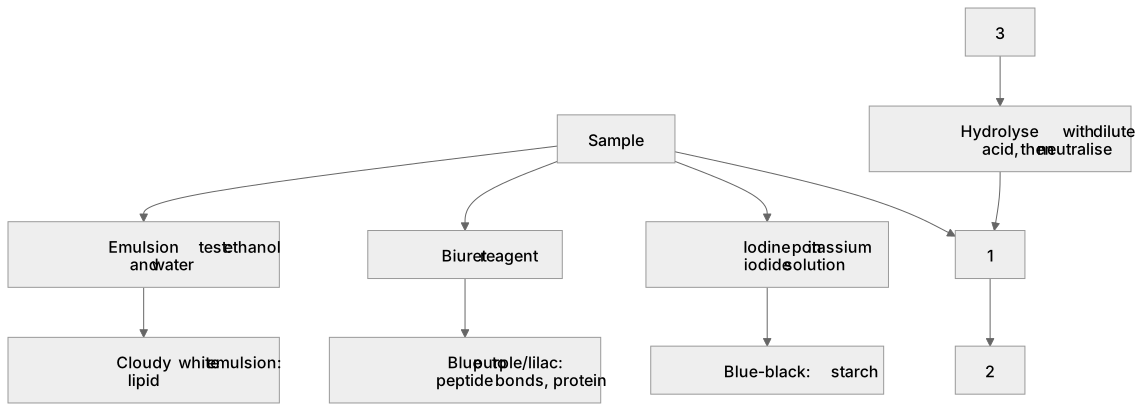
1Box 1
2Box 2
3Box 3
There is more to this lesson
The full lesson goes on to check your understanding and help you earn the marks. Create a free account to carry on, with your progress saved.
A week of Premium from your first lesson · Then the free plan continues · No card, no charge
Test your understanding of Use of apparatus and techniques: (f) use of qualitative reagents to identify biological molecules
Active recall beats re-reading. Take an instant quiz now to test what you’ve learned and lock it into long-term memory.
A week of Premium from your first lesson · Then the free plan continues · No card, no charge