Pearson Edexcel · A-Level · Business
Corporate Objectives and Strategy
Mastering Corporate Objectives and Strategy is crucial for A-Level Business success, as it forms the backbone of all major business decisions. This guide breaks down the core models and exam techniques needed to analyse how businesses from local cafes to global giants like Apple plan for long-term success and secure top marks.
- 7 min read
- 3 worked examples
- 5 practice questions
- 6 key terms
Study Notes
Overview
Corporate Objectives and Strategy (Edexcel A-Level Business, Theme 3) is a cornerstone of your studies, focusing on the highest level of decision-making within a business. It explores how leaders set the long-term direction and how they formulate plans to achieve their goals in a competitive landscape. Examiners are looking for candidates who can move beyond simple definitions and apply strategic models to real-world business scenarios, building logical chains of argument and evaluating the merits of different strategic paths. This topic requires you to think like a director, weighing up risks, analysing data, and making justified judgements. Mastering this will not only prepare you for the exam but also provide a genuine insight into how successful businesses operate.

The Hierarchy of Objectives
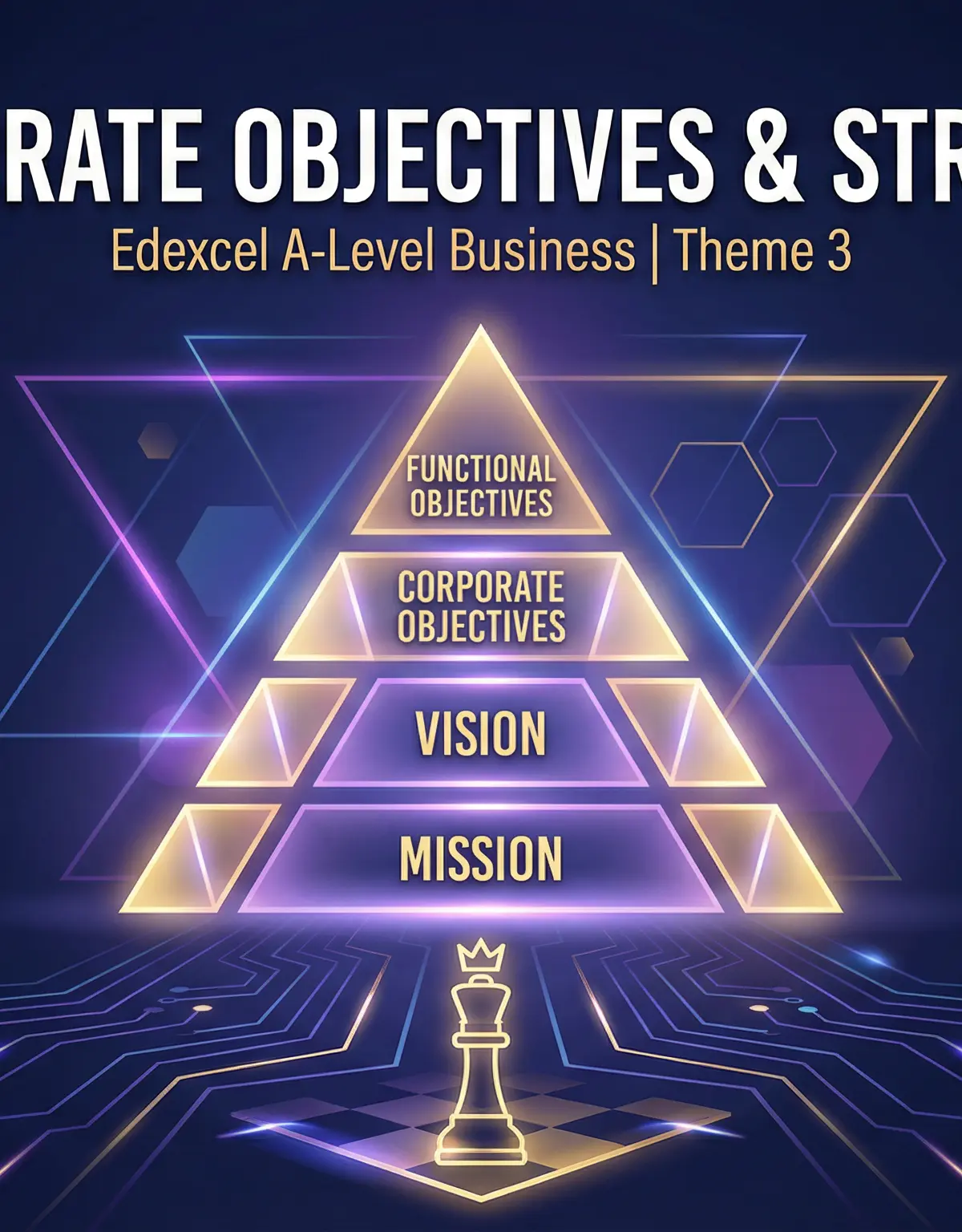
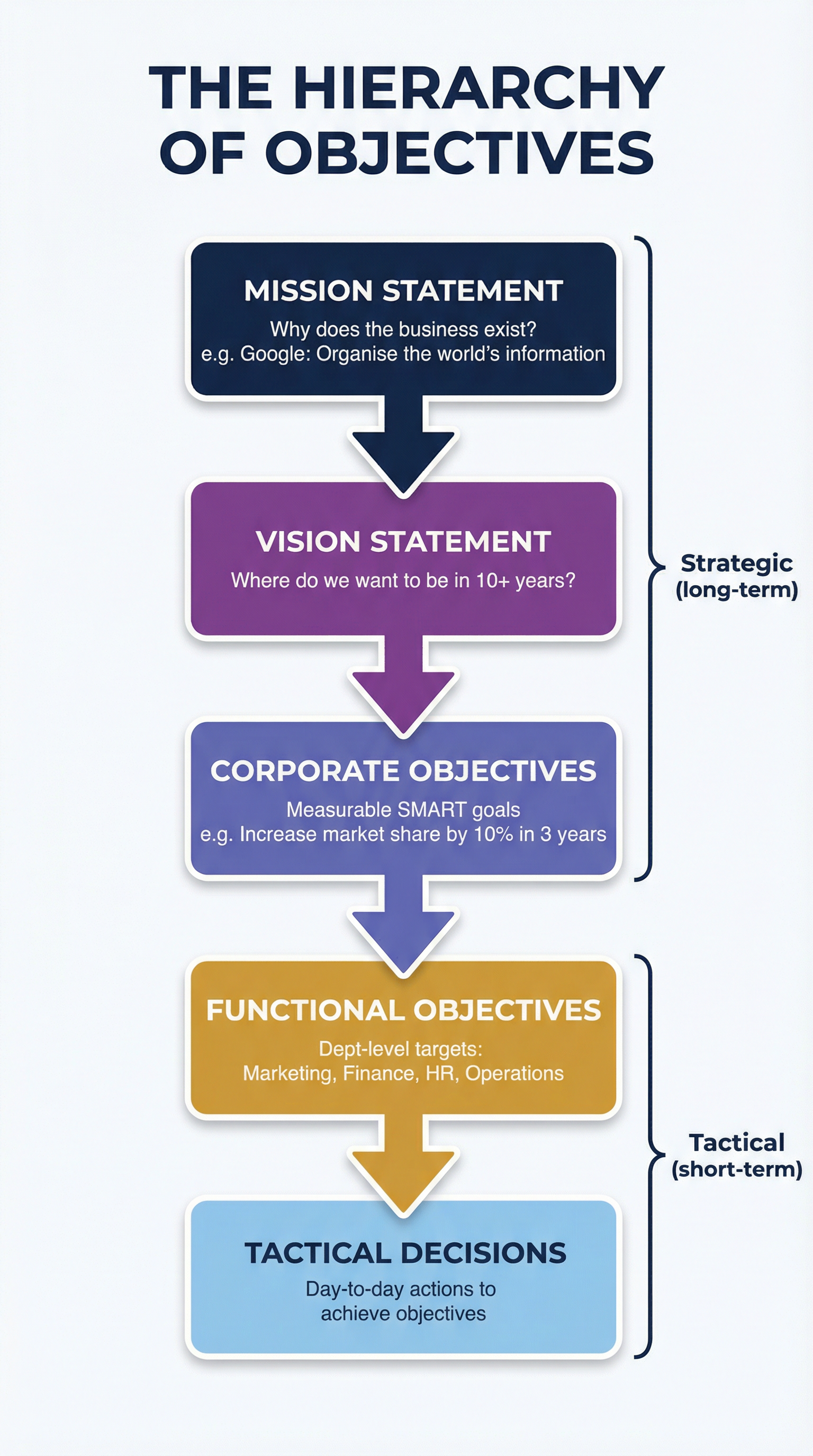
Understanding the hierarchy of objectives is fundamental. It shows how the broad purpose of a business is cascaded down into specific, actionable targets. Examiners expect you to distinguish clearly between each level.
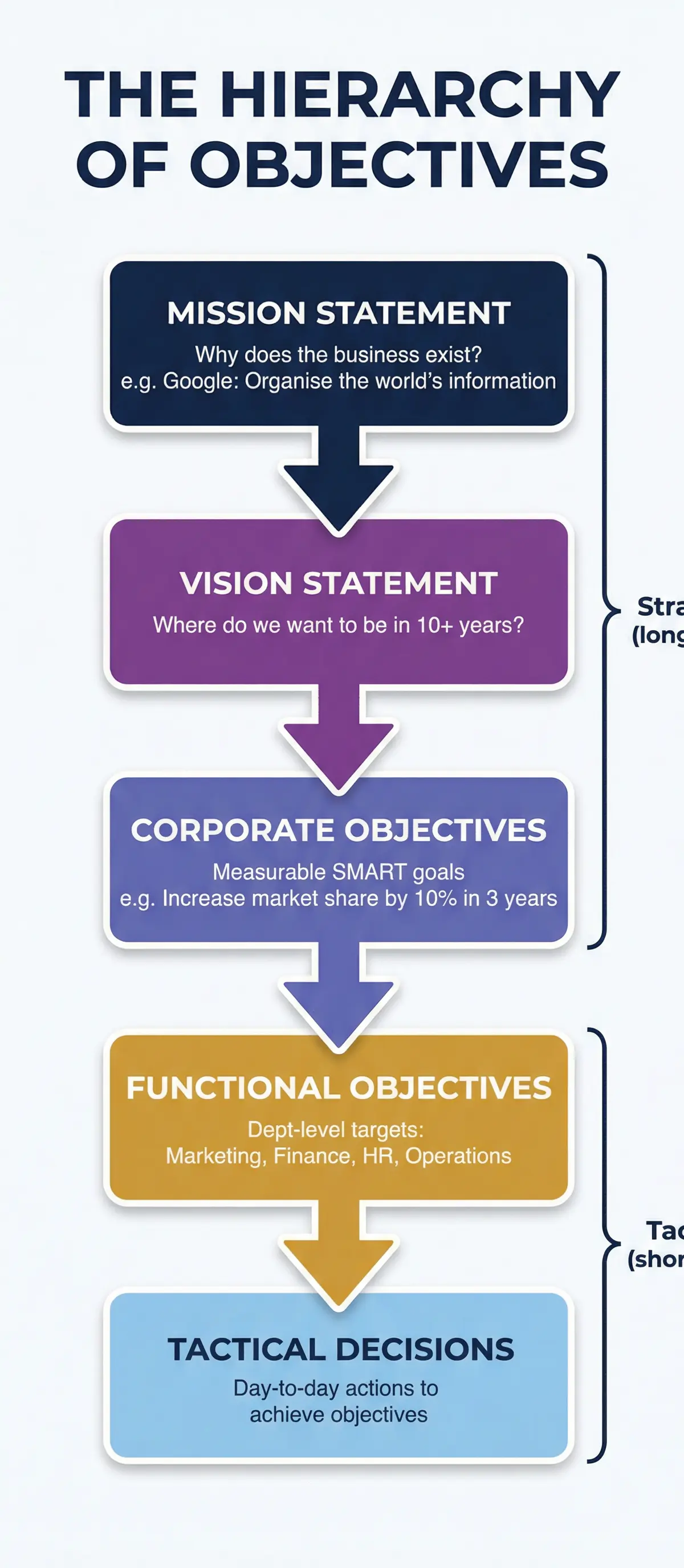
- Mission Statement: This is the starting point. It is a qualitative statement of the business’s core purpose and values. It answers the question, "Why do we exist?" For example, The Walt Disney Company's mission is "to entertain, inform and inspire people around the globe through the power of unparalleled storytelling."
- Vision Statement: This outlines what the organisation wants to become in the long term. It is a source of inspiration and strategic direction.
- Corporate Objectives: These are the medium-to-long-term, quantifiable goals for the business as a whole. They must be SMART (Specific, Measurable, Achievable, Relevant, Time-bound). An example is, "To achieve a 15% market share in the European electric vehicle market by 2030."
- Functional Objectives: These are the specific targets for each department (e.g., Marketing, Finance, HR, Operations) that are designed to help achieve the corporate objectives. For instance, a marketing functional objective might be, "To increase brand awareness among 18-25 year olds by 20% in the next fiscal year."
- Tactics: These are the short-term, day-to-day actions taken to achieve the objectives. A price promotion or a new social media campaign would be a tactic.
Examiner Tip: A common question involves spotting inconsistencies. For example, a business might have a mission focused on sustainability but a corporate objective of cutting costs by sourcing cheaper, less ethical materials. Highlighting and explaining this conflict will gain you significant credit.
Strategic Models for Growth and Analysis
To make strategic decisions, businesses use established models to analyse their position and evaluate potential options. You must be able to apply these models to case study information.
Ansoff’s Matrix
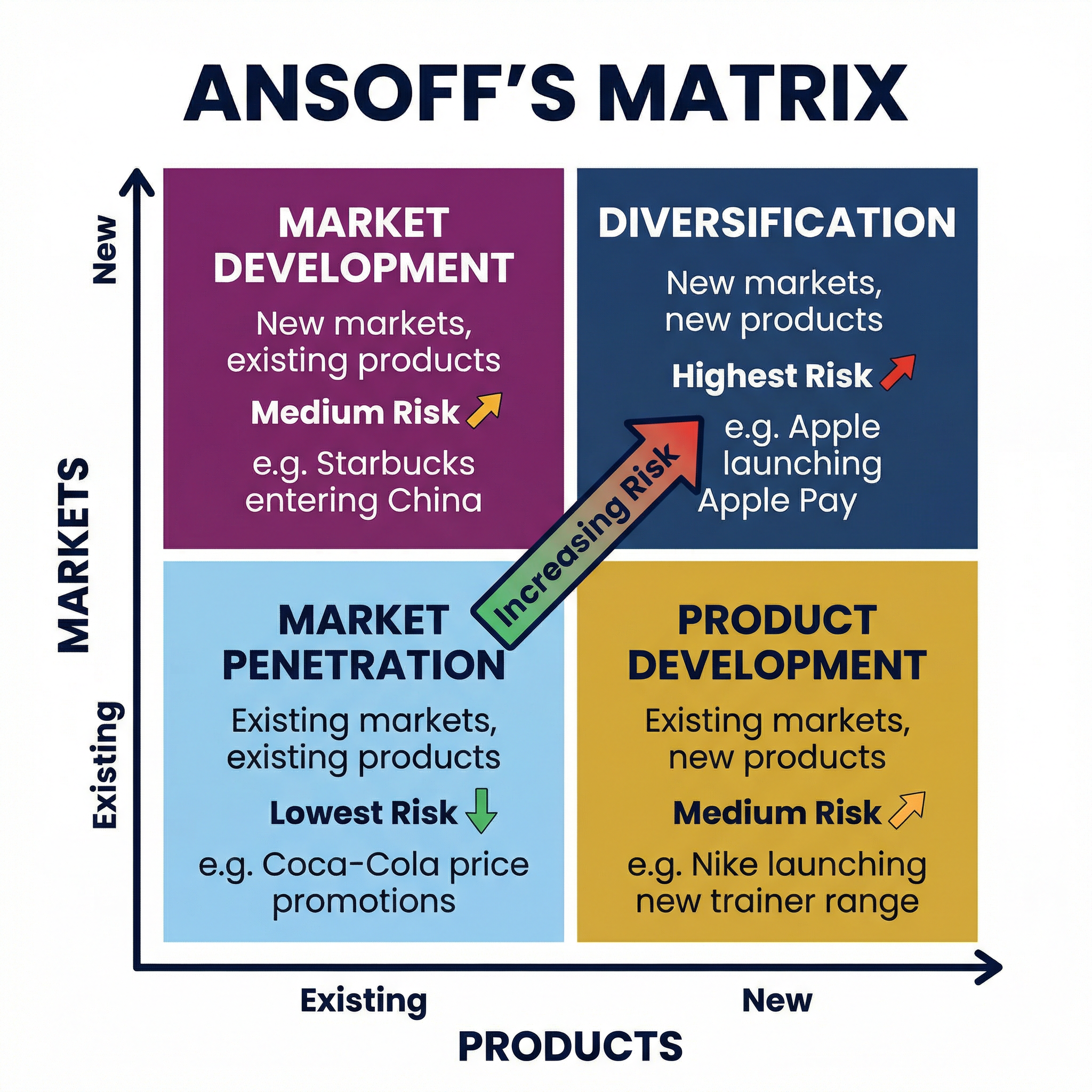
Ansoff's Matrix is a key tool for analysing growth strategies. It helps a business decide its direction based on its products and markets.
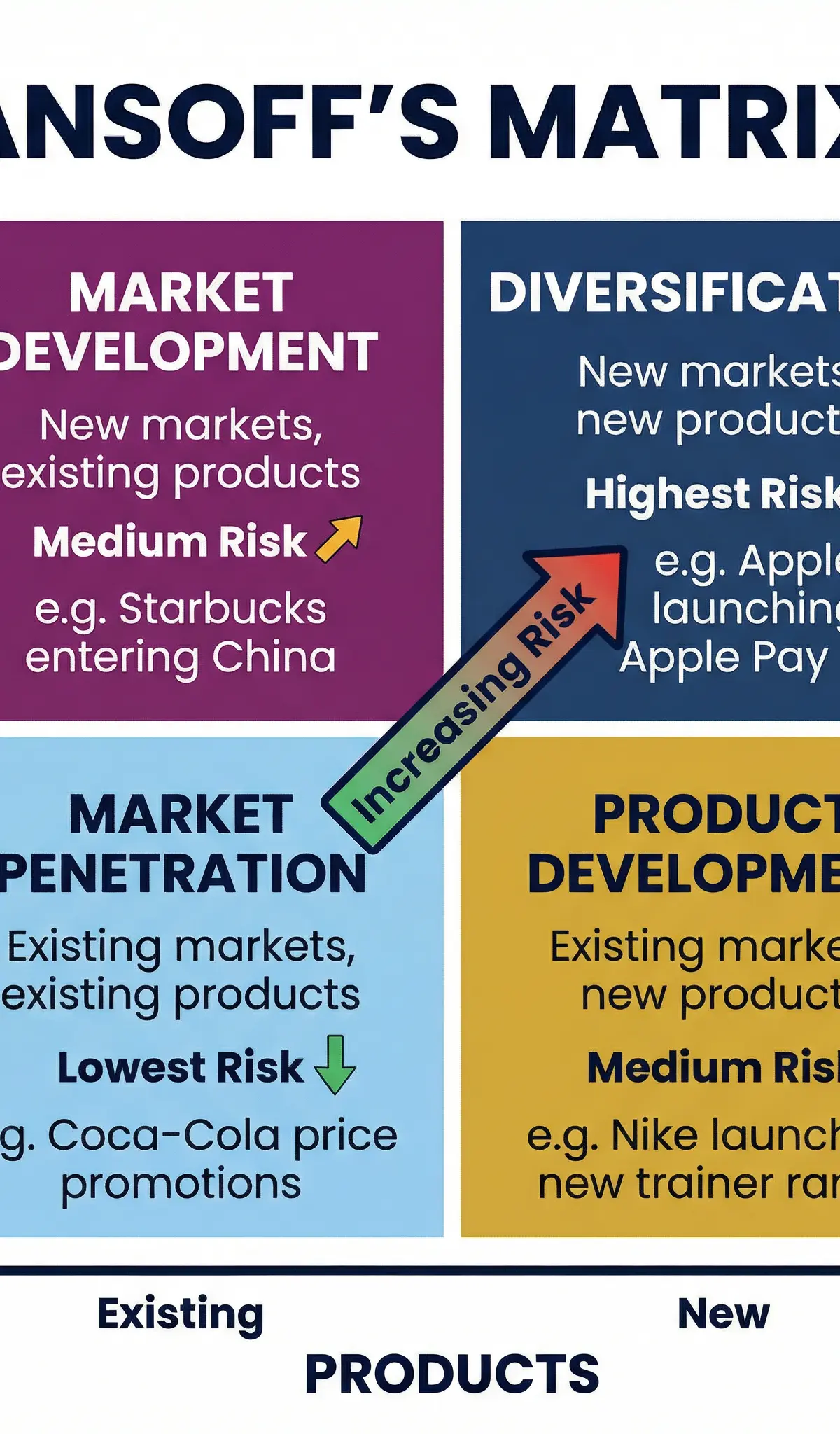
- Market Penetration: Selling more existing products to existing markets. This is the lowest-risk strategy, often involving tactics like loyalty schemes, price adjustments, and increased promotion. Example: A coffee shop chain like Costa offering a new loyalty card to encourage repeat purchases.
- Product Development: Launching new products for existing markets. This is riskier and often involves significant investment in research and development (R&D). Example: Apple launching the Apple Watch to its existing base of iPhone users.
- Market Development: Taking existing products into new markets. This could be a new geographical market or a new demographic segment. Example: IKEA expanding from Europe into the Chinese market.
- Diversification: The riskiest strategy – launching new products in new markets. This can be related diversification (leveraging existing expertise) or unrelated (venturing into a completely new industry). Example: Virgin Group moving from music (Virgin Records) into air travel (Virgin Atlantic).
Porter's Five Forces
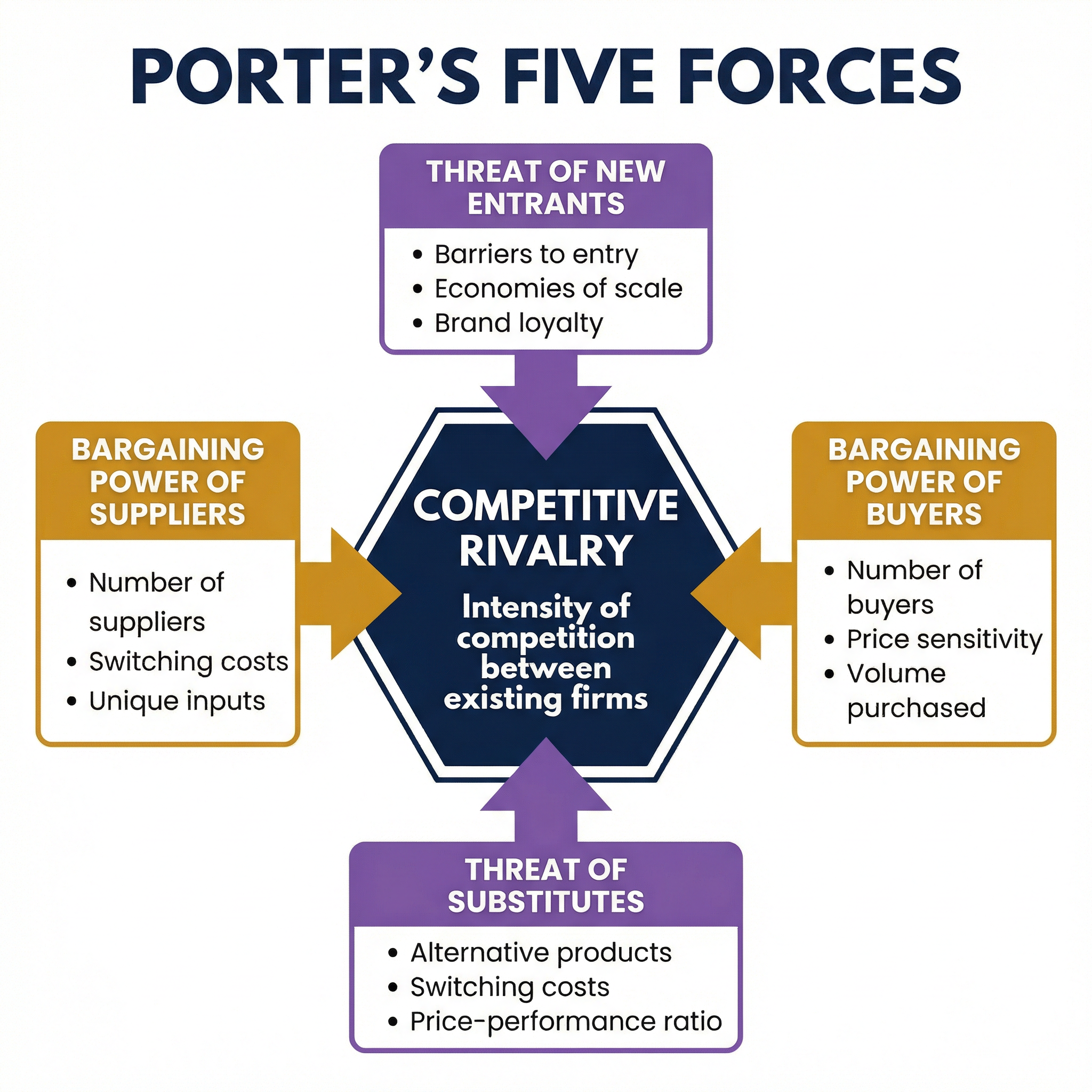
This model is used to analyse the competitive intensity and therefore attractiveness of an industry. A strong understanding allows a business to position itself more effectively.
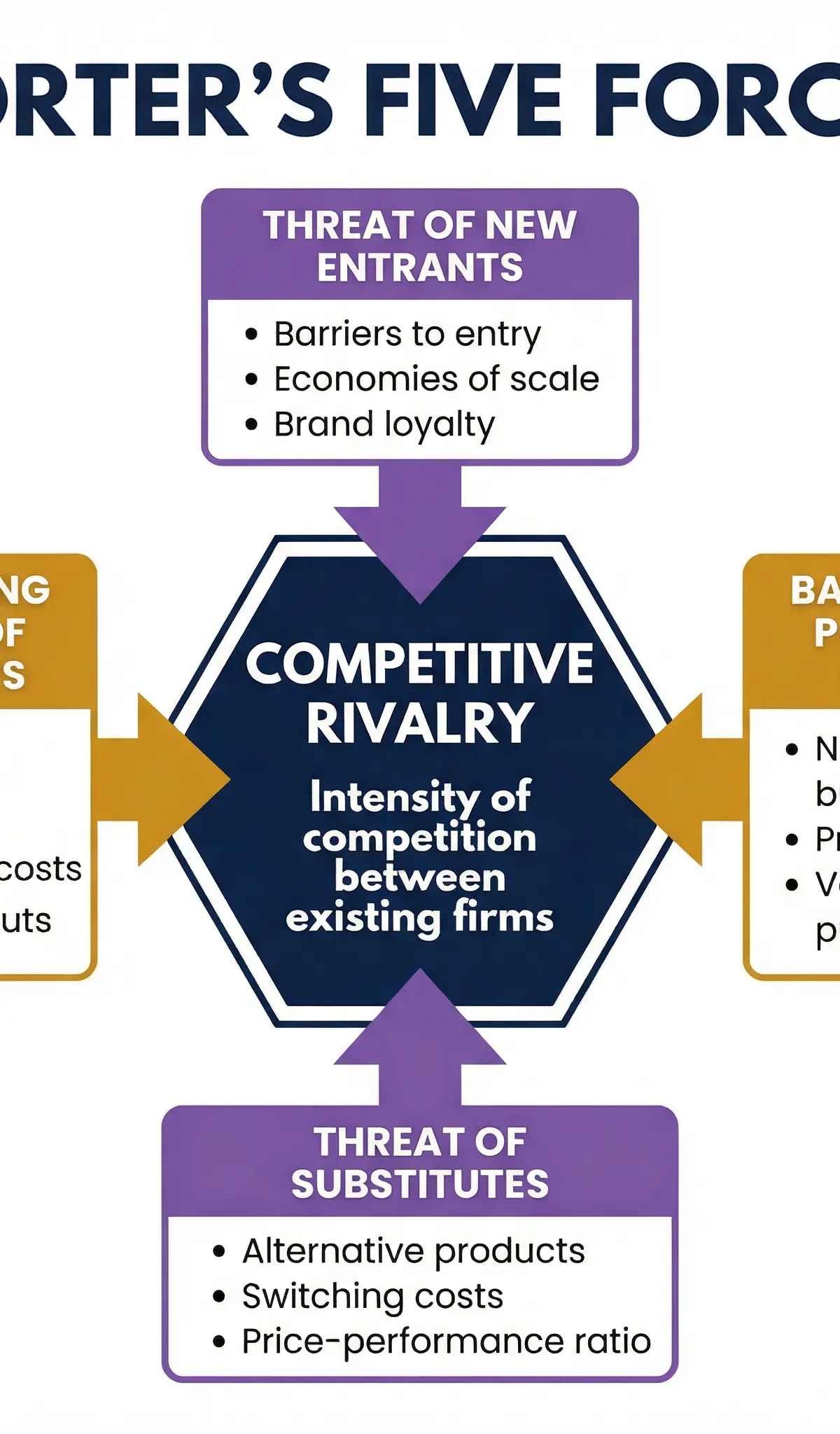
- Threat of New Entry: How easy is it for new competitors to enter the market? High barriers to entry (e.g., high start-up costs, strong brand loyalty, patents) make an industry more attractive for existing firms.
- Bargaining Power of Buyers: How much power do customers have to drive down prices? Power is high when there are many sellers, products are undifferentiated, and switching costs are low.
- Bargaining Power of Suppliers: How much power do suppliers have to increase their prices? Power is high when there are few suppliers, the input is crucial, or the cost of switching suppliers is high.
- Threat of Substitution: How likely is it that customers will switch to an alternative product or service? The availability of close substitutes can cap the prices a firm can charge.
- Competitive Rivalry: How intense is the competition among existing firms in the industry? Rivalry is high when there are many competitors of similar size, industry growth is slow, and exit barriers are high.
Porter's Generic Strategies
After analysing the competitive environment, Porter argues a business must choose a clear strategic position to gain a competitive advantage. Trying to do everything (a "stuck in the middle" strategy) leads to failure.
- Cost Leadership: Aiming to be the lowest-cost producer in the industry. This allows the firm to compete on price. This strategy requires ruthless efficiency, economies of scale, and often involves basic, no-frills products. Example: Ryanair, Aldi.
- Differentiation: Making your product or service unique and desirable in a way that allows you to charge a premium price. This can be achieved through superior quality, branding, customer service, or technology. Example: Dyson, Rolex.
- Focus: Concentrating on a narrow niche market and serving it better than anyone else. This can be done through either a cost focus (e.g., a local budget taxi firm) or a differentiation focus (e.g., a specialist vegan, gluten-free bakery).
Worked Examples
3 worked examples — open one to explore the question and available guidance.
Practice Questions
Test your understanding — click to reveal model answers
Analyse how a strategy of product development might help a smartphone manufacturer achieve its corporate objectives. (12 marks)
Hint: Think about the specific objectives a smartphone company might have (e.g., market share, profitability, brand image). Build a chain of reasoning to show how launching a new phone model helps achieve them.
Evaluate the usefulness of PESTLE analysis for a business that operates globally. (20 marks)
Hint: This is an evaluation question. Argue for its usefulness (provides a structured way to analyse the complex external environment) and against it (can be too generic, quickly becomes outdated, doesn't provide solutions). Conclude with a justified judgement.
Explain two reasons why a business might change its corporate objectives. (8 marks)
Hint: Think about internal and external pressures. Consider a change in leadership (internal) or a major economic downturn (external).
Analyse the potential conflict between the corporate objective of maximising profit and an objective of corporate social responsibility (CSR). (12 marks)
Hint: Show the trade-off. CSR actions (paying higher wages, using sustainable materials, reducing pollution) often increase costs in the short term, which reduces profit. Then, consider how they might align in the long term (better brand image, attracting talent).
Assess the importance of a mission statement for a large business. (10 marks)
Hint: Consider its value for different stakeholders. For employees (motivation, direction), for customers (brand identity), for managers (strategic alignment). Also consider the counter-argument: can it just be corporate jargon with no real impact?