AQA · GCSE · Business
Course version: 8132 · Version from Sept 2017
Calculate gross profit margin and net profit margin to help assess…
Full specification wording
Analysing the financial performance of a business: calculate gross profit margin and net profit margin to help assess financial performance.
Profit margins express profit as a percentage of revenue, making comparison easier.
Checked against the AQA 8132 specification (opens in a new tab) on .
- Point 9 of 9
- 3 key terms
Study notes
From the checked teaching notes for this specification point.
The idea
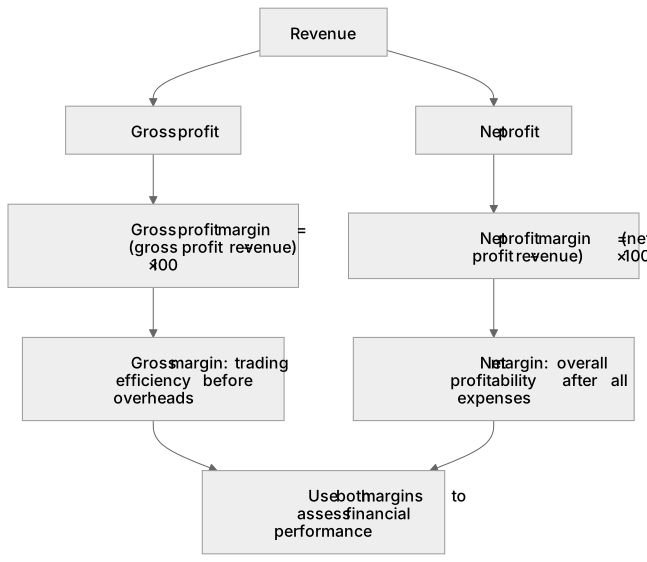
Profit margins express profit as a percentage of revenue, making comparison easier. Gross profit margin = (gross profit ÷ revenue) × 100. Net profit margin = (net profit ÷ revenue) × 100. For example, revenue £200,000, gross profit £80,000 and net profit £30,000 give a gross profit margin of 40% and a net profit margin of 15%. The gross margin shows trading efficiency before overheads; the net margin shows overall profitability after all expenses. A falling net margin may mean rising overheads or interest, even if gross margin is stable. Use both margins, and compare them over time or with competitors, to assess financial performance.
What earns the marks
- States the correct formula for gross profit margin: (gross profit ÷ revenue) × 100.
- States the correct formula for net profit margin: (net profit ÷ revenue) × 100.
- Substitutes the correct profit and revenue figures into each formula.
- Calculates each margin accurately and expresses it as a percentage.
- Uses the calculated margins to comment on financial performance, such as profitability or cost control.
Common mistakes and how to put them right
Dividing revenue by profit instead of profit by revenue.
Put it right: Divide the profit figure by revenue.
Forgetting to multiply by 100, leaving the answer as a decimal.
Put it right: Multiply by 100 to convert to a percentage.
Using the same profit figure for both margins.
Put it right: Use gross profit for the gross margin and net profit for the net margin.
Exam tips
- Write the formula before substituting numbers to secure method marks.
- Show each step of the calculation, including the division and multiplication by 100.
- Round percentages to one or two decimal places and include the % sign.
Try the lesson
The start of the Analysing the financial performance of a business: calculate gross profit margin and net profit margin to help assess financial performance. lesson, made from checked teaching notes for this specification point.
Have a go first
A business has a gross profit of £100,000 and revenue of £500,000. What is its gross profit margin?
Listen
Profit margins express profit as a percentage of revenue, making comparison easier. Gross profit margin = (gross profit ÷ revenue) × 100. Net profit margin = (net profit ÷ revenue) × 100. For example, revenue £200,000, gross profit £80,000 and net profit £30,000 give a gross profit margin of 40% and a net profit margin of 15%. The gross margin shows trading efficiency before overheads; the net margin shows overall profitability after all expenses. A falling net margin may mean rising overheads or interest, even if gross margin is stable. Use both margins, and compare them over time or with competitors, to assess financial performance. A strong answer earns marks for these points. States the correct formula for gross profit margin: (gross profit ÷ revenue) × 100. States the correct formula for net profit margin: (net profit ÷ revenue) × 100. Substitutes the correct profit and revenue figures into each formula. Calculates each margin accurately and expresses it as a percentage. A common slip: Dividing revenue by profit instead of profit by revenue. Instead, divide the profit figure by revenue. Exam tip: Write the formula before substituting numbers to secure method marks.
See it
Key words
Say what each word means before you turn the card.
Gross profit margin
Try answering aloud or in your head before turning the card.
Net profit margin
Try answering aloud or in your head before turning the card.
Financial performance
Try answering aloud or in your head before turning the card.
See every definition
- Gross profit margin
- Calculated as (gross profit ÷ revenue) × 100, it shows trading efficiency before overheads.
- Net profit margin
- Calculated as (net profit ÷ revenue) × 100, it shows overall profitability after all expenses.
- Financial performance
- Assessed by using both margins and comparing them over time or with competitors.
Label the diagram
Some boxes have lost their names. Pick the right name for each number.
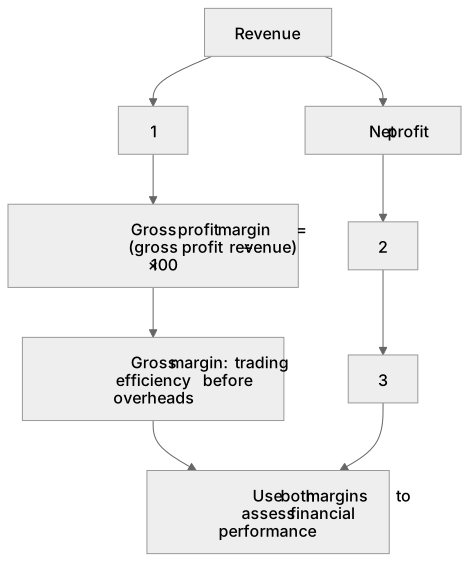
1Box 1
2Box 2
3Box 3
There is more to this lesson
The full lesson goes on to check your understanding and help you earn the marks. Create a free account to carry on, with your progress saved.
A week of Premium from your first lesson · Then the free plan continues · No card, no charge
Test your understanding of Analysing the financial performance of a business: calculate gross profit margin and net profit margin to help assess financial performance.
Active recall beats re-reading. Take an instant quiz now to test what you’ve learned and lock it into long-term memory.
A week of Premium from your first lesson · Then the free plan continues · No card, no charge