AQA · GCSE · Business
Course version: 8132 · Version from Sept 2017
Consider current performance, performance against previous years,…
Full specification wording
Analysing the financial performance of a business: consider current performance, performance against previous years, performance against competitors and performance from the perspective of a range of stakeholders
Analysing financial performance means comparing key figures in several ways.
Checked against the AQA 8132 specification (opens in a new tab) on .
- Point 8 of 9
- 4 key terms
Study notes
From the checked teaching notes for this specification point.
The idea
Analysing financial performance means comparing key figures in several ways. First, consider current performance: is profit, cash flow or turnover healthy now? Second, compare with previous years to spot trends, such as a rising gross profit margin from 18% to 22%. Third, benchmark against competitors: a 5% net profit margin may look weak if rivals achieve 9%. Finally, view results through different stakeholders' eyes. Shareholders want profit and dividends; employees want job security and fair pay; suppliers want prompt payment; customers want value; lenders want interest cover. A single figure rarely tells the whole story, so combine these comparisons to judge whether performance is improving, competitive and sustainable.
What earns the marks
- Identifies current performance using a named financial indicator such as revenue, gross profit, net profit, cash flow or margin.
- Compares performance with previous years, using a trend or percentage change to show improvement or decline.
- Compares performance with competitors, using a benchmark figure or relative statement such as above or below the market average.
- Considers at least two stakeholder perspectives, explaining what each group wants from the financial results.
- Reaches a supported judgement about overall financial performance by weighing the comparisons together.
Common mistakes and how to put them right
Describing only one comparison, such as last year's profit, and ignoring competitors and stakeholders.
Put it right: Structure the answer around all four comparisons.
Treating a high profit as automatically good for everyone.
Put it right: Explain that employees may still face redundancies if costs are cut, and customers may face higher prices.
Confusing profit with cash.
Put it right: State that a profitable business can still run short of cash if customers pay late.
Exam tips
- Use a short paragraph for each comparison: current, previous years, competitors and stakeholders.
- Quote or calculate a figure for each comparison so the analysis is evidence-based.
- Finish with a clear overall judgement that weighs the evidence rather than listing points.
Try the lesson
The start of the Analysing the financial performance of a business: consider current performance, performance against previous years, performance against competitors and performance from the perspective of a range of stakeholders lesson, made from checked teaching notes for this specification point.
Have a go first
A business compares its current year's profit with the profit it made in previous years. Which type of comparison is this?
Listen
Analysing financial performance means comparing key figures in several ways. First, consider current performance: is profit, cash flow or turnover healthy now? Second, compare with previous years to spot trends, such as a rising gross profit margin from 18% to 22%. Third, benchmark against competitors: a 5% net profit margin may look weak if rivals achieve 9%. Finally, view results through different stakeholders' eyes. Shareholders want profit and dividends; employees want job security and fair pay; suppliers want prompt payment; customers want value; lenders want interest cover. A single figure rarely tells the whole story, so combine these comparisons to judge whether performance is improving, competitive and sustainable. A strong answer earns marks for these points. Identifies current performance using a named financial indicator such as revenue, gross profit, net profit, cash flow or margin. Compares performance with previous years, using a trend or percentage change to show improvement or decline. Compares performance with competitors, using a benchmark figure or relative statement such as above or below the market average. Considers at least two stakeholder perspectives, explaining what each group wants from the financial results. A common slip: Describing only one comparison, such as last year's profit, and ignoring competitors and stakeholders. Instead, structure the answer around all four comparisons. Exam tip: Use a short paragraph for each comparison: current, previous years, competitors and stakeholders.
See it
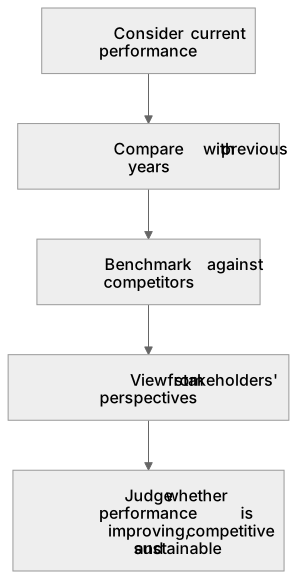
Put it in order
Put these steps in the order they happen.
- 1. Compare with previous years
- 2. Benchmark against competitors
- 3. Consider current performance
- 4. Judge whether performance is improving, competitive and sustainable
- 5. View from stakeholders' perspectives
Key words
Say what each word means before you turn the card.
Financial analysis
Try answering aloud or in your head before turning the card.
Trend analysis
Try answering aloud or in your head before turning the card.
Competitive benchmarking
Try answering aloud or in your head before turning the card.
Stakeholder perspectives
Try answering aloud or in your head before turning the card.
See every definition
- Financial analysis
- Comparing key figures in several ways to judge whether performance is improving, competitive and sustainable.
- Trend analysis
- Comparing performance with previous years to spot trends, such as a rising gross profit margin.
- Competitive benchmarking
- Comparing performance against competitors, where a figure may look weak if rivals achieve more.
- Stakeholder perspectives
- Viewing results through different stakeholders' eyes, such as shareholders wanting profit and dividends and employees wanting job security and fair pay.
Label the diagram
Some boxes have lost their names. Pick the right name for each number.
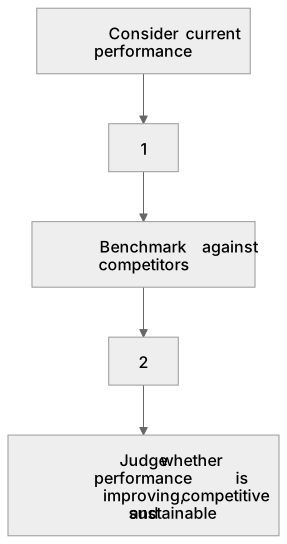
1Box 1
2Box 2
There is more to this lesson
The full lesson goes on to check your understanding and help you earn the marks. Create a free account to carry on, with your progress saved.
A week of Premium from your first lesson · Then the free plan continues · No card, no charge
Test your understanding of Analysing the financial performance of a business: consider current performance, performance against previous years, performance against competitors and performance from the perspective of a range of stakeholders
Active recall beats re-reading. Take an instant quiz now to test what you’ve learned and lock it into long-term memory.
A week of Premium from your first lesson · Then the free plan continues · No card, no charge