AQA · GCSE · Business
Course version: 8132 · Version from Sept 2017
Students should understand the interdependent nature of business…
Full specification wording
Business operations: Students should understand the interdependent nature of business operations, human resources, marketing and finance. Students should be able to give examples of how business objectives would be split into functional plans with clear links throughout.
Business operations, human resources, marketing, and finance are interdependent: decisions in one area affect the others.
Checked against the AQA 8132 specification (opens in a new tab) on .
- Point 1 of 2
- 4 key terms
Study notes
From the checked teaching notes for this specification point.
The idea
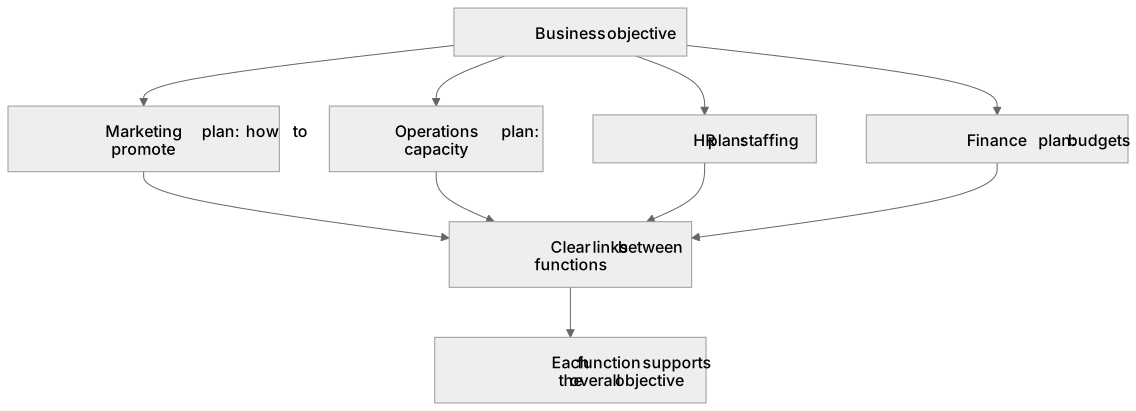
Business operations, human resources, marketing, and finance are interdependent: decisions in one area affect the others. For example, a marketing campaign to boost sales requires operations to increase production, HR to recruit staff, and finance to fund the campaign. Business objectives, such as increasing market share by 10%, are split into functional plans. Marketing plans how to promote, operations plans capacity, HR plans staffing, and finance plans budgets. Clear links ensure each function supports the overall objective. Understanding this interdependence helps explain why businesses must coordinate activities and why a change in one function can cause problems elsewhere.
What earns the marks
- Interdependence means that operations, human resources, marketing, and finance rely on each other and decisions in one area affect the others.
- Business objectives are overarching goals that are broken down into specific functional plans for each department.
- For example, an objective to increase sales would lead marketing to plan promotions, operations to plan increased output, HR to plan recruitment, and finance to plan funding.
- Clear links throughout mean that each functional plan must align with the overall objective and with each other, avoiding conflicts.
- A change in one function, such as a finance budget cut, can impact marketing activities, operations capacity, and HR staffing.
Common mistakes and how to put them right
Treating each function as independent.
Put it right: Functions are interdependent and must coordinate to achieve objectives.
Assuming functional plans are identical to business objectives.
Put it right: Functional plans are specific actions that contribute to achieving the broader objective.
Ignoring the impact of one function on another.
Put it right: Consider how a decision in one area affects the others.
Exam tips
- Use a specific business example to show how an objective is split into functional plans, such as a bakery aiming to increase sales by 20%.
- Explain the links between functions, for example how finance provides the budget for marketing to run a campaign.
- For higher marks, analyse the consequences of a change in one function on the others and on the overall objective.
Try the lesson
The start of the Business operations: Students should understand the interdependent nature of business operations, human resources, marketing and finance. Students should be able to give examples of how business objectives would be split into functional plans with clear links throughout. lesson, made from checked teaching notes for this specification point.
Have a go first
A business sets an objective to increase sales by 10% next year. Which functional area would be most directly responsible for planning an advertising campaign to help achieve this?
Listen
Business operations, human resources, marketing, and finance are interdependent: decisions in one area affect the others. For example, a marketing campaign to boost sales requires operations to increase production, HR to recruit staff, and finance to fund the campaign. Business objectives, such as increasing market share by 10%, are split into functional plans. Marketing plans how to promote, operations plans capacity, HR plans staffing, and finance plans budgets. Clear links ensure each function supports the overall objective. Understanding this interdependence helps explain why businesses must coordinate activities and why a change in one function can cause problems elsewhere. A strong answer earns marks for these points. Interdependence means that operations, human resources, marketing, and finance rely on each other and decisions in one area affect the others. Business objectives are overarching goals that are broken down into specific functional plans for each department. For example, an objective to increase sales would lead marketing to plan promotions, operations to plan increased output, HR to plan recruitment, and finance to plan funding. Clear links throughout mean that each functional plan must align with the overall objective and with each other, avoiding conflicts. A common slip: treating each function as independent. Instead, functions are interdependent and must coordinate to achieve objectives. Exam tip: Use a specific business example to show how an objective is split into functional plans, such as a bakery aiming to increase sales by 20%.
See it
Key words
Say what each word means before you turn the card.
Interdependence
Try answering aloud or in your head before turning the card.
Business objectives
Try answering aloud or in your head before turning the card.
Functional plans
Try answering aloud or in your head before turning the card.
Coordination
Try answering aloud or in your head before turning the card.
See every definition
- Interdependence
- Operations, human resources, marketing, and finance rely on each other and decisions in one area affect the others.
- Business objectives
- Overarching goals that are broken down into specific functional plans for each department.
- Functional plans
- Specific actions for each department that contribute to achieving the broader objective.
- Coordination
- Functions must coordinate their activities to achieve objectives, because a change in one function can cause problems elsewhere.
Label the diagram
Some boxes have lost their names. Pick the right name for each number.
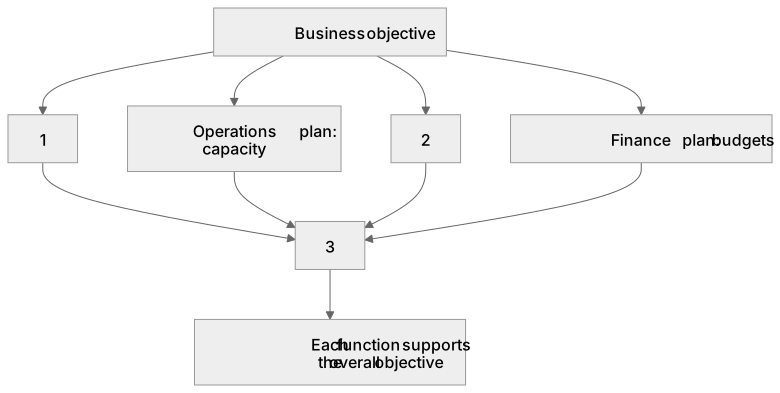
1Box 1
2Box 2
3Box 3
There is more to this lesson
The full lesson goes on to check your understanding and help you earn the marks. Create a free account to carry on, with your progress saved.
A week of Premium from your first lesson · Then the free plan continues · No card, no charge
Test your understanding of Business operations: Students should understand the interdependent nature of business operations, human resources, marketing and finance. Students should be able to give examples of how business objectives would be split into functional plans with clear links throughout.
Active recall beats re-reading. Take an instant quiz now to test what you’ve learned and lock it into long-term memory.
A week of Premium from your first lesson · Then the free plan continues · No card, no charge