AQA · GCSE · Business
Course version: 8132 · Version from Sept 2017
Business ownership: Partnerships
A partnership is a business owned by two or more people who share ownership, capital, profits, and decision-making under a partnership agreement.
Checked against the AQA 8132 specification (opens in a new tab) on .
- Point 2 of 9
- 4 key terms
Study notes
From the checked teaching notes for this specification point.
The idea
A partnership is a business owned by two or more people who share ownership, capital, profits, and decision-making under a partnership agreement. Partners usually have unlimited liability, so personal assets can be used to pay business debts, although some partners may have limited liability in certain forms. Partnerships can raise more finance and bring wider skills than a sole trader, but profits are shared and disagreements can occur. For example, two accountants form a partnership, each contributing £20,000; they share profits equally and are jointly liable for debts. A written agreement should cover profit shares, roles, and dispute resolution to reduce conflict.
What earns the marks
- Defines a partnership as a business owned by two or more people who share ownership and control.
- Explains that partners share capital, profits, and decision-making, often guided by a partnership agreement.
- Explains unlimited liability for partners: personal assets can be used to settle business debts, increasing risk.
- Explains advantages such as more finance, shared skills, and shared workload compared with a sole trader.
- Explains disadvantages such as shared profits, potential disagreements, and joint liability for debts.
- Applies partnership concepts to a scenario, showing how shared ownership affects finance, control, and risk.
Common mistakes and how to put them right
Thinking partnerships always have limited liability.
Put it right: Most partnerships have unlimited liability, so personal assets are at risk.
Assuming all partners must contribute equal capital or receive equal profits.
Put it right: Contributions and profit shares can vary and should be set out in a partnership agreement.
Believing partnerships are legally restricted to a maximum of 20 partners.
Put it right: The historical 20-partner limit was abolished in the UK in 2002, so partnerships can have many more members.
Ignoring the need for a partnership agreement.
Put it right: A written agreement helps prevent disputes over roles, profits, and decision-making.
Exam tips
- Define partnership clearly, then explain how shared ownership affects finance, control, and risk.
- Use the term 'unlimited liability' and explain its impact on partners' personal assets.
- When evaluating, compare partnerships with sole traders or limited companies before making a recommendation.
Try the lesson
The start of the Business ownership: Partnerships lesson, made from checked teaching notes for this specification point.
Have a go first
How many owners are required to form a partnership?
Listen
A partnership is a business owned by two or more people who share ownership, capital, profits, and decision-making under a partnership agreement. Partners usually have unlimited liability, so personal assets can be used to pay business debts, although some partners may have limited liability in certain forms. Partnerships can raise more finance and bring wider skills than a sole trader, but profits are shared and disagreements can occur. For example, two accountants form a partnership, each contributing £20,000; they share profits equally and are jointly liable for debts. A written agreement should cover profit shares, roles, and dispute resolution to reduce conflict. A strong answer earns marks for these points. Defines a partnership as a business owned by two or more people who share ownership and control. Explains that partners share capital, profits, and decision-making, often guided by a partnership agreement. Explains unlimited liability for partners: personal assets can be used to settle business debts, increasing risk. Explains advantages such as more finance, shared skills, and shared workload compared with a sole trader. A common slip: Thinking partnerships always have limited liability. Instead, most partnerships have unlimited liability, so personal assets are at risk. Exam tip: Define partnership clearly, then explain how shared ownership affects finance, control, and risk.
See it
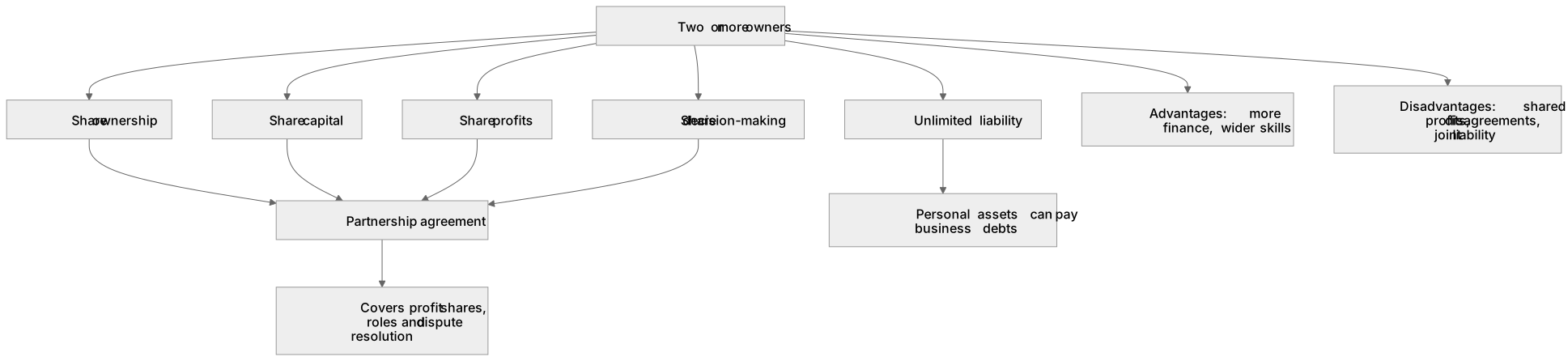
Key words
Say what each word means before you turn the card.
Shared ownership and control
Try answering aloud or in your head before turning the card.
Liability and risk
Try answering aloud or in your head before turning the card.
Finance and profit sharing
Try answering aloud or in your head before turning the card.
Conflict and agreements
Try answering aloud or in your head before turning the card.
See every definition
- Shared ownership and control
- A business owned by two or more people who share ownership, capital, profits, and decision-making under a partnership agreement.
- Liability and risk
- Partners usually have unlimited liability, so personal assets can be used to pay business debts, although some partners may have limited liability in certain forms.
- Finance and profit sharing
- Partnerships can raise more finance and bring wider skills than a sole trader, but profits are shared.
- Conflict and agreements
- Disagreements can occur, so a written agreement should cover profit shares, roles, and dispute resolution to reduce conflict.
Label the diagram
Some boxes have lost their names. Pick the right name for each number.
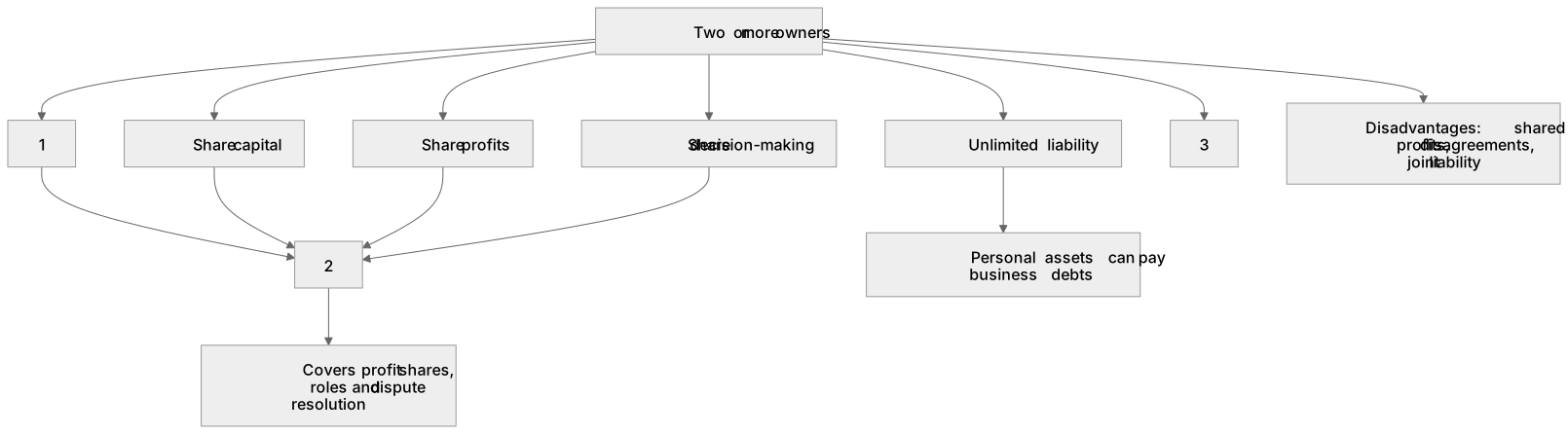
1Box 1
2Box 2
3Box 3
There is more to this lesson
The full lesson goes on to check your understanding and help you earn the marks. Create a free account to carry on, with your progress saved.
A week of Premium from your first lesson · Then the free plan continues · No card, no charge
Test your understanding of Business ownership: Partnerships
Active recall beats re-reading. Take an instant quiz now to test what you’ve learned and lock it into long-term memory.
A week of Premium from your first lesson · Then the free plan continues · No card, no charge