AQA · GCSE · Business
Course version: 8132 · Version from Sept 2017
Business ownership
Master the five main types of business ownership and the crucial difference between limited and unlimited liability. This study guide breaks down the structures, their benefits and drawbacks, and how to evaluate which is best for different business scenarios to secure top marks.
- 5 min read
- 3 worked examples
- 5 practice questions
- 6 key terms
Check what you remember
Read the wording for your board, then hide it and explain Unlimited Liability in your own words. Rough notes are fine. This is a self-check, with no mark or grade.
Reference: AQA
The legal status where business owners are personally responsible for all business debts, putting their personal assets at risk.
Study Notes
Overview
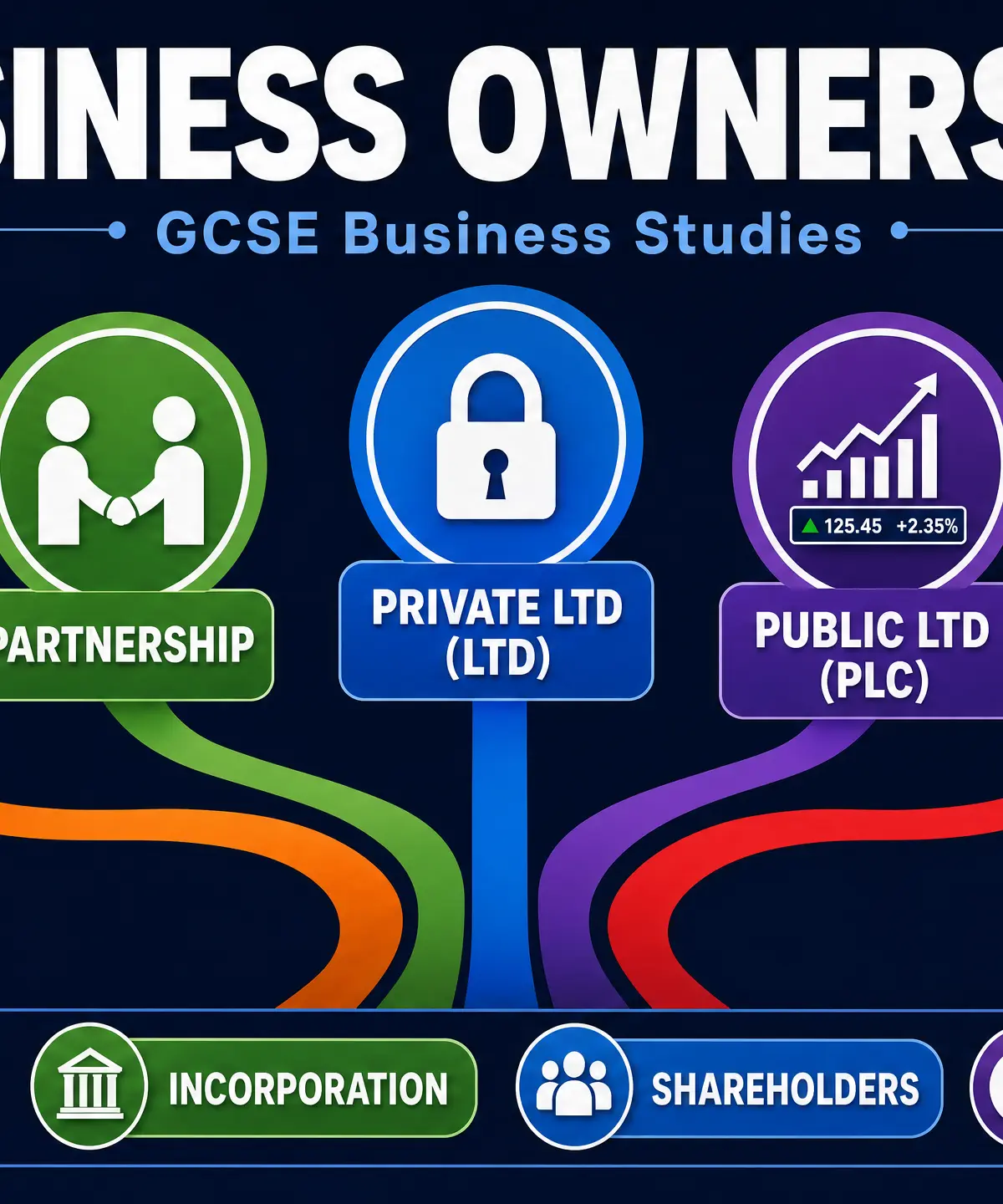
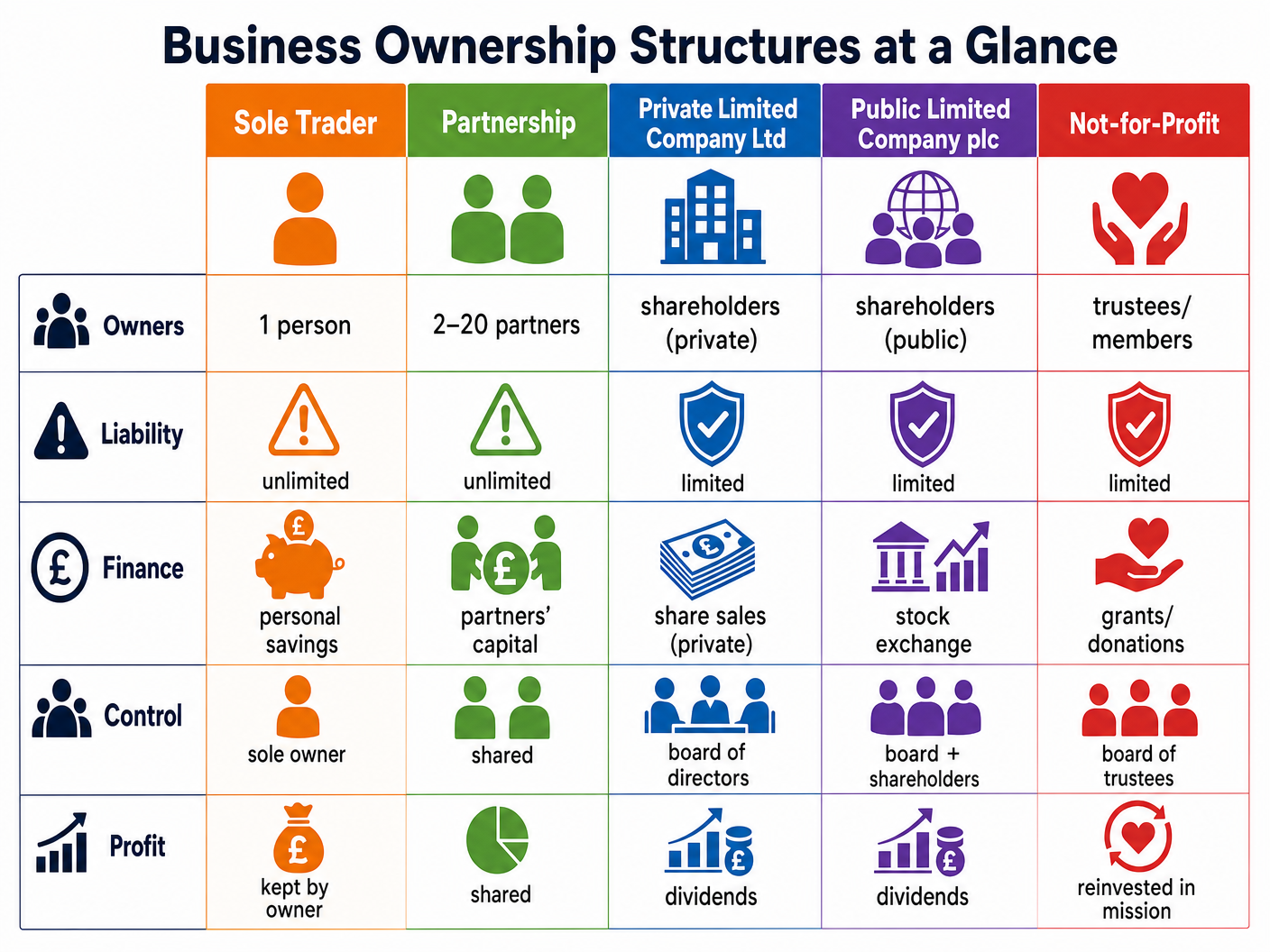
This study guide covers the various legal structures businesses can adopt: sole traders, partnerships, private limited companies (Ltd), public limited companies (plc), and not-for-profit organisations. You will explore the implications of these structures regarding management, control, sources of finance, liability, and profit distribution. Examiners place a specific emphasis on the concept of limited liability versus unlimited liability and the legal process of incorporation. You must be able to analyse the benefits and drawbacks of each structure and, crucially, evaluate the most appropriate legal structure for specific business examples (such as start-ups versus established businesses).
Key Concepts & Structures
1. Sole Trader
Definition: A business owned and operated by one person. They may employ staff, but there is only one owner.
Key Characteristics:
- Simplest and most common form of business structure in the UK.
- Minimal legal formalities to set up.
- The owner has complete control over decision-making.
- The owner keeps 100% of the profits.
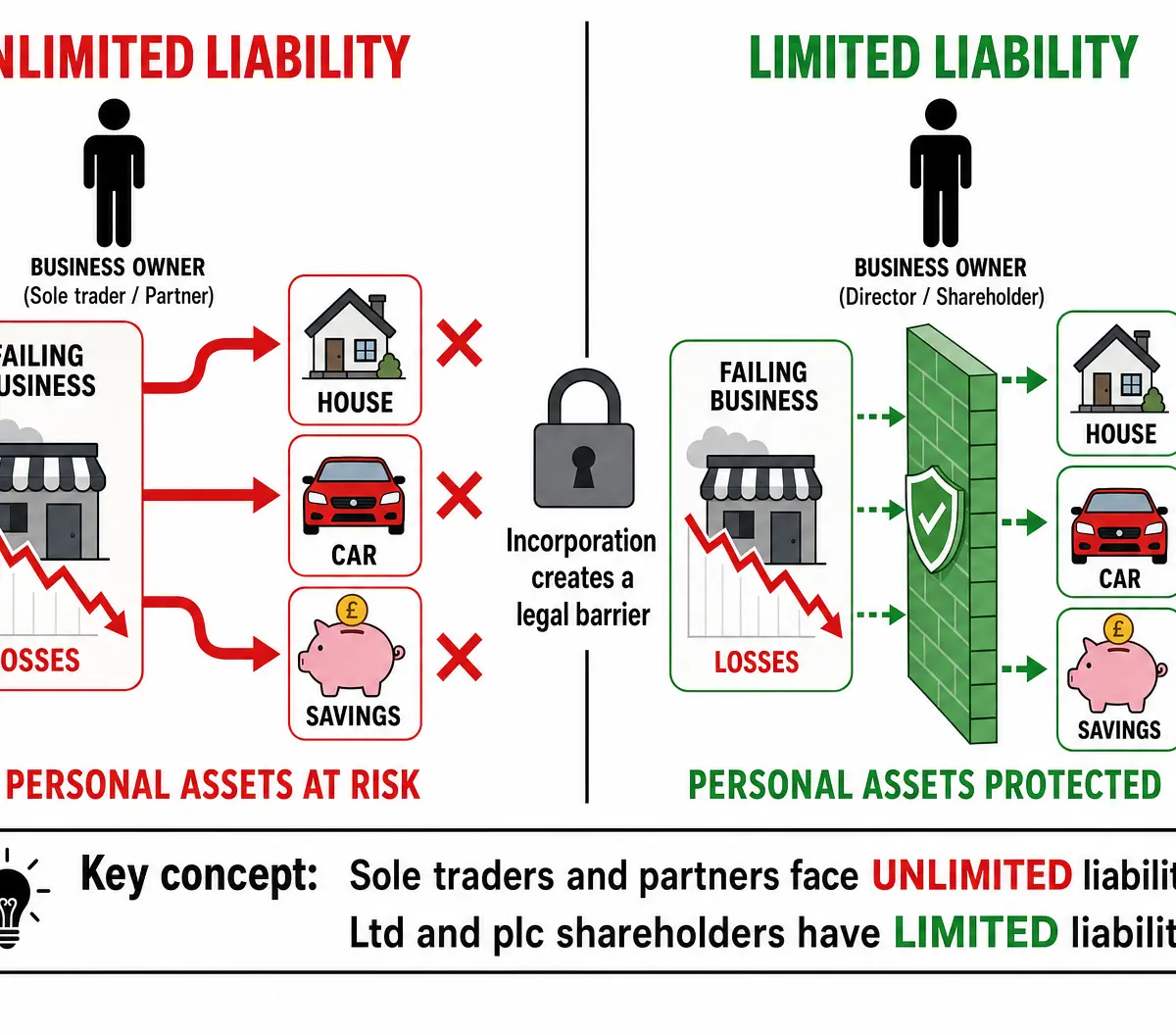
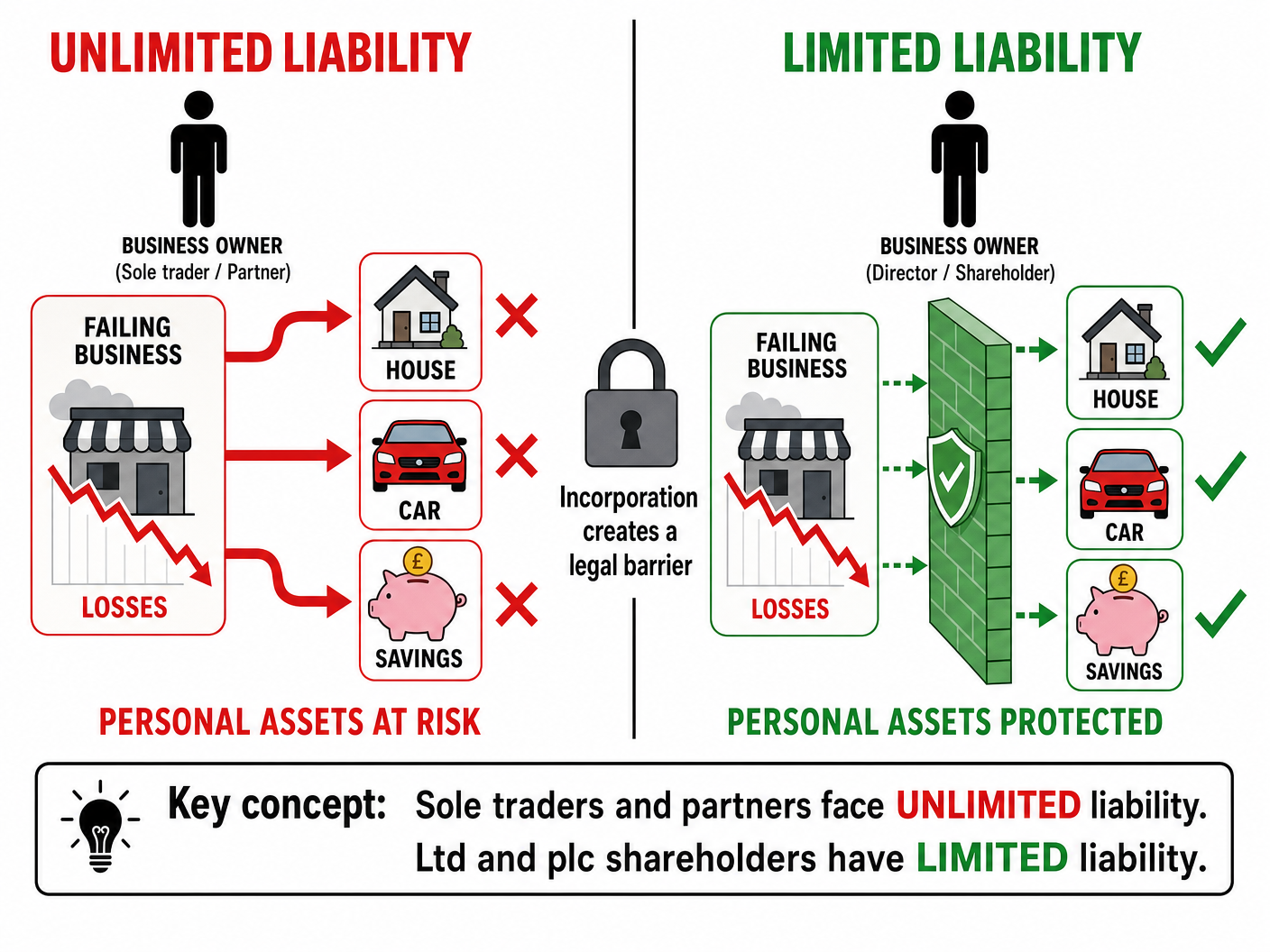
- Unlimited Liability: The owner is personally responsible for all business debts.
Why it matters: Examiners often use sole traders as the starting point in case studies. You must be able to explain why this is suitable for a new, small business (e.g., a local plumber) but risky due to unlimited liability.
2. Partnership
Definition: A business owned by two or more people (usually between 2 and 20 partners) who share the responsibility, risks, and rewards.
Key Characteristics:
- A 'Deed of Partnership' is usually drawn up to outline how profits and responsibilities are shared.
- Partners can pool their capital (money) and skills/expertise.
- Shared decision-making can lead to disagreements.
- Unlimited Liability: Partners are 'jointly and severally liable' for the debts of the business (except in a Limited Liability Partnership, LLP).
Why it matters: Partnerships are common in professions like law, accountancy, and medicine. Examiners will expect you to contrast the shared burden with the risk of unlimited liability.
3. Private Limited Company (Ltd)
Definition: An incorporated business owned by shareholders, where shares can only be sold privately (usually to friends and family) with the agreement of existing shareholders.
Key Characteristics:
- Incorporation: The business is a separate legal entity from its owners.
- Limited Liability: Shareholders can only lose the amount they invested; personal assets are protected.
- Often run by a Board of Directors who are also the main shareholders.
- Cannot sell shares to the general public on a stock exchange.
- Must publish financial accounts (though less detailed than a plc).
Why it matters: This is the logical next step for a growing sole trader or partnership seeking to protect personal assets while raising more finance.
4. Public Limited Company (plc)
Definition: A large, incorporated business that can sell its shares to the general public via a stock exchange.
Key Characteristics:
- Limited Liability for all shareholders.
- Can raise vast amounts of capital by selling shares publicly.
- Minimum share capital requirement (usually £50,000).
- Strict regulatory requirements: must publish detailed accounts and hold an Annual General Meeting (AGM).
- Risk of hostile takeover if a rival buys a majority of shares.
- Divorce of ownership and control: owners (shareholders) are often separate from the managers (directors).
Why it matters: Plcs are the giants of the business world (e.g., Tesco, BP). Examiners test your understanding of how going public changes control and scrutiny.
5. Not-for-Profit Organisations
Definition: Organisations set up to achieve a social, charitable, or community objective, rather than to maximise profit for owners.
Key Characteristics:
- Includes charities, social enterprises, and community interest companies.
- Any surplus (profit) generated is reinvested back into the organisation's mission.
- Often benefit from tax exemptions and grants/donations.
- Controlled by a board of trustees or a management committee.
- Usually have limited liability to protect trustees.
Why it matters: Examiners use not-for-profits to test your understanding of differing business objectives. You must contrast their aims with profit-seeking enterprises.

Visual Resources
2 diagrams and illustrations
Interactive Diagrams
1 interactive diagram to visualise key concepts
Conceptual Flow Outline
Flowchart showing incorporation and liability
Worked Examples
3 worked examples — open one to explore the question and available guidance.
Practice Questions
Try the question, then reveal an answer plan or example response
State two features of a sole trader. (2 marks)
Hint: Think about ownership and liability.
Explain one reason why a business might choose to operate as a partnership rather than a sole trader. (3 marks)
Hint: What do two people bring that one person doesn't?
Explain the difference between a Private Limited Company (Ltd) and a Public Limited Company (plc). (4 marks)
Hint: Focus on how and to whom they sell shares.
Evaluate whether becoming a Public Limited Company (plc) is the best way for a successful national retail chain to fund international expansion. (12 marks)
Hint: Weigh the massive capital injection against the loss of control and increased scrutiny.
Explain how the objectives of a not-for-profit organisation differ from those of a sole trader. (4 marks)
Hint: What happens to the money left over at the end of the year?
Exam technique
How to turn what you know into marks
How to approach the question
Always identify the command word and the context. If a business is named, use their specific situation in your answer.
How to structure your answer
- Explain questions
- State point → Explain how it works → Explain the impact on the business.
- Evaluate questions
- State option 1 benefits → State option 1 drawbacks → State option 2 benefits → State option 2 drawbacks → Final justified conclusion.
- Recommend questions
- Why the recommendation works for THIS business → Why the alternative is worse → Conclusion weighing up the most important factor.
Timing
Approximately 1 minute per mark.
Common pitfalls
- Confusing Ltd (private) with plc (public).
- Stating that not-for-profits cannot make a profit (they can, they just call it a surplus and reinvest it).
- Failing to explain what unlimited liability actually means (you must mention personal assets being at risk).
What the command words want
- Analyse
- Examine the causes or consequences in detail, showing a chain of impacts.
- Explain
- Make a point and develop it with linked reasoning (e.g., 'This means that...', 'Therefore...').
- State/Identify
- Short, factual answer. No explanation needed.
- Evaluate/Recommend
- Look at both sides of the argument, apply to the context, and make a final judgement based on the evidence.
Watch or listen (optional)
Test your understanding of Business ownership
Active recall beats re-reading. Take an instant quiz now to test what you’ve learned and lock it into long-term memory.
7 days Premium · Then the free plan continues · No card, no charge