AQA · GCSE · Business
Course version: 8132 · Version from Sept 2017
Understand the different legal structures that businesses adopt
Full specification wording
Business ownership: understand the different legal structures that businesses adopt
Legal structure determines who owns a business, how it is controlled, how profits are shared and the extent of owners' liability.
Checked against the AQA 8132 specification (opens in a new tab) on .
- Point 6 of 9
- 4 key terms
Study notes
From the checked teaching notes for this specification point.
The idea
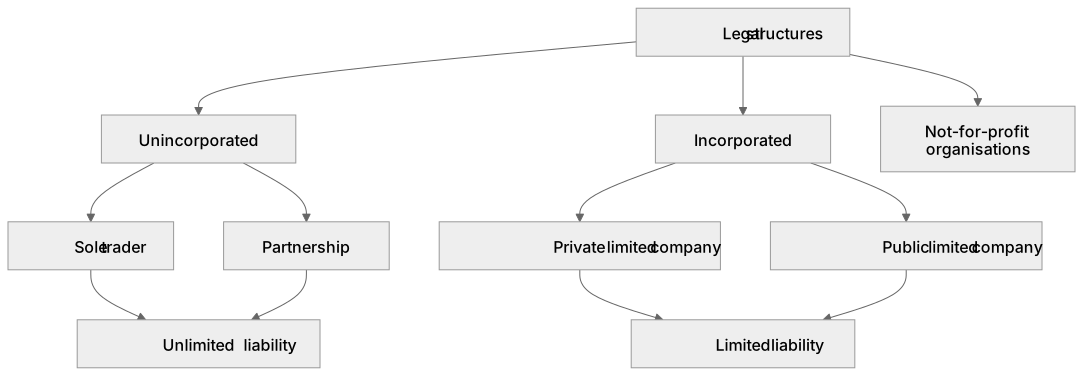
Legal structure determines who owns a business, how it is controlled, how profits are shared and the extent of owners' liability. Unincorporated structures include sole traders and partnerships; owners have unlimited liability, so personal assets are at risk. Incorporated structures include private and public limited companies; they have separate legal identity and limited liability, but must register and disclose more information. Other forms include not-for-profit organisations. Choosing a structure affects access to finance, tax, risk and decision-making. For example, a sole trader keeps all profit but faces unlimited liability, while a private limited company can sell shares to raise capital but must file accounts. Understanding these differences allows students to recommend a suitable structure for a given business context.
What earns the marks
- Identifies and names a range of legal structures, including sole trader, partnership, private limited company, public limited company, and not-for-profit organisations.
- Explains the key difference between unincorporated and incorporated structures, including separate legal identity and limited versus unlimited liability.
- Describes how ownership, control and profit distribution vary between structures, for example sole trader versus private limited company.
- Explains how the choice of legal structure affects access to finance, risk, tax and administrative requirements.
- Applies knowledge to a business scenario by recommending a suitable legal structure and justifying the choice with reference to the context.
Common mistakes and how to put them right
Thinking a private limited company and a public limited company are the same.
Put it right: A private limited company cannot offer shares to the general public, while a public limited company can.
Believing a partnership always has limited liability.
Put it right: In a standard partnership, partners usually have unlimited liability, although limited liability partnerships exist.
Assuming a sole trader cannot employ staff.
Put it right: A sole trader can employ staff, but remains the sole owner with unlimited liability.
Confusing a franchise with a legal structure.
Put it right: Franchising is a method of growth, not a legal structure like a sole trader or limited company.
Exam tips
- When comparing legal structures, use a table or clear paragraphs to contrast liability, ownership, finance and control.
- In application questions, name the structure and then link its features directly to the case study details, such as the need for capital or the owner's attitude to risk.
- For evaluation questions, weigh up the advantages and disadvantages of at least two structures before making a justified recommendation.
Try the lesson
The start of the Business ownership: understand the different legal structures that businesses adopt lesson, made from checked teaching notes for this specification point.
Have a go first
Which legal structure is a business with unlimited liability and a single owner?
Listen
Legal structure determines who owns a business, how it is controlled, how profits are shared and the extent of owners' liability. Unincorporated structures include sole traders and partnerships; owners have unlimited liability, so personal assets are at risk. Incorporated structures include private and public limited companies; they have separate legal identity and limited liability, but must register and disclose more information. Other forms include not-for-profit organisations. Choosing a structure affects access to finance, tax, risk and decision-making. For example, a sole trader keeps all profit but faces unlimited liability, while a private limited company can sell shares to raise capital but must file accounts. Understanding these differences allows students to recommend a suitable structure for a given business context. A strong answer earns marks for these points. Identifies and names a range of legal structures, including sole trader, partnership, private limited company, public limited company, and not-for-profit organisations. Explains the key difference between unincorporated and incorporated structures, including separate legal identity and limited versus unlimited liability. Describes how ownership, control and profit distribution vary between structures, for example sole trader versus private limited company. Explains how the choice of legal structure affects access to finance, risk, tax and administrative requirements. A common slip: Thinking a private limited company and a public limited company are the same. Instead, a private limited company cannot offer shares to the general public, while a public limited company can. Exam tip: When comparing legal structures, use a table or clear paragraphs to contrast liability, ownership, finance and control.
See it
Key words
Say what each word means before you turn the card.
Legal structure
Try answering aloud or in your head before turning the card.
Unlimited liability
Try answering aloud or in your head before turning the card.
Limited liability
Try answering aloud or in your head before turning the card.
Incorporated structures
Try answering aloud or in your head before turning the card.
See every definition
- Legal structure
- Determines who owns a business, how it is controlled, how profits are shared and the extent of owners' liability.
- Unlimited liability
- A feature of unincorporated structures where owners' personal assets are at risk.
- Limited liability
- A feature of incorporated structures, which have separate legal identity.
- Incorporated structures
- Private and public limited companies, which have separate legal identity and limited liability but must register and disclose more information.
Label the diagram
Some boxes have lost their names. Pick the right name for each number.
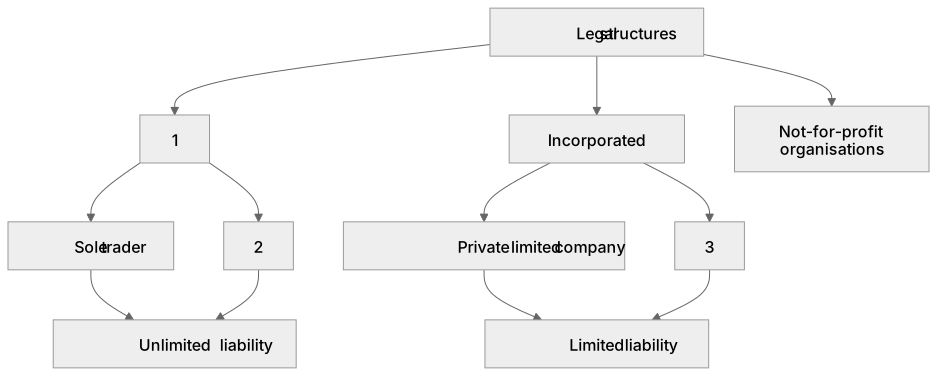
1Box 1
2Box 2
3Box 3
There is more to this lesson
The full lesson goes on to check your understanding and help you earn the marks. Create a free account to carry on, with your progress saved.
A week of Premium from your first lesson · Then the free plan continues · No card, no charge
Test your understanding of Business ownership: understand the different legal structures that businesses adopt
Active recall beats re-reading. Take an instant quiz now to test what you’ve learned and lock it into long-term memory.
A week of Premium from your first lesson · Then the free plan continues · No card, no charge