AQA · GCSE · Business
Course version: 8132 · Version from Sept 2017
Business ownership: Not-for-profit organisations
Not-for-profit organisations trade to fund a mission rather than to distribute profit to owners.
Checked against the AQA 8132 specification (opens in a new tab) on .
- Point 5 of 9
- 4 key terms
Study notes
From the checked teaching notes for this specification point.
The idea
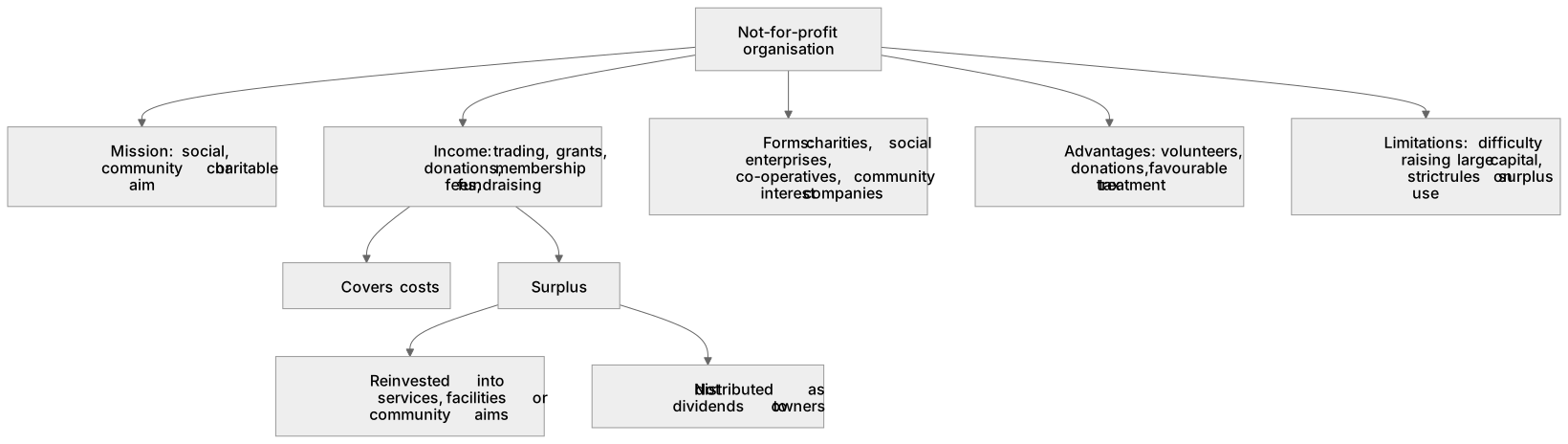
Not-for-profit organisations trade to fund a mission rather than to distribute profit to owners. Surplus is reinvested into services, facilities or community aims. Common forms include charities, social enterprises, co-operatives and community interest companies. They still need income to cover costs, so they may sell goods, bid for grants or run fundraising events. For example, a community sports club charges membership fees; any surplus buys equipment or maintains pitches instead of paying dividends. This structure can attract volunteers, donations and favourable tax treatment, but it may struggle to raise large capital and can face strict rules on how surplus is used. Understanding this helps explain why some businesses prioritise social impact over shareholder returns.
What earns the marks
- Defines a not-for-profit organisation as one whose main aim is to fulfil a social, community or charitable mission rather than to generate profit for owners.
- Explains that any surplus or profit is retained and reinvested into the organisation's mission, not distributed as dividends to owners or shareholders.
- Identifies common legal forms such as charities, social enterprises, co-operatives and community interest companies, and links each to the not-for-profit category.
- Describes how such organisations generate income, for example through trading, grants, donations, membership fees or fundraising, and why income is still necessary.
- Explains at least one advantage, such as access to volunteers, donations or favourable tax treatment, and one limitation, such as difficulty raising large amounts of capital or legal restrictions on surplus use.
Common mistakes and how to put them right
Assuming not-for-profit organisations cannot make a surplus.
Put it right: They can and often must generate a surplus to reinvest, but they do not distribute it to owners.
Confusing not-for-profit with a charity.
Put it right: All charities are not-for-profit, but not all not-for-profit organisations are charities; social enterprises and community interest companies are other examples.
Believing not-for-profit organisations do not need to cover costs.
Put it right: They must still generate enough income to pay staff, bills and other expenses, or they will fail.
Exam tips
- When asked to explain a not-for-profit organisation, always state the mission and what happens to any surplus, using a named example such as a community sports club or a charity shop.
- Use comparative language if the question asks you to distinguish not-for-profit from private limited companies, for example by contrasting dividend distribution with reinvestment.
- Apply the concept to a short case study by identifying the organisation's aim and then explaining how its legal form affects its funding or decision-making.
Try the lesson
The start of the Business ownership: Not-for-profit organisations lesson, made from checked teaching notes for this specification point.
Have a go first
Which of the following best describes a not-for-profit organisation?
Listen
Not-for-profit organisations trade to fund a mission rather than to distribute profit to owners. Surplus is reinvested into services, facilities or community aims. Common forms include charities, social enterprises, co-operatives and community interest companies. They still need income to cover costs, so they may sell goods, bid for grants or run fundraising events. For example, a community sports club charges membership fees; any surplus buys equipment or maintains pitches instead of paying dividends. This structure can attract volunteers, donations and favourable tax treatment, but it may struggle to raise large capital and can face strict rules on how surplus is used. Understanding this helps explain why some businesses prioritise social impact over shareholder returns. A strong answer earns marks for these points. Defines a not-for-profit organisation as one whose main aim is to fulfil a social, community or charitable mission rather than to generate profit for owners. Explains that any surplus or profit is retained and reinvested into the organisation's mission, not distributed as dividends to owners or shareholders. Identifies common legal forms such as charities, social enterprises, co-operatives and community interest companies, and links each to the not-for-profit category. Describes how such organisations generate income, for example through trading, grants, donations, membership fees or fundraising, and why income is still necessary. A common slip: Assuming not-for-profit organisations cannot make a surplus. Instead, they can and often must generate a surplus to reinvest, but they do not distribute it to owners. Exam tip: When asked to explain a not-for-profit organisation, always state the mission and what happens to any surplus, using a named example such as a community sports club or a charity shop.
See it
Key words
Say what each word means before you turn the card.
Not-for-profit organisation
Try answering aloud or in your head before turning the card.
Surplus
Try answering aloud or in your head before turning the card.
Legal structures and ownership
Try answering aloud or in your head before turning the card.
Stakeholder influence and social responsibility
Try answering aloud or in your head before turning the card.
See every definition
- Not-for-profit organisation
- An organisation whose main aim is to fulfil a social, community or charitable mission rather than to generate profit for owners.
- Surplus
- Money that is retained and reinvested into the organisation's mission, not distributed as dividends to owners or shareholders.
- Legal structures and ownership
- Common forms include charities, social enterprises, co-operatives and community interest companies.
- Stakeholder influence and social responsibility
- Some businesses prioritise social impact over shareholder returns.
Label the diagram
Some boxes have lost their names. Pick the right name for each number.
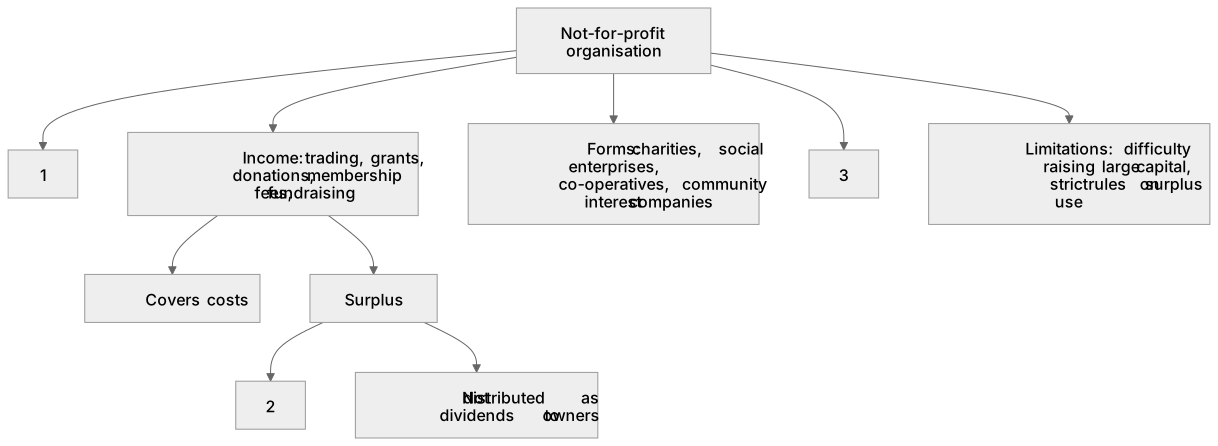
1Box 1
2Box 2
3Box 3
There is more to this lesson
The full lesson goes on to check your understanding and help you earn the marks. Create a free account to carry on, with your progress saved.
A week of Premium from your first lesson · Then the free plan continues · No card, no charge
Test your understanding of Business ownership: Not-for-profit organisations
Active recall beats re-reading. Take an instant quiz now to test what you’ve learned and lock it into long-term memory.
A week of Premium from your first lesson · Then the free plan continues · No card, no charge